
Infineon has set a new annual sales record. Revenue reached €16.353 billion in fiscal 2026, edging above the €16.309 billion reported in fiscal 2023. Fourth-quarter revenue of €4.706 billion also set a quarterly record.
The company expects a larger increase in the year ahead. Announcing its results on November 10, Infineon forecast approximately €20 billion in FY2027 revenue, an increase of more than 20%. Data center revenue is expected to approach €4 billion, making power delivery one of the largest contributors to that growth.
Record sales accompanied by stronger profit and cash flow #
Infineon's fiscal 2026 ran from October 1, 2025, to September 30, 2026.
| Measure | FY2026 | Year-on-year change |
|---|---|---|
| Revenue | €16.353 billion | Up approximately 12% |
| Segment Result | €3.223 billion | Up approximately 26% |
| Segment Result Margin | 19.7% | Up 2.2 percentage points |
| Net income | €1.512 billion | Up approximately 49% |
| Free cash flow | €993 million | Improved by €2.044 billion |
Segment Result is Infineon's measure of operating performance across its businesses. Full-year IFRS operating profit was €2.214 billion. Free cash flow turned positive from an outflow of €1.051 billion in the previous year.
Management began the year expecting a gradual recovery, with demand improving at different speeds across its markets. AI demand then accelerated beyond the company's initial expectations. AI-related revenue alone reached €1.7 billion, more than doubling year on year.
Infineon adopted its Automotive, Power Systems and Edge Systems structure on July 1, 2026. The following divisional figures have been restated on that basis.
Automotive remains the largest business #
Automotive revenue reached €7.765 billion, up 5%, accounting for almost half of group sales. Segment Result Margin was 20.0%, down 0.4 percentage points.
The division supplies microcontrollers, power devices, sensors and vehicle networking products. Traction inverters, onboard chargers, DC-DC converters and battery management systems require power and control chips. Zonal controllers, driver assistance and vehicle networks add computing and communications requirements. Electrification and software-defined vehicle architectures give Infineon more electronic systems to serve within each car.
On November 4, Infineon announced AURIX RC1, its first RISC-V automotive microcontroller platform. Samples are planned for the first half of 2027. The platform brings capabilities from AURIX and TRAVEO into a common platform for next-generation vehicle control applications and is designed to support ASIL D functional safety requirements.
The acquisition of Marvell's automotive Ethernet business also strengthened Infineon's high-speed networking portfolio. As vehicle electronics move toward domain and zonal architectures, communication between controllers becomes another area of expansion.
Power Systems grows 31% as data centers drive demand #
Power Systems was Infineon's fastest-growing division. Revenue rose 31% to €5.434 billion, while Segment Result Margin increased from 15.1% to 23.5%.
Data center revenue reached €2.2 billion, approximately 40% of divisional sales. That total comprised €1.7 billion from AI and €500 million from conventional data centers. Infineon expects data center revenue to approach €4 billion in FY2027.
More powerful AI servers place greater demands on electrical infrastructure. Power entering a facility must pass through conversion, protection and regulation stages before reaching the processor. Infineon's illustrated power-delivery path extends from an 11 kV AC input through stages including 800 V DC to roughly 1 V at the AI processor. Its portfolio includes silicon, silicon carbide and gallium nitride power devices, controllers, gate drivers and current-sensing products.
That coverage gives the company a role in facility distribution, power supplies, backup power and board-level regulation. Higher-power racks increase the need for efficient conversion, thermal management and protection throughout the system.
Grid investment and energy storage add demand beyond computing. The International Energy Agency projects global electricity demand rising from approximately 28,000 TWh in 2025 to 34,000 TWh in 2030. Data centers, electric vehicles and industrial consumption contribute to the expansion of power infrastructure, supporting demand for power modules, drivers and sensors.
Edge Systems adds a humanoid robotics opportunity #
Edge Systems revenue increased 2% to €3.154 billion, with a Segment Result Margin of 12.5%, down 1.4 percentage points. The division serves consumer, industrial and security applications. Humanoid robotics is one of its most closely watched emerging markets.
In its November 10 investor presentation, Infineon estimated that a humanoid robot could use up to $1,000 worth of its chips. Its May presentation had put the figure at approximately $500. On the earnings call, management identified Ethernet connectivity and fingertip tactile sensing as important contributors to the higher estimate.
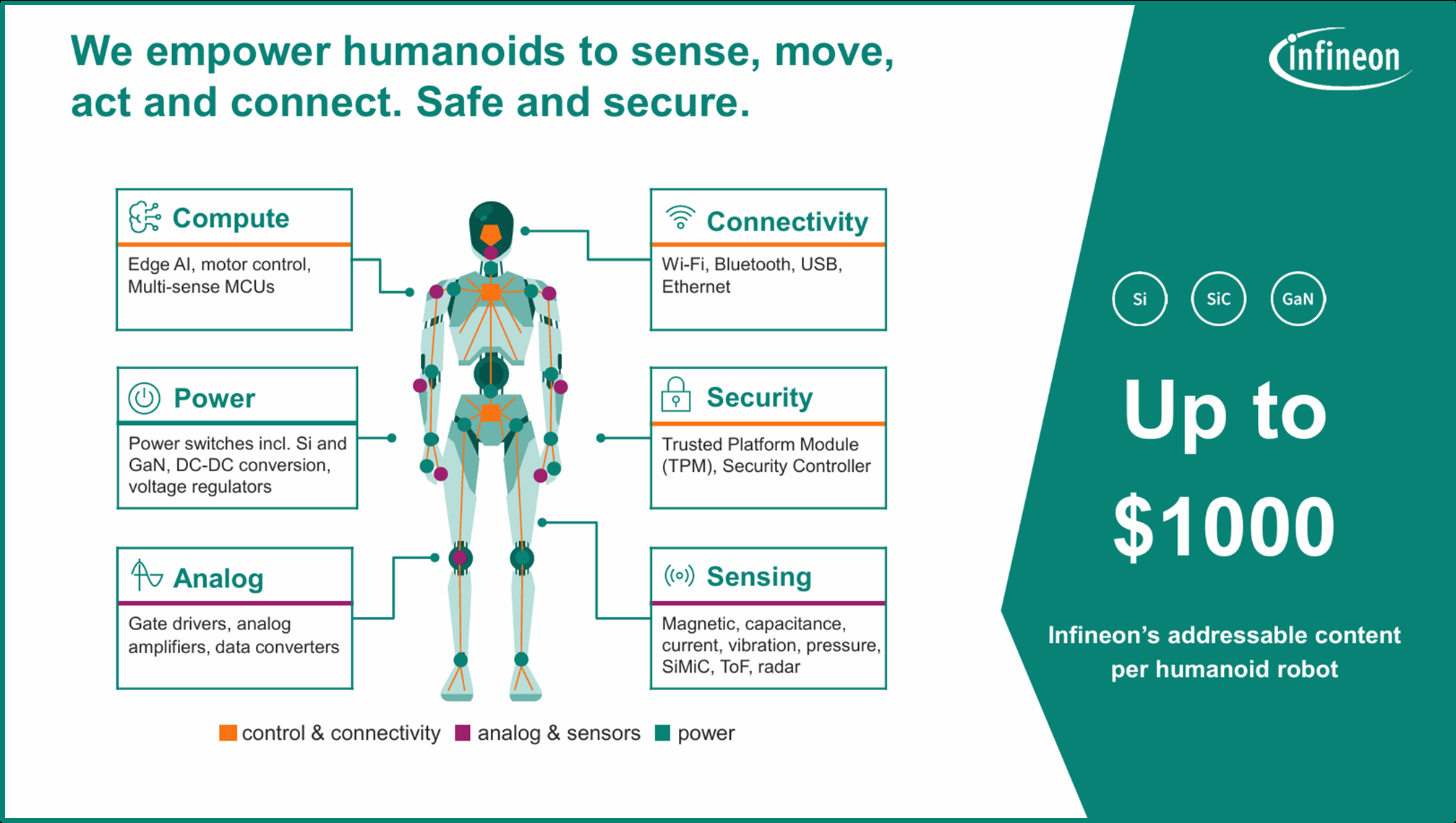
The six product groups shown cover computing, electrical actuation, analog signal processing, networking, security and sensing. Joint motors need power switches and gate drivers. Motion control needs microcontrollers and position feedback. Dexterous hands add tactile sensing, while distributed control nodes must exchange data continuously.
Infineon's NVIDIA collaboration already includes control hardware and simulation tools. PSOC Control C3 microcontrollers can connect to Jetson Thor through the NVIDIA Holoscan Sensor Bridge to handle real-time motor control. Digital twins of smart actuators and selected sensors are also being brought into Isaac Sim and Isaac Lab, allowing developers to tune control and sensing before hardware integration.
The sensing portfolio is expanding too. In July 2026, Infineon completed its acquisition of ams OSRAM's non-optical analog and mixed-signal sensor business, adding position, capacitive and temperature sensing capabilities, along with CT and digital X-ray ASICs.
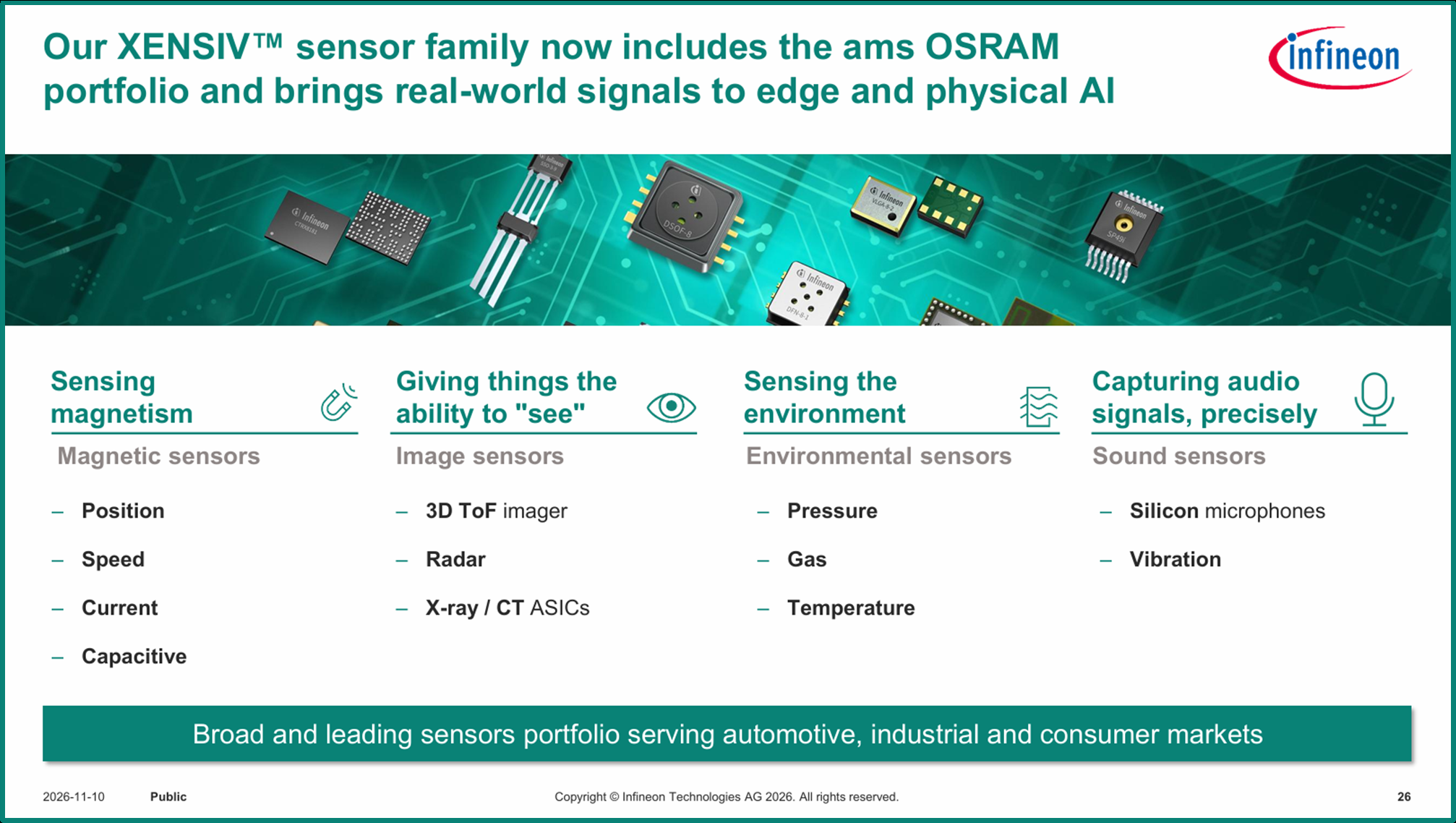
The slide groups the portfolio into four areas. Magnetic and capacitive sensing cover measurements such as position, speed and current. ToF, radar, X-ray and CT ASICs serve different imaging and detection applications. Environmental sensors measure pressure, gas and temperature, while microphones and vibration sensors capture acoustic and mechanical signals. The applications extend across robots, industrial automation, medical equipment, smart homes and wearables.
Humanoid platforms are still progressing through development and commercialization. Management expects several years to pass before the market makes a material contribution to group revenue.
FY2027 targets higher sales, margins and investment #
Infineon's main FY2027 targets are approximately €20 billion in revenue, a Segment Result Margin around 25% and free cash flow of approximately €1.8 billion. The outlook assumes an exchange rate of $1.15 to the euro.
Planned investment of €3 billion to €3.5 billion will support the expansion. The Dresden Smart Power Fab opened ahead of schedule in July 2026, adding manufacturing capacity for power semiconductors.
Portfolio changes are proceeding alongside the capacity investment. Automotive Ethernet strengthens connectivity, and the sensor acquisition broadens sensing. Infineon has also agreed to sell its NOR Flash and F-RAM businesses to Winbond for $1.12 billion, with completion expected in the second half of calendar 2027.
Data center power supplies provide the clearest source of additional revenue as Infineon moves from €16.353 billion toward €20 billion. Automotive remains its largest revenue base, while humanoids bring control, power, networking and sensing products into another equipment platform. The pace of data center orders, capacity expansion and customer production launches will determine how much of that growth reaches the FY2027 results.