
A small robot duck makes an unusually good starting point for understanding the semiconductor business. Microduck, from Pollen Robotics, part of Hugging Face, opened for pre-orders on August 27, 2026. Its appeal is immediately visible: an expressive, 25-centimetre biped that can walk, sit and get back up. The more consequential promise is that developers can retrain its behaviours in simulation and deploy them to physical hardware. These are the capabilities described on the official Microduck product page, reviewed September 6.
Inside that story is a familiar name: Rockchip. Pollen's own software repository identifies the onboard processor as the RK3566. For engineers who have also encountered RK3588 in development boards and edge-computing products, the question comes naturally: why does Rockchip keep appearing?
The answer is about the distance between a chip specification and a working product. Rockchip's appeal becomes clearer when we examine three different jobs: running a small robot, building a versatile embedded platform and accelerating larger local AI models.
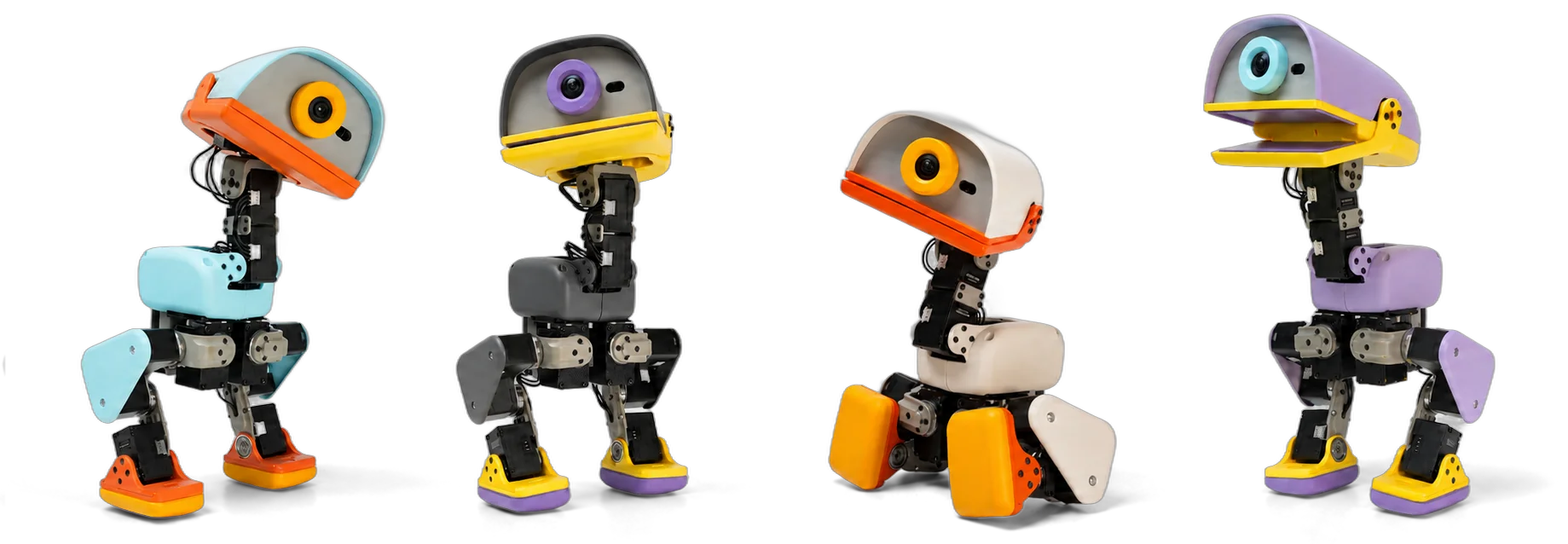
Explore the code and development documentation in the Microduck GitHub project.
Microduck: the right processor for the whole robot #
The Microduck software repository, reviewed September 6, describes a 50 Hz control loop driving fifteen servos from neural policies, alongside camera, wireless and software-update services. Training happens in a separate workflow using MuJoCo and PPO; the resulting policies are exported to ONNX for deployment.
That distinction matters. Executing a learned movement policy on a robot is different from training it, and different again from serving a large conversational model. An engaging demonstration does not tell us that every AI task runs locally, or that the processor was chosen for the largest available NPU.
For this class of product, the engineering question is whether control, sensing, communications and updates work reliably together within the power and cost budget. Our interpretation is that Microduck illustrates the value of a usable embedded platform. Pollen has not published a complete procurement decision explaining why it selected RK3566, so claiming a specific price advantage or a benchmark victory would go beyond the evidence.
A history of building complete devices #
Rockchip's earlier markets help explain that platform orientation. Intel's May 27, 2014 partnership announcement described a company founded in 2001 with experience in portable multimedia products, tablets, audio/video and Android. The agreement concerned an Intel-branded, quad-core SoFIA 3G platform aimed primarily at entry-level and value tablets.
The useful historical thread is the accumulation of system knowledge: how software, media processing and peripheral hardware become a device that another company can manufacture. Those skills can transfer between markets even when the individual products differ substantially.
There is also recent evidence of business growth. Rockchip's 2026 interim report summary, disclosed August 18, reports first-half revenue of approximately RMB 2.877 billion, up 40.60%, and net profit attributable to listed-company shareholders of approximately RMB 859 million, up 61.73%.
These are company-wide results for a period ending before Microduck opened for pre-orders. They provide context for Rockchip's position; they cannot establish the duck's contribution to revenue or explain a subsequent share-price movement.
RK3588: capability becomes more valuable with an ecosystem #
RK3588 shows another side of the same story. Radxa's ROCK 5B/5B+ documentation, reviewed September 6, identifies RK3588 as its processor, combining four Cortex-A76 and four Cortex-A55 CPU cores with an NPU rated at up to 6 TOPS. The board exposes a broad set of display and peripheral connections.
The distinction between silicon and board vendor is important: ROCK 5B is a Radxa product based on a Rockchip SoC. Its existence demonstrates an ecosystem around the processor, rather than a development board manufactured by Rockchip itself.
Radxa's download and hardware-resource page supplies concrete examples of that ecosystem: Linux and Android images, flashing tools, schematics and mechanical drawings. These resources give a team something it can evaluate before committing to a custom design.
This is where platform economics become persuasive. A working board lets engineers test the camera path, connect storage, examine thermal behaviour and try the actual application. Reusable software and documented hardware can reduce uncertainty at several stages of development. That is a more defensible explanation of platform appeal than an unsupported claim that no competitor can challenge it.
The qualification work still belongs to the product team. Booting Linux does not demonstrate that every required camera, codec or accelerator works on the chosen kernel. A successful prototype also does not establish production availability, lifecycle support or environmental qualification. Our RK3588 core-board sourcing guide examines those board-level decisions in more detail.
RK182X: when moving model data becomes the problem #
Larger local AI models introduce a different constraint. Arithmetic units need a steady supply of model data, and moving that data consumes energy. Capacity determines what can reside in memory; bandwidth determines how quickly it can be accessed. Improving one does not automatically solve the other.
Rockchip addresses this with RK182X. Its January 19, 2026 architecture announcement describes DRAM stacked directly above the compute chip, shortening internal connections. This is a packaging and integration approach to the memory problem. It should not be confused with a claim that Rockchip has become a commodity DRAM manufacturer, or that the product is interchangeable with HBM.
The RK182X product specification, reviewed September 6, describes an AI coprocessor with the following features:
| Specification | Published RK182X detail |
|---|---|
| CPU | Multi-core RISC-V |
| AI workloads | Local 3B/7B language models and traditional CNN inference |
| Compute formats | INT4, INT8, INT16, FP8, FP16 and BF16 |
| Integrated DRAM | 2.5GB / 5GB capacity options |
| Host connections | PCIe 2.0 and USB 3.0 |
2.5GB and 5GB are capacities, not bandwidth figures. Bandwidth needs a per-second unit, such as GB/s. Model compatibility also depends on the exact device, quantisation, context length and software release; a supported parameter count is not a guarantee that every model of that size fits with every setting.
The software story continues here. Rockchip's March 9, 2026 RKNN3 SDK release explicitly covers RK3588/RK3576 hosts paired with RK1820/RK1828, including model conversion, board-side APIs and Android/Linux support. It also reports selected model support beyond the original 3B/7B description. That is why a design review must record the SDK version as carefully as the part number.
Two roles, rather than one chip for every task #
In its February 12, 2026 ecosystem-conference report, Rockchip outlined a dual-track strategy: general-purpose SoCs for the main system and AI coprocessors for more demanding inference. It also previewed RK1860. A preview establishes roadmap intent, not the current availability of an orderable production device.
The architectural attraction is understandable. A manufacturer may retain much of its host platform while adding specialised AI capability. The trade-off is another component, a host link, additional power and thermal requirements, and a software interface that must remain compatible.
For a robot, the first decision is therefore where each task belongs: immediate motion control, perception, user interaction and larger-model inference can have different latency and resource requirements. Microduck's documented RK3566 implementation should not be read as evidence that it also uses RK182X.
Why does Rockchip keep appearing? #
Rockchip's recurring presence is best understood as the combination of product breadth and practical routes into development. RK3566 provides the host platform in Microduck. RK3588 supports a more capable class of embedded boards. RK182X adds a separate path for memory-intensive AI inference. Their relevance comes from different system roles.
For an engineering buyer, the strongest evidence is a platform that runs the intended workload on the intended software, survives sustained operation and has a supportable production BOM. The duck attracts attention; the ability to turn a development platform into a maintainable product explains why the chip supplier deserves a closer look.
Need stock, date-code or package confirmation?
Send the part number, quantity, target date code and packaging requirements. LimChip will check available lots and RFQ details before you place the order.
Send RFQ