
Why RK3588 core boards are getting attention #
RK3588 core boards package a Rockchip application processor, memory, storage and power-management circuitry into a module that can be mounted onto a carrier board. That removes much of the high-speed layout work from a product team while leaving the carrier board free for connectors, sensors and application-specific I/O.
The platform is aimed at edge devices that need more than a basic microcontroller: industrial HMIs, machine vision, robots, smart retail terminals, medical interfaces and multi-display products. Rockchip's official RK3588 brief datasheet lists the processor clusters, NPU, multimedia engines, memory interfaces and peripheral blocks. The exact board configuration remains a module-vendor choice, so buyers must not treat every RK3588 board as electrically identical.
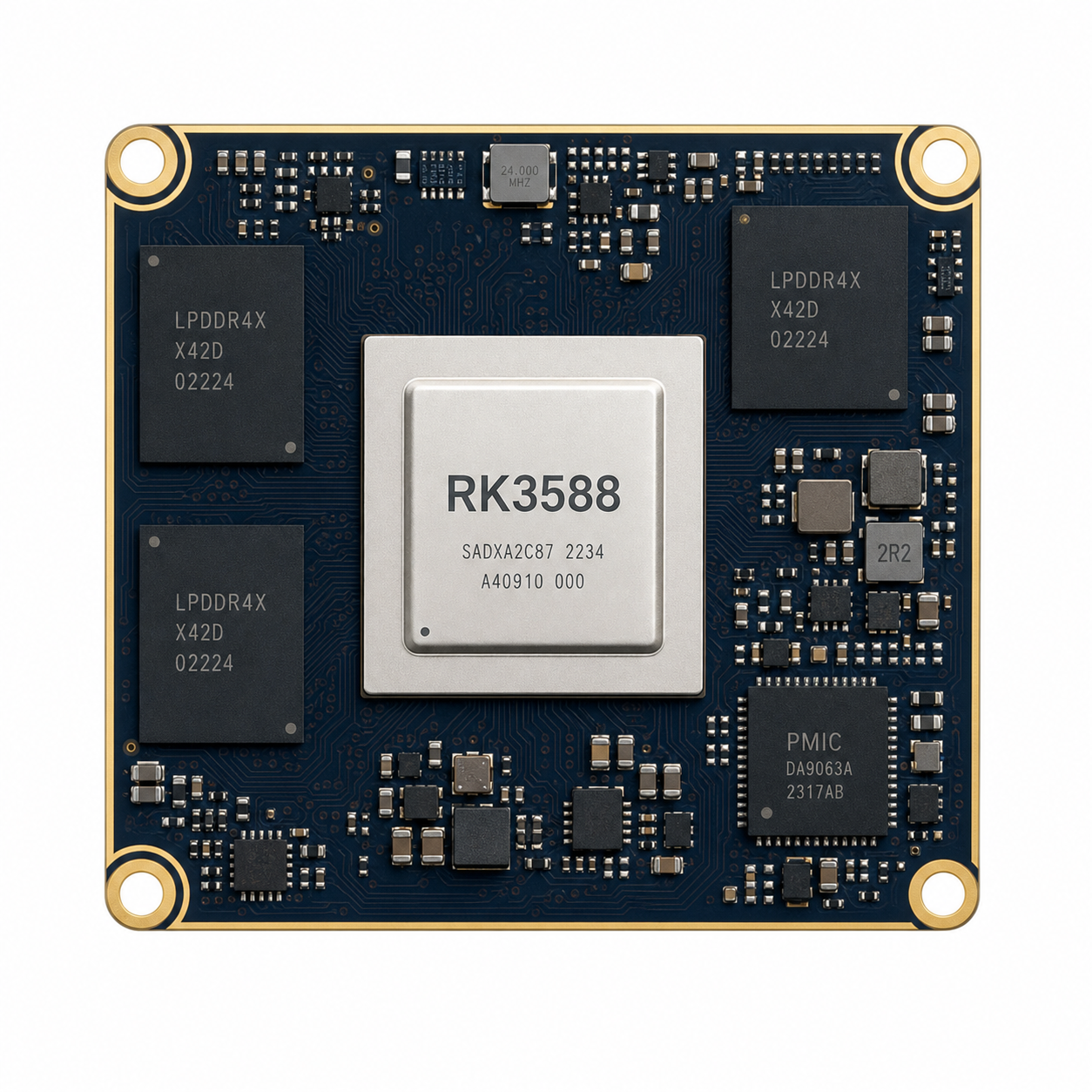
The following original LimChip illustration shows the typical physical module form factor and component arrangement. It is a conceptual product visual, not a verified photograph of one supplier's exact board revision.
What is inside the module? #
CPU and NPU #
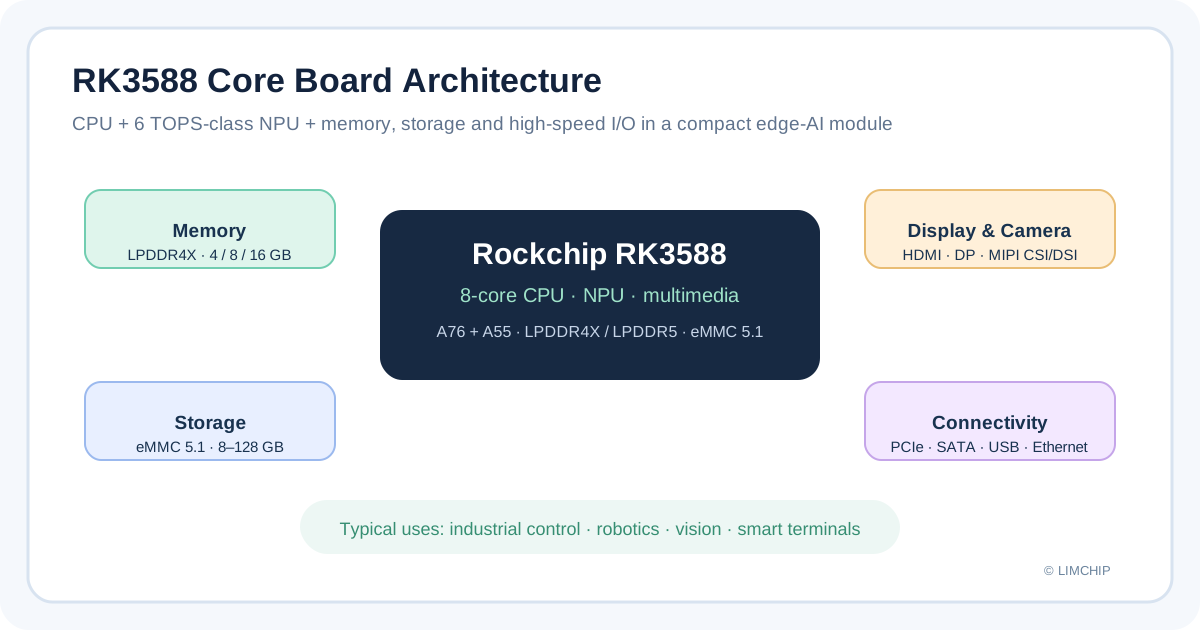
The RK3588 SoC combines four Cortex-A76 cores and four Cortex-A55 cores with a high-performance NPU advertised in the 6 TOPS class. The NPU can accelerate supported AI operators, but real application performance depends on model conversion, quantization, runtime support, memory bandwidth and thermal conditions. A “6 TOPS” label is therefore a peak capability reference, not a guaranteed application throughput figure.
Memory and storage #
Common module configurations use LPDDR4X in 4 GB, 8 GB or 16 GB options and eMMC 5.1 for boot and application storage. Some designs may use other memory configurations supported by the SoC. Confirm the exact memory density, data width, speed grade, eMMC capacity, boot-device arrangement and whether the memory is soldered or replaceable.
Display and camera #
The official brief lists HDMI 2.1 transmit, DisplayPort/eDP and MIPI display interfaces, together with multiple MIPI CSI camera inputs. A carrier board may expose only a subset of those resources. Ask for the schematic or pinout rather than assuming that every advertised SoC interface is available on the connector.
Expansion and control I/O #
Depending on the module and carrier, designers may use PCIe, SATA, USB, RGMII Ethernet, UART, SPI, I2C, PWM, SDIO, ADC and CAN. The user-supplied module configuration lists combinations such as PCIe Gen 3 x4, SATA 3.0, two gigabit Ethernet interfaces and multiple serial buses. These should be treated as the quoted board configuration and verified against the vendor's current pinout and BOM.
Systems and software support #
RK3588 boards are commonly offered with Android, Ubuntu, Debian or Linux-based environments. A product team should request the exact BSP version, kernel version, bootloader, device-tree source, graphics stack, NPU runtime and long-term maintenance commitment. “Supports Android/Linux” is too broad for a production release: a kernel driver or camera pipeline that works on one BSP may not be available in another.
For Qt products, confirm the Qt version, hardware-accelerated display path, input method, camera API and cross-compilation toolchain. For AI products, confirm which ONNX, TensorFlow Lite, PyTorch or vendor-specific model formats are supported and whether the supplied runtime uses the NPU or falls back to CPU/GPU.
Where this module fits in an edge-AI architecture #
The RK3588 is an embedded SoC, not an FPGA and not a discrete GPU. That distinction matters when selecting a platform:
| Requirement | RK3588 core board | FPGA / adaptive SoC | Discrete GPU |
|---|---|---|---|
| Fast product integration | Strong, if the BSP is mature | More hardware and timing work | Strong at the software level, but larger system |
| Reconfigurable data path | Limited to SoC peripherals and software | Strong | Software-programmable, not hardware-reconfigurable |
| Multi-camera and display integration | Strong platform feature | Depends on device and IP | Usually needs additional capture/display hardware |
| Deterministic custom pipeline | Requires careful software and accelerator design | Strong | Depends on runtime and batching |
| Power and size | Suitable for compact edge products | Device-dependent | Often higher system power |
The right choice depends on the product's latency, interface, model and lifecycle requirements. A core board can shorten development time, while an FPGA may be preferable when the data path itself must be customized or updated in hardware.
Sourcing checks before approving a board #
| Check item | What to confirm |
|---|---|
| Exact module | Board part number, revision, dimensions and connector pinout |
| SoC | RK3588, RK3588S or RK3588M; do not treat the names as interchangeable |
| Memory | LPDDR4X/LPDDR5 type, capacity, width and supplier |
| Storage | eMMC capacity, speed class, boot arrangement and endurance expectations |
| Thermal design | Heatsink, enclosure airflow, sustained NPU load and throttling behavior |
| BSP | Android/Linux version, kernel, device tree, drivers and update policy |
| Interfaces | Which HDMI, DP, MIPI, PCIe, SATA, USB and Ethernet ports are actually routed |
| Lifecycle | Planned production window, availability of the exact module and carrier |
| Traceability | Lot, date code, original packaging and module-vendor quality records |
The physical dimensions in a listing—such as a 60 mm × 50 mm module—are not enough to qualify a replacement. Connector placement, mounting holes, keep-out zones, thermal height and carrier-board routing must also match.
How to write a useful RFQ #
An RFQ should specify the exact RK3588 module or approved board family, target memory and eMMC capacity, operating system, display and camera requirements, quantity, prototype or production stage, destination and date-code or traceability requirements. If the board is already part of an approved design, include the carrier-board revision and connector pinout.
Ask suppliers to separate the SoC, memory, storage, PMIC, module assembly and carrier-board availability. A board can be “in stock” while one memory option or one BSP revision is unavailable. That distinction matters when the module is already integrated into a production enclosure.
Bottom line #
RK3588 core boards are attractive when a product needs a capable ARM SoC, integrated AI acceleration, multimedia I/O and a compact development path. The headline numbers—eight CPU cores, a 6 TOPS-class NPU and multi-display/camera support—are useful starting points, not substitutes for board-level verification. Confirm the exact module, memory, storage, routed interfaces, BSP and thermal behavior before approving a design or accepting a replacement.
Sources #
- Rockchip RK3588 Brief Datasheet
- Rockchip RK3588 product page
- Rockchip: RK3588 industrial and edge-AI applications
The board dimensions, memory options and interface combination in this guide describe the supplied module configuration. They are not a universal specification for every RK3588 core board. Verify the exact vendor part number and revision before purchase.
Need stock, date-code or package confirmation?
Send the part number, quantity, target date code and packaging requirements. LimChip will check available lots and RFQ details before you place the order.
Send RFQ