
Reports of a Texas Instruments customer letter dated September 1, 2026 have put component buyers on notice for further pricing changes. The document describes upcoming adjustments across products in TI's portfolio, with the effect varying by product. It does not specify a universal increase, an effective date or a list of affected ordering codes.
This is now a reported industry development, beyond the circulation of a screenshot. ESM China reported the letter on September 3, describing it as a customer notice circulating through supply-chain channels and noting that TI had not issued a corresponding public announcement at the time of its report. EE Times China covered the same notice on September 4. Both reports concern the same document; their publication does not establish two separate price actions.
What the September letter says #
The copy supplied to LimChip carries the name of Mark Roberts, Senior Vice President of Worldwide Sales and Marketing. It attributes the planned changes to market conditions and rising supply-chain costs, explaining that materials, technologies and manufacturing processes will influence the adjustment for each product. It also directs customers to account-dashboard notifications and follow-up communication for specific details.
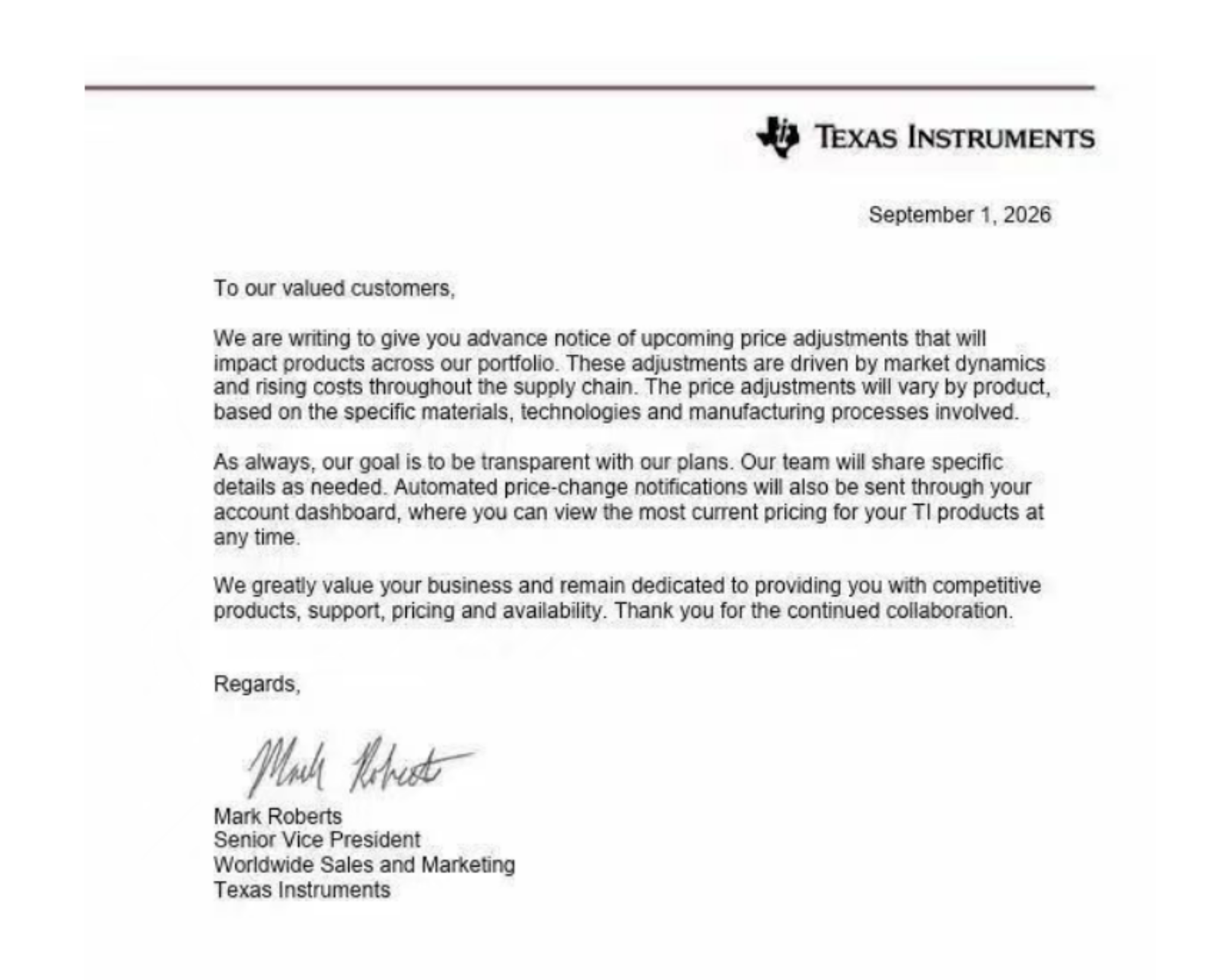
Open the full-resolution customer letter to inspect the document. Its contents are summarised in the surrounding text for readers on smaller screens.
The practical message is that purchasing teams should expect part-level communication. A broad portfolio notice is not enough to calculate the cost change for an approved BOM, and it does not establish that every TI device will move by the same percentage.
September 1 is the letter date, not a purchasing deadline #
The distinction matters because the reporting is not uniform. EE Times China's headline presents September 1 as the start of increases, while ESM China explicitly distinguishes the letter's date from an effective date. The supplied document describes future adjustments without assigning a start date. For this notice, LimChip therefore treats September 1 as the document date only.
Reports also place the letter within earlier rounds of TI repricing. That background should not be used to infer a new deadline or carry a previous percentage increase into a current quotation. A customer-specific notification is needed to establish which order lines change, when they change and whether an earlier agreement still applies.
TI's public pricing FAQ, checked September 6, states that website pricing and availability can change. That general policy is relevant to quote validation, but it does not authenticate this particular letter or supply its missing product-level details.
What procurement teams can do now #
The immediate task is to identify exposure, rather than apply a blanket uplift across the BOM. Start with open TI quotations, scheduled deliveries and parts that have no approved alternative. Ask the responsible supplier or TI contact for the revised unit price, quantity break, currency, quotation validity and applicable shipment date for each affected ordering code.
Keep treatment of existing orders explicit. A notice about future pricing does not, by itself, tell a buyer whether an accepted order, scheduled release or outstanding quotation is protected. Record the supplier's written answer against the relevant order line before changing the purchasing forecast.
For any proposed replacement, involve engineering before approving a substitution. Package, electrical behaviour, firmware dependencies and qualification requirements can make a seemingly cheaper alternative expensive to introduce. Where an urgent sourcing review is needed, include the exact part number, quantity, required delivery date and existing quote reference in an RFQ to LimChip.
The next signal is the part-level notification #
The September letter is a reason to refresh pricing assumptions and contact suppliers. It is not yet a complete price schedule. The decisive evidence for a purchasing decision will be an affected-part list or customer notification that connects an exact ordering code to a revised price and effective date. Until then, reported repricing pressure and confirmed procurement cost should remain separate in the buying plan.
For the wider supplier picture, our August–September chip price-increase roundup compares reported implementation dates and available details across TI, ST, ADI and other manufacturers.
Need stock, date-code or package confirmation?
Send the part number, quantity, target date code and packaging requirements. LimChip will check available lots and RFQ details before you place the order.
Send RFQ