
Microduck, the small biped robot from Pollen Robotics, uses Rockchip's RK3566 as its onboard processor. That choice points to a broader reason Rockchip turns up in edge AI products: developers need a chip, software and a workable hardware platform together. RK3566, RK3588 and RK182X serve different roles in that process; they are not three versions of the same robot design.
Pollen's published software identifies RK3566 on the robot and shows how developers train movement policies in simulation before deploying them to the physical robot.
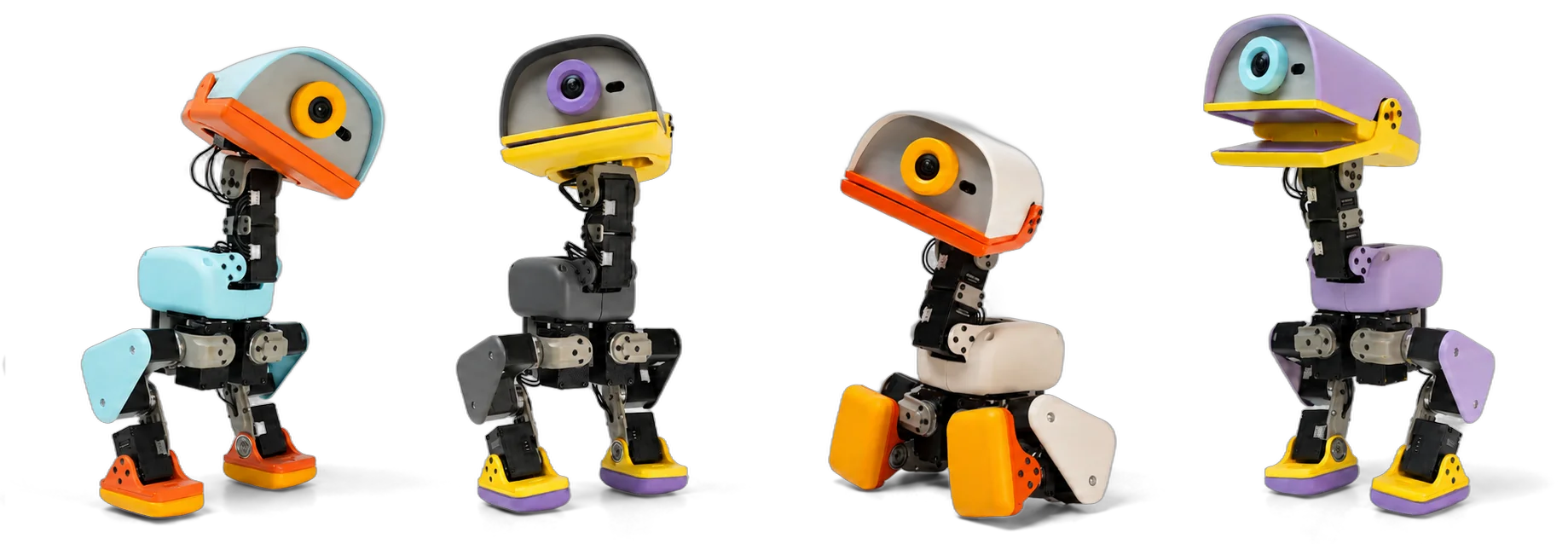
Microduck needs a complete control platform #
The Microduck software describes a 50 Hz control loop driving fifteen servos from learned policies. Camera, wireless and software-update services run alongside it. Training uses MuJoCo and PPO in a separate workflow; the resulting policy is exported to ONNX for deployment. Running the policy on the robot has a different computing requirement from training it.
This makes RK3566's role clearer. The product needs reliable coordination of motion, sensing, communications and updates within a small power and cost budget. Pollen has not published a full account of its component selection, so a precise price advantage or benchmark win cannot be inferred from the choice. The observable point is that RK3566 is part of a working embedded product, with software that developers can inspect.
RK3588 shows why the surrounding ecosystem matters #
The RK3588-based ROCK 5B and 5B+ boards show another route into Rockchip hardware. Radxa's board documentation lists four Cortex-A76 and four Cortex-A55 CPU cores and an NPU rated up to 6 TOPS. It also provides Linux and Android images, flashing tools, schematics and mechanical drawings. ROCK 5B is a Radxa board built around a Rockchip SoC, rather than a board made by Rockchip.
Those resources let a team test cameras, storage, thermals and its application before designing custom hardware. A board that boots Linux is only a starting point: the chosen kernel and software image still need to support the required camera, codec and accelerator paths. Production planning also has to account for board revision, software support and component availability.
RK182X tackles a different limit: model memory #
Larger local AI models put pressure on memory capacity and data movement. Capacity determines how much model data can reside near the processor; bandwidth affects how quickly that data reaches the compute units. Rockchip's RK182X architecture places DRAM above the compute die to shorten internal connections. It is an AI coprocessor approach, not a claim that Microduck contains RK182X or that RK182X is an HBM substitute.
Rockchip's published RK182X specification describes these options and interfaces:
| Item | Published RK182X detail |
|---|---|
| CPU | Multi-core RISC-V |
| AI workloads | Local 3B/7B language models and CNN inference |
| Compute formats | INT4, INT8, INT16, FP8, FP16 and BF16 |
| Integrated DRAM | 2.5GB or 5GB capacity |
| Host connections | PCIe 2.0 and USB 3.0 |
The 2.5GB and 5GB figures describe capacity, not bandwidth. Whether a particular model runs also depends on quantisation, context length, software release and the exact device. For a system that pairs a host SoC with an AI coprocessor, the host interface, power budget, thermal design and SDK version become part of the component decision.
The choice starts with the workload #
Microduck's RK3566 handles a documented robot control stack. RK3588 offers a more capable host platform with development-board resources. RK182X addresses memory-intensive inference as a separate component. A buyer should first identify which work must happen on the device, then validate it on the intended board and software version before committing to a production bill of materials. That practical route from silicon to product explains Rockchip's recurring presence better than any single performance figure.
Key references #
- Pollen Robotics: Microduck software repository
- Radxa: ROCK 5B and 5B+ documentation
- Rockchip: RK182X architecture announcement, January 19, 2026
- Rockchip: RK182X product specification