
The November memory market is pulling in two directions. DDR5 chip spot prices eased in early November but stayed high, while spot prices for 512Gb TLC NAND wafers fell for several weeks. Buyers can use the NAND move to reopen negotiations on client SSDs. Server memory still calls for closer attention to delivery dates and platform qualification.
DDR5 has eased from its peak and remains expensive #
At 11 a.m. GMT+8 on November 24, DRAMeXchange listed an average spot price of US$60.833 for 16Gb DDR5 chips in a 2G×8 organization. The quote was still high for this cycle after a small dip in early November. Contract prices were slower to turn. Wallstreetcn's coverage of Bank of America's (BofA) November 13 report put October contract prices for 16Gb DDR5 chips up 5% month over month.
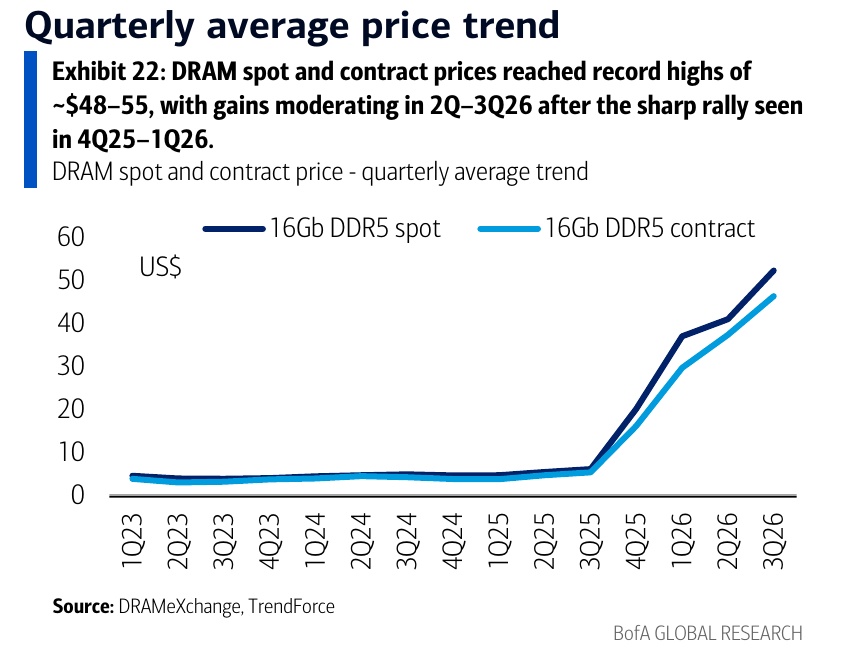
Spot quotes respond quickly to near-term orders. Contract prices reflect terms agreed for particular customers, volumes and delivery periods. A November chip spot quote can help buyers compare offers made that day. To budget for scheduled deliveries, ask suppliers to quote the same quantity and delivery window on the same terms.
HBM and server demand keep pressure on DRAM supply #
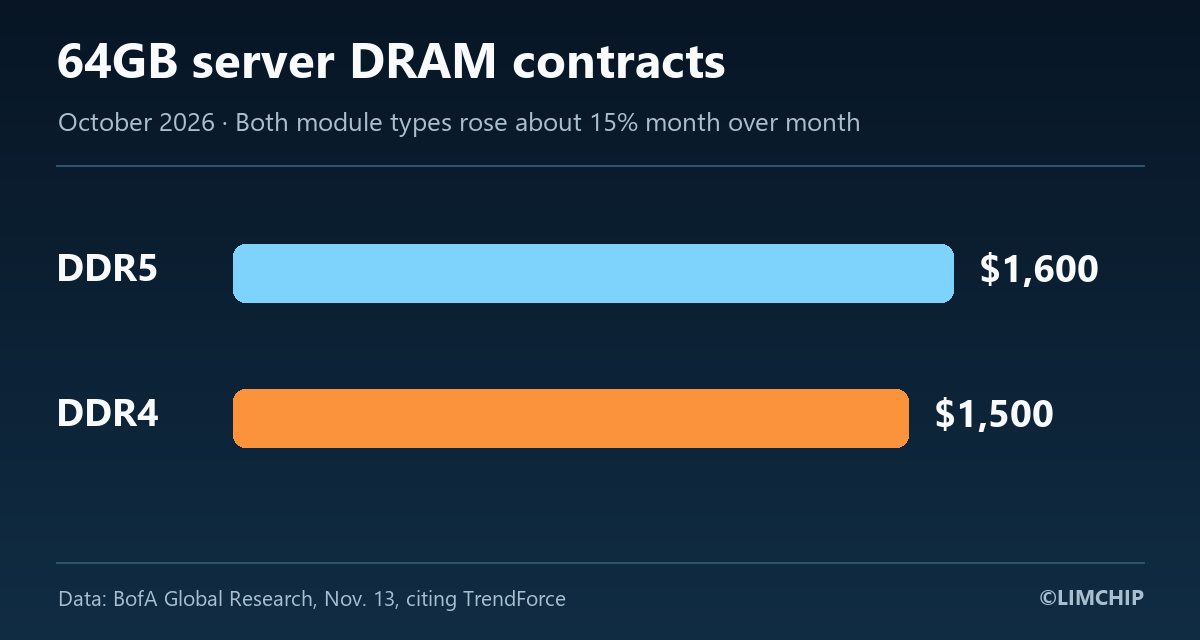
BofA's November 13 report put October contract prices for 64GB DDR5 and DDR4 server modules at about US$1,600 and US$1,500, respectively. Both rose roughly 15% from September. TrendForce's October 30 public summary also recorded rising server DRAM contract prices. Shrinking DDR4 supply particularly affects buyers maintaining legacy platforms. For an example of the hardware buyers qualify, Samsung's M321R8GA0EB2-CCPKC is a 64GB DDR5-6400 ECC RDIMM with a 2Rx4 organization.
HBM and conventional DRAM compete for some of the same advanced wafer capacity. HBM output also depends on stacking, packaging and testing, while higher memory capacity per server absorbs more conventional DRAM. TrendForce's September 29 outlook projected that the blended HBM average selling price could rise 121% year over year in 2027 as HBM4 and other newer products take a larger share. Its November 20 DRAM outlook expected quarterly price increases to narrow in 2027 as capacity expansion and process migrations add supply.
TLC wafer spot prices fall ahead of SSD contract prices #
TrendForce's average spot quote for 512Gb TLC NAND wafers fell from US$18.592 on October 19 to US$16.883 on October 26, US$16.152 on November 2 and US$14.238 on November 16. That is a 23.4% decline between the first and last observations. BofA's November 13 report cited an October contract price of about US$27 for 512Gb NAND wafers. The impact of weaker spot trading on longer-term prices depends on the next round of contract negotiations.
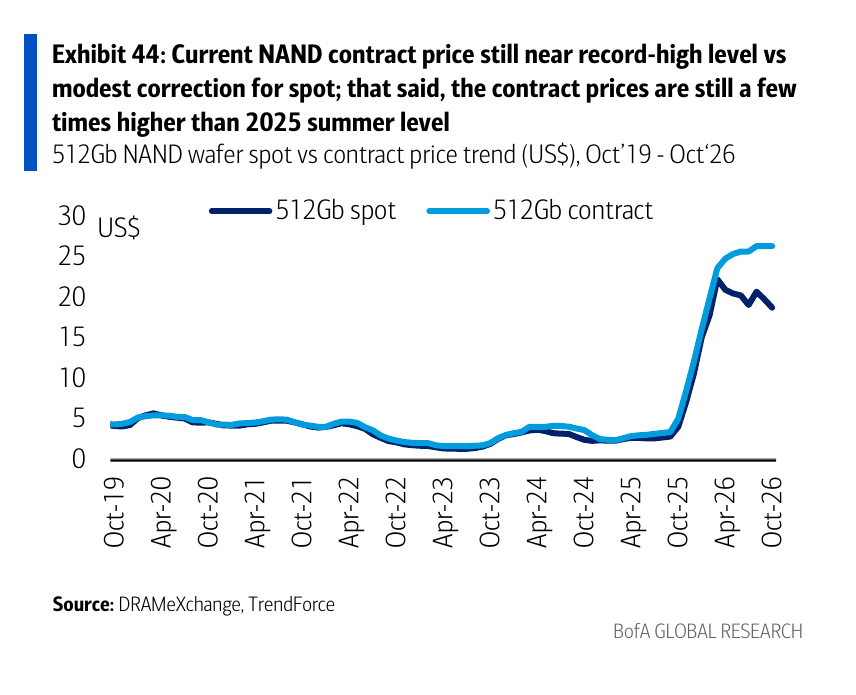
On October 29, TrendForce reported that client SSD contract prices were rising more slowly. Its November 19 outlook put overall NAND contract prices up 8–13% in the fourth quarter of 2026 and flat to down 5% in the first quarter of 2027. Weaker PC and mobile demand adds pressure, and some Chinese cloud service providers are cutting enterprise SSD orders. Those cuts can soften local quotes even as enterprise demand elsewhere holds up. Buyers of a qualified data-center drive such as Samsung's 3.84TB U.2 PM9A3 MZQL23T8HCLS-00A07 should check quotes and delivery dates for their exact configuration.
Long-term commitments matter for 2027 allocation #
On October 28, SK hynix said it had signed 14 long-term agreements with customers including major global cloud service providers. The agreements typically run for five years and cover more than half of the company's total planned capacity for 2027–28. Buyers outside those agreements still need suppliers to confirm how much they can deliver and when.
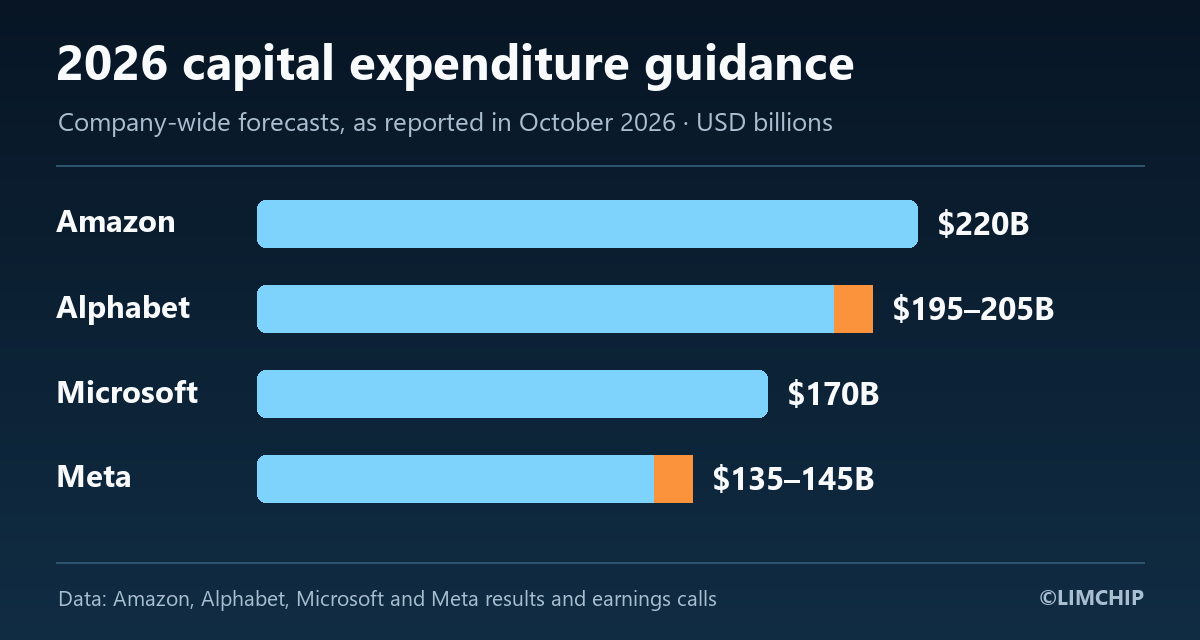
The four companies' October guidance points to around US$730 billion in combined 2026 capital spending, using the midpoints of the ranges where applicable. Their capex definitions differ. VistaShares' November summary of analyst estimates put the 2027 total above US$1 trillion. The figures cover company-wide investment, while memory shipments depend on server deployment schedules, orders and supplier commitments. Power connections and financing can still change which new projects go ahead first.
For server DDR5, cover the near-term build against the exact approved part number, rank and DIMM population rules, and confirm the supplier's shipment schedule before committing. For client SSDs, request fresh quotes at the same capacity, interface and qualification level, then stagger orders if inventory allows. For enterprise SSDs, verify lead times for each qualified drive and delivery region before revising the build schedule.