
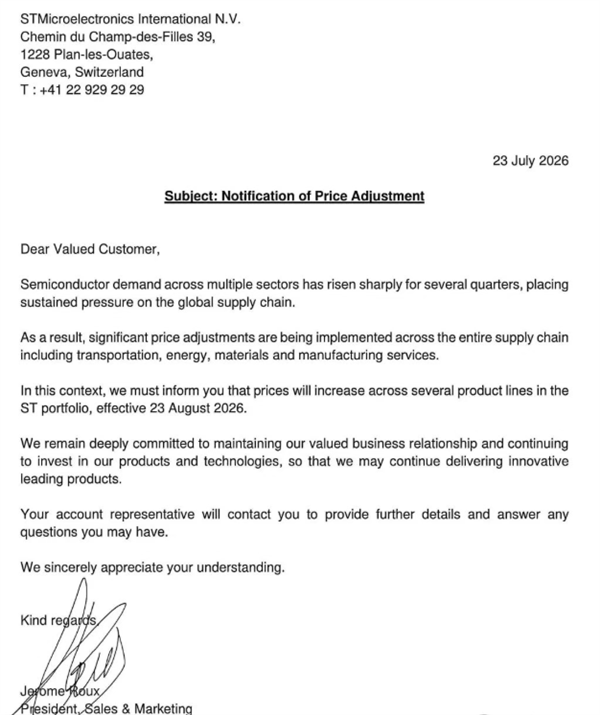
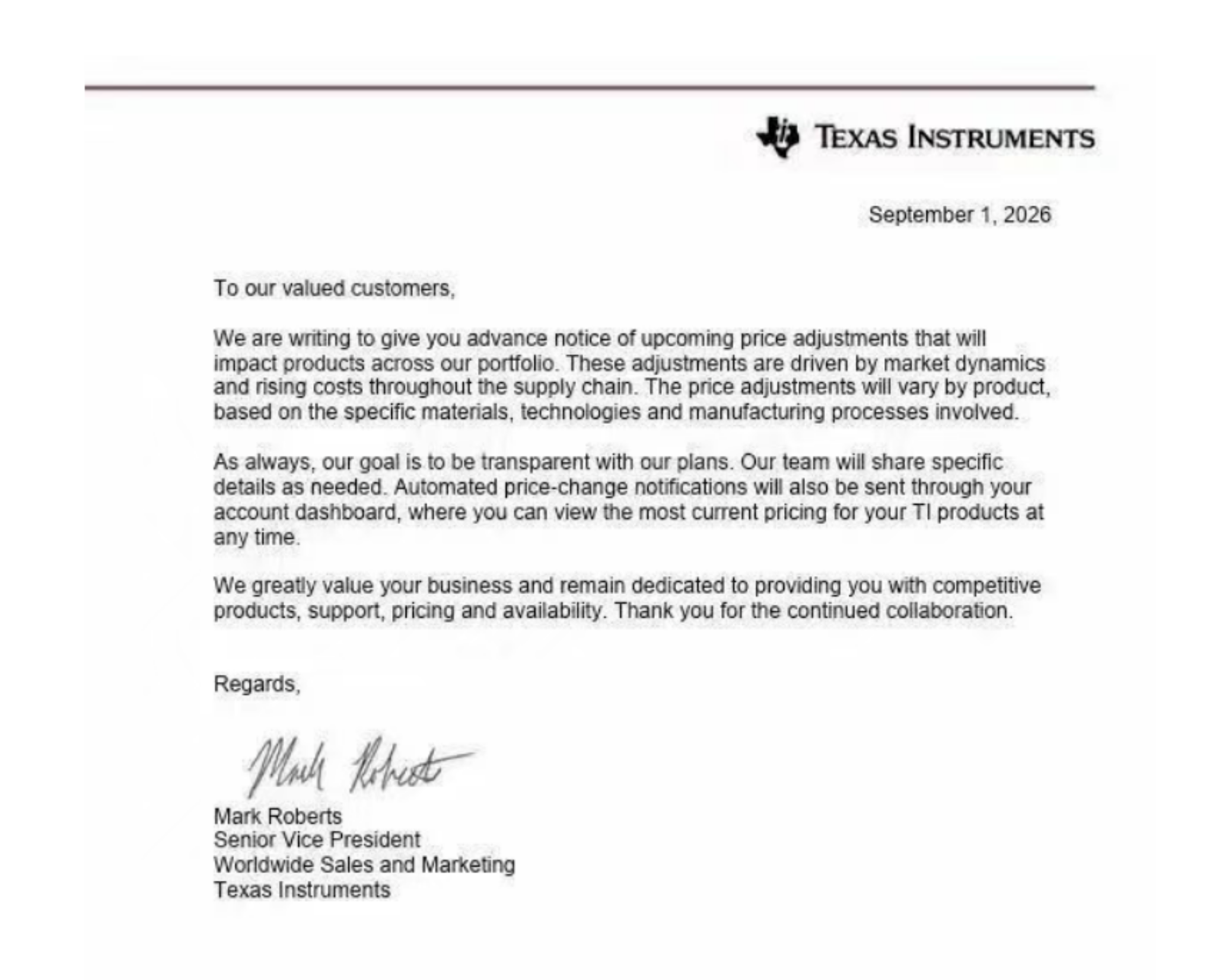
Put five price letters side by side and it is easy to mistake the letter date for the price-change date. ST named August 23, Maxscend September 1, Analog Devices September 13 and Nationstech October 1 as effective dates. TI's September 1 customer letter named no effective date. A current quote for the exact ordering code still decides what a buyer will pay.
What the letters actually date #
| Supplier | Scope in the notice | Stated effective date | Detail still needed |
|---|---|---|---|
| STMicroelectronics | Multiple product lines; July 23 letter | August 23 | Increase for each ordering code |
| Maxscend | RF products; August 10 letter | September 1 | Rates to be confirmed by sales contacts |
| Analog Devices | Several product series | September 13 | New price for each ordering code |
| Nationstech | Selected products, mainly high-performance MCUs | October 1 | Each part's increase within a stated 10–20% range |
| Texas Instruments | Multiple product series; September 1 letter | Not stated | Start date and part-specific price |
ST's notice is the clearest example: the letter is dated July 23, while the change starts August 23. It does not give one percentage for every affected product.
Nationstech gives a 10–20% range without assigning a rate to each MCU. TI goes further in the other direction: its customer letter gives no implementation date at all. September 1 is the date of the letter, not an automatic repricing date for a purchase order.
Compare quotes under the same terms #
The stated effective dates have passed. On a current quote, check the full ordering code, quantity, currency, destination and validity period together. Then ask whether accepted but unshipped orders retain their earlier terms. Without those details, two unit prices may not be comparable.
For TI in particular, do not invent an effective date the letter did not provide. If a new quote is higher, ask whether that comes from a manufacturer change, exchange rate, freight or a premium on available stock.
Compare old and new prices under the same written order conditions.