

The short answer: DRAM is entering a longer, tighter cycle
DRAM has historically been a boom-and-bust business: a year of shortage, two years of glut, then another price collapse. What we are seeing in 2026 is different. AI data-center build-out, HBM capacity expansion, and the DDR5 upgrade wave are pulling the industry toward a longer period of supply constraint, higher capital intensity, and a bigger role for long-term supply agreements.
That is good news for suppliers and their equipment vendors. For component buyers, it means lead times, contract structures, and second-source planning need more attention than in a typical downturn. This article explains the mechanics behind the shift and what procurement teams should verify before committing to orders.
Throughout this article we separate three kinds of input: official supplier information (product and technology details from vendor pages), industry estimates (forecasts from SEMI, WSTS and analyst commentary), and LimChip procurement analysis (our read for component buyers). Figures without a stated source are industry estimates or planning assumptions, not verified supplier data.
AI is reshaping the demand profile
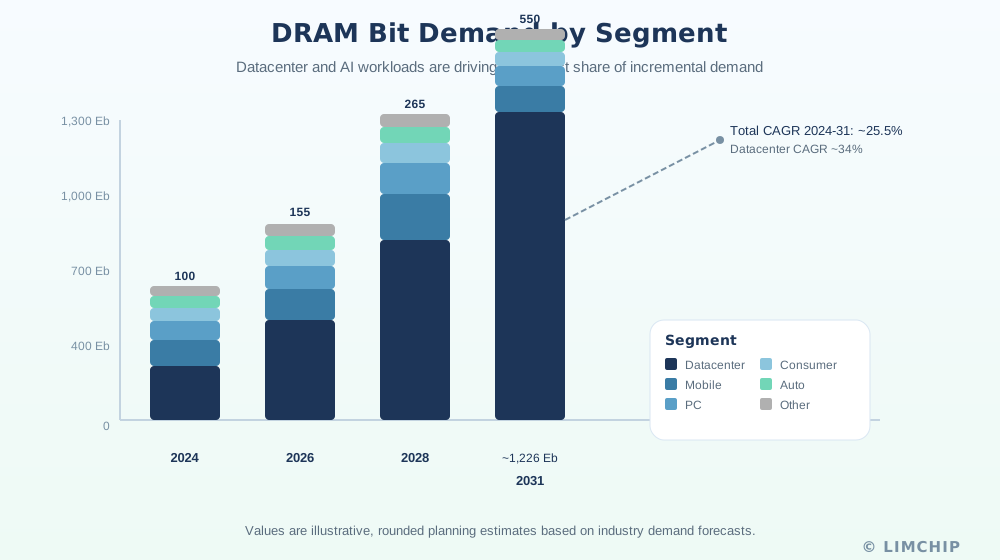
AI infrastructure has changed where DRAM bits go. Hyperscale data centers — Microsoft, Google, Meta, Amazon and similar operators — now account for the fastest-growing share of demand. Industry forecasts point to a substantial increase in AI data-center power demand through 2030, but the exact level varies by workload, deployment model and power-accounting method. These buyers have deep balance sheets and long project horizons, so their purchasing is less price-elastic than consumer PC or smartphone demand.
Agentic AI adds another wrinkle. In a single-shot inference pipeline, the CPU is mostly a thin orchestration layer and the GPU does the heavy lifting. In agentic workloads, the model plans, routes, calls tools, parses outputs, and manages state across many steps. That shifts the CPU:GPU balance from roughly 4:1 toward something closer to 1:1. More CPU cycles per accelerator mean more DDR5 and LPDDR5 per rack, not just more HBM.
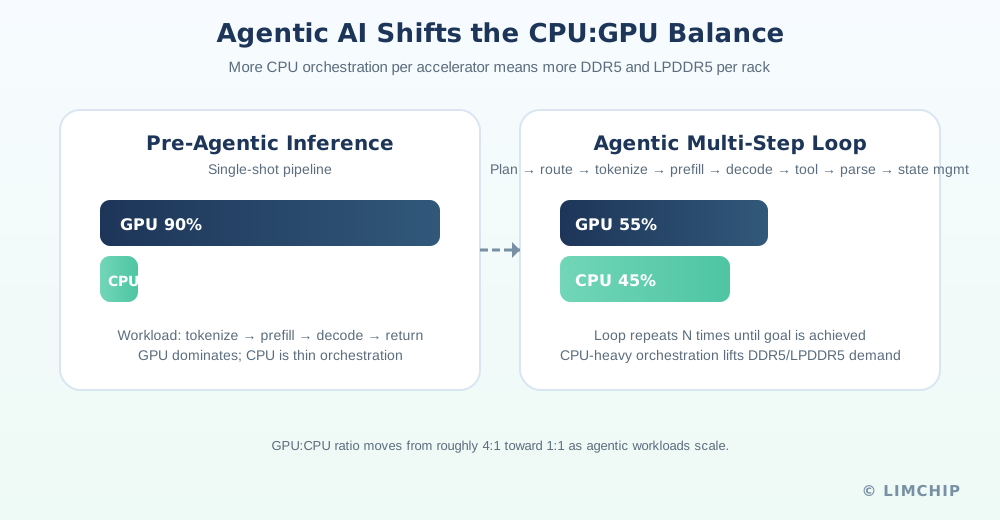
The implication is that AI lifts the entire DRAM stack, not only the high-bandwidth memory attached to GPUs.
Three forces are holding the market tight
1. AI demand keeps growing
Training clusters continue to scale, but inference is becoming the larger driver. Agentic systems, retrieval-augmented generation, and multi-modal services all keep more state in memory, which increases DRAM intensity per user and per workload. Hyperscalers are locking in supply years ahead because a stalled build-out is more expensive than paying a higher price for memory.
2. New capacity arrives slowly
Capital spending on DRAM fabs began recovering in 2024, expanded in 2025, and is continuing into 2026. The problem is that a greenfield fab takes roughly three years to come online. Wafers committed today mostly affect supply in 2027 and beyond. Until then, the industry lives with the capacity already installed. That is why industry forecasts show wafer production rising substantially through 2031 while supply remains tight in the near term.
3. HBM imposes a heavy "tax" on wafer supply
High-bandwidth memory is the headline story, but its effect on mainstream DRAM is easy to underestimate. HBM dies are larger, use more advanced packaging, and run at lower yield than standard DRAM. A wafer allocated to HBM therefore produces far fewer usable bits than the same wafer allocated to commodity DDR5. The industry shorthand is the HBM tax: every HBM wafer consumes capacity that could otherwise supply PC, mobile, or server DIMMs.
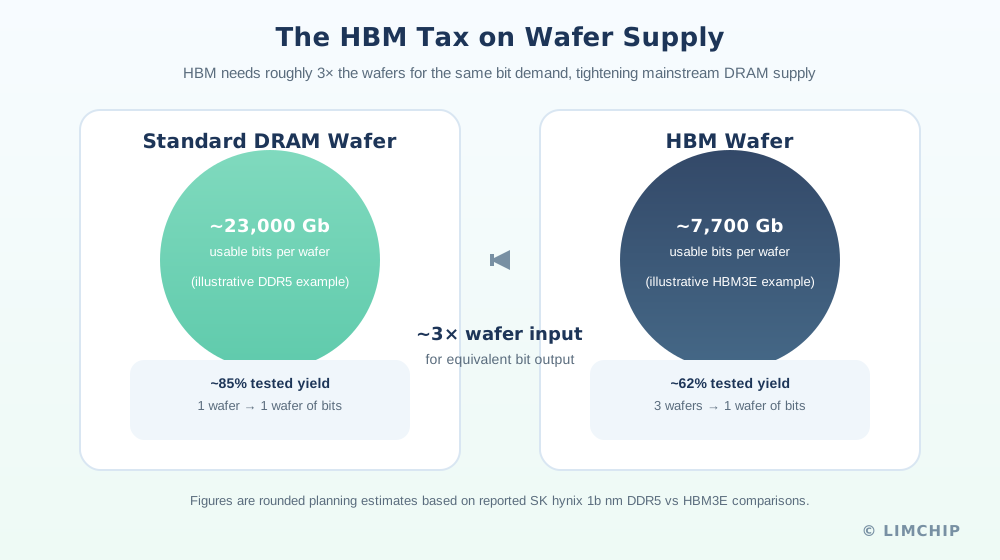
As HBM capacity expands, it pulls wafers away from mainstream DRAM and tightens supply for everything else. That is why DRAM prices can remain firm even when headline bit demand outside AI looks modest.
HBM: the price and margin inflection point
HBM3E is widely described by industry observers as a major current HBM shipment generation, while HBM4 has begun ramping; the exact mix varies by supplier and quarter. Because HBM is a more complex product, its manufacturing cost is materially higher than standard DRAM. Industry estimates put HBM cost at roughly three times that of a comparable DDR5 bit, yet HBM pricing has not yet fully reflected that gap. Industry pricing estimates expect HBM prices to move toward two times and eventually three times standard DRAM pricing as HBM4 volumes scale, restoring HBM margins to a level that justifies the capital and R&D intensity.
For buyers, the near-term HBM story is largely about allocation, not spot-price negotiation. Leading suppliers are tying HBM volumes to long-term contracts with cloud customers, and the physical die is increasingly customized for each accelerator platform. That makes second sourcing harder than for commodity DDR5.
Standard DRAM is not left behind
HBM gets the attention, but DDR5 and LPDDR5 are also seeing stronger demand than a simple PC or smartphone replacement cycle would imply. Server CPU upgrades, agentic AI orchestration, and memory bandwidth expansion all require faster, higher-density DRAM. The move from DDR4 to DDR5 in servers is now well underway, and LPDDR5 is becoming standard in high-end edge devices and AI-capable mobile platforms.
Long-term supply agreements are becoming the norm for these products too. The structure gives buyers volume certainty but reduces the chance of catching a sharp price decline. It also means buyers need to understand exactly what is committed: price, volume, delivery windows, and what happens if demand changes.
Long-term agreements are changing the cycle
When large cloud customers sign multi-year memory contracts, they trade price volatility for supply certainty. That is why many analysts expect DRAM operating margins to settle at a higher level than in the 2010s. HBM-heavy product mixes may support higher margins than traditional commodity DRAM, but actual margins will depend on pricing, yield, product mix and contract structure.
For procurement, LTAs are a double-edged sword. They protect supply during tight periods but can leave buyers locked into higher prices if the market turns. The key is to negotiate flexibility: volume bands, rebalancing rights, and clear language on technology transitions such as DDR5 to DDR5X or HBM3E to HBM4.
Capex is flowing into equipment and materials
The DRAM expansion cycle is not only a memory-vendor story. Wafer fabrication equipment is the largest single component of DRAM capital spending, with Applied Materials, ASML, Lam Research, Tokyo Electron, and KLA remaining the dominant suppliers. As memory vendors move through 1a-, 1b- and 1c-class nodes (vendor naming differs, and the roadmap toward 1d is not uniform), the mix of lithography, deposition, and etch tools shifts toward more advanced, more expensive systems.
Materials also matter. Advanced packaging for HBM needs new substrates, thermal interfaces, and interposer supply chains. Glass substrates are still a future option, but they are already part of the roadmap discussion for higher stack counts and better signal integrity.
China and CXMT: capacity grows, but the gap remains
Industry estimates differ on CXMT's future capacity and effective bit output. Buyers should track node, yield, product qualification and actual shipment volume rather than wafer-start announcements alone. More wafer starts do not translate one-for-one into more competitive bit supply, and equipment access continues to shape how much effective capacity actually reaches the market.
For buyers, this has two implications. First, Chinese-sourced DRAM will remain a bigger factor in legacy and mainstream nodes than in HBM or the most advanced DDR5. Second, geopolitical restrictions on equipment can shift supply faster than capacity numbers alone suggest, so buyers should monitor node-specific availability rather than just total wafer capacity.
What buyers should do now
The DRAM market in 2026 is not a simple shortage story. It is a structural shift toward higher capital intensity, longer lead times, and more contract-based allocation. Here is a practical checklist for buyers:
| Check item | What to verify |
|---|---|
| Technology node | Confirm whether the quoted part is on the right node for your platform (DDR5 vs DDR4, HBM3E vs HBM4, LPDDR5X). |
| LTA terms | Review price bands, volume commitments, rebalancing clauses, and transition rules for the next DRAM generation. |
| Allocation | For HBM and high-density DDR5, ask about supplier allocation and whether the volume is committed or forecasted. |
| Date-code window | Tight supply makes older date codes more common; confirm acceptable year/week ranges for your application. |
| Traceability | Insist on full lot documentation, especially for HBM modules where custom packaging is common. |
| Second source | Map alternative suppliers early; commodity DRAM has more options than HBM or customized server modules. |
| End-market risk | Make sure your forecast matches the segment — datacenter demand is structurally different from consumer PC. |
| RFQ clarity | Specify exact part number, target quantity, date-code range, packaging, and destination. Vague RFQs get vague allocation. |
What could extend the cycle even further
Most forecasts focus on AI servers and large-model training. The next layer of demand — humanoid robots, physical AI, industrial automation, and edge AI inference — is only beginning to appear in models. If these markets scale faster than expected, DRAM demand could exceed current projections and the tight-supply phase could last longer than the market is pricing in. That is a tail risk, but it is a real one for procurement planning.
Bottom line for component buyers
DRAM is no longer just a cyclical commodity. AI infrastructure, HBM expansion, and the DDR5 transition are moving the industry toward a higher-margin, longer-tight cycle. For buyers, the watchwords are allocation, LTA discipline, and technology-node clarity. The cheapest quote is no longer the only metric; the right question is whether the supply can actually show up when your build plan needs it.
If you are sizing a memory BOM or need help locking in HBM, DDR5, or LPDDR5 supply, send us the target part numbers and quantities. We can cross-check allocation channels, date-code ranges, and second-source options.
Sources
- Samsung DRAM official product information.
- SK hynix HBM official product information.
- Micron DRAM official product information.
- SEMI World Fab Forecast.
- WSTS Semiconductor Market Forecast.
- Original Chinese-language market material, rewritten and independently structured by LimChip.
The vendor links above support product and technology information only; they are not sources for market-share or margin data. Market-size, CAGR and price-level figures in this article are industry estimates or planning assumptions unless explicitly attributed to an official supplier statement. This article separates official supplier information, industry estimates and LimChip procurement analysis; it is an independent LimChip write-up, not a translation or reprint of the original material.
Need stock, date-code or package confirmation?
Send the part number, quantity, target date code and packaging requirements. LimChip will check available lots and RFQ details before you place the order.
Send RFQ