
Reported cap-free contracts point to stronger supplier leverage #
SK hynix is reportedly entering some long-term memory supply agreements without an upper limit on price, according to Korean media and market reports citing industry and securities sources. In the reported structure, customers secure a volume framework and a price floor, but contract pricing can continue to rise with the market rather than stopping at a predefined ceiling.
If accurately described, this is an important change in risk allocation. A traditional memory LTA can exchange volume certainty for a bounded price range. A contract without a price ceiling may still reserve supply, but it no longer guarantees the buyer a maximum acquisition cost during a shortage.
SK hynix has not publicly released the relevant contracts or confirmed that every customer, memory type and contract uses the same terms. The development should therefore be described as reported contract practice, not a company-wide policy proven by public filings.
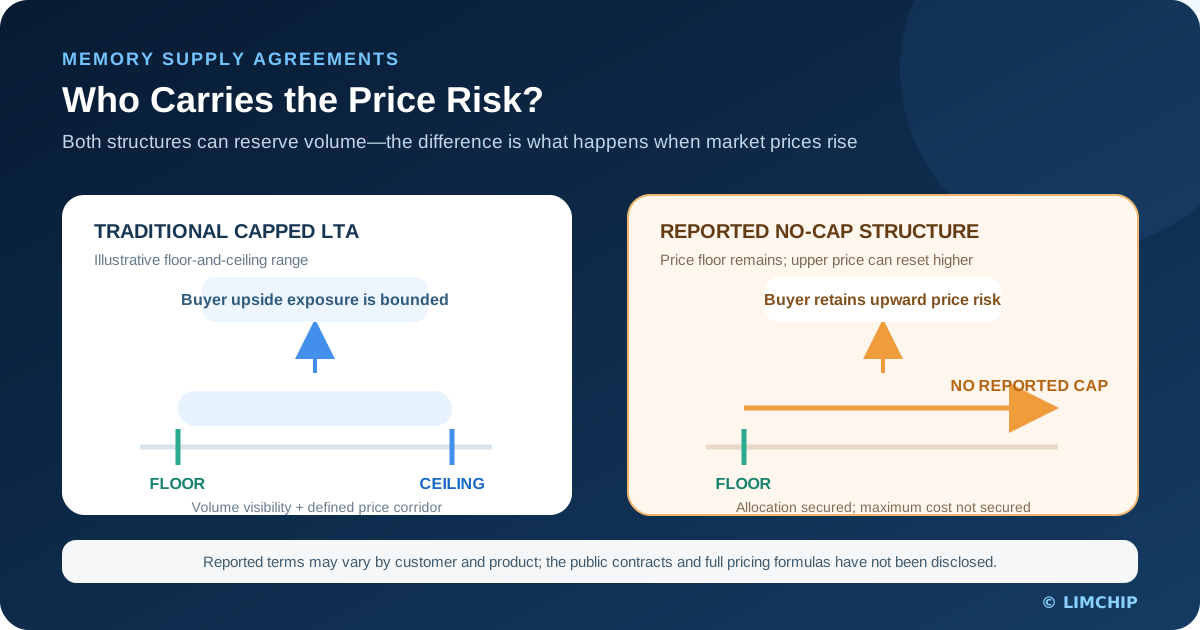
| Contract feature | Traditional floor-and-ceiling LTA | Reported no-cap SK hynix structure |
|---|---|---|
| Volume | Customer commits or forecasts agreed supply | Supply volume or allocation remains the core commitment |
| Downside protection for supplier | Price floor can protect minimum economics | Price floor reportedly remains |
| Upside protection for buyer | Price ceiling limits exposure during a price spike | No reported ceiling; price can move higher with the market |
| Main buyer benefit | Supply visibility plus a bounded price range | Primarily supply visibility |
| Main buyer risk | Paying above a falling spot market | Budget exposure during a shortage |
| Main supplier risk | Giving up some upside if the market surges | Demand or technology risk over a longer commitment |
The exact pricing reference matters. “Market price” can mean a published spot indicator, a negotiated contract benchmark, a product-specific index or a formula with timing adjustments. A headline saying that spot increases are “fully reflected” is not sufficient for procurement; the written formula, review frequency and product definition determine the actual invoice.
Why AI memory changed the negotiation #
For most of its history, DRAM and NAND behaved like commodity markets. Suppliers expanded capacity during an upcycle, oversupply pushed prices down, and long-term agreements helped both sides reduce volatility. Customers offered demand visibility; suppliers offered allocation and some price protection.
AI infrastructure changes the immediate priority. HBM is attached to accelerator platform qualification, advanced packaging, yield and lengthy co-development. A hyperscaler or accelerator vendor cannot always replace an approved HBM stack with another supplier's product on short notice. When the operational risk is “the accelerator cannot ship” rather than “memory costs more,” allocation can become more valuable than a fixed ceiling.
SK hynix and NVIDIA publicly announced a multi-year technology partnership in June 2026 covering next-generation memory for AI factories. That announcement confirms longer technical and supply coordination, but it does not disclose commercial price-cap terms. The reported no-cap agreements and the public NVIDIA partnership should not be treated as the same document.
| Source of leverage | Why it matters | Limitation |
|---|---|---|
| HBM qualification | Switching requires platform validation and close customer coordination | Samsung and Micron can gain share as products qualify |
| Advanced packaging | HBM output depends on more than DRAM wafer starts | Capacity investment and yield improvements can ease constraints |
| AI demand visibility | Large customers want multi-year supply assurance | Hyperscaler capital spending can slow or platform schedules can move |
| Supplier concentration | Few vendors can ship advanced HBM at scale | Concentration attracts regulatory, customer and competitive responses |
| Long lead investments | New fabs and packaging lines take time | New capacity can eventually turn scarcity into oversupply |
“Lock the volume, not the price” shifts risk to the buyer #
A no-cap LTA is not the same as a fixed-price purchase order. It can reserve capacity while leaving the buyer exposed to periodic repricing. Procurement teams therefore need two approvals: one for the supply commitment and another for the pricing mechanism.
The buyer should model several cases instead of treating one contract price as the budget:
| Scenario | Supply environment | Possible contract effect | Procurement response |
|---|---|---|---|
| Persistent shortage | AI demand exceeds qualified output | Price resets continue upward | Set budget bands and escalation approval before signing |
| Balanced market | New capacity catches demand | Price stabilizes near the reference formula | Recheck minimum purchase and take-or-pay exposure |
| Downcycle | Demand slows or supply expands faster | Floor may prevent full participation in lower market prices | Compare floor against redesign and alternate-source costs |
| Product transition | HBM generation or DRAM node changes | Old and new products may follow different curves | Define transition, qualification and end-of-life obligations |
This is why an LTA can increase supply certainty without creating total cost certainty. For a buyer, availability and price protection are separate products.
Earnings upside is real—but not automatic #
Removing a price ceiling can increase supplier revenue and gross-margin upside when prices rise. It does not mean that every percentage point of market price appreciation becomes net profit. Product mix, wafer cost, packaging, yield, customer rebates, currency, R&D, depreciation, tax and contract timing all affect the outcome.
It is therefore unsafe to claim that a 20% revenue increase will mechanically produce a 40% or 50% increase in net income. The more defensible conclusion is that cap-free pricing can preserve more operating leverage during a shortage than a contract that fixes or caps the selling price.
Longer agreements may also improve revenue visibility, but they do not eliminate the memory cycle. A multi-year volume commitment can stabilize utilization while creating other risks: customers may renegotiate, technology can change, demand can miss forecasts, and a price floor can become contentious in a downturn.
Does this create an industry-wide pricing model? #
Reports indicate that major memory suppliers are experimenting with different structures rather than adopting one uniform template. SK hynix is reported to use no upper cap in some LTAs; Micron has been reported to retain a ceiling and a price floor in certain strategic agreements; Samsung has reportedly pursued longer commitments with major customers.
That is evidence of greater supplier negotiating power, but not proof of coordinated or permanent oligopoly pricing. Products, customers, qualification status and contract dates differ. Buyers should not assume that one supplier's reported HBM terms automatically apply to commodity DDR4, LPDDR, NAND or every other customer.
The structural change is more precise: memory contracts are moving from short, transactional price negotiation toward a mix of multi-year allocation, technology collaboration, prepayment, floors, periodic resets and product-specific pricing formulas. The price mechanism is becoming as important as the quoted price.
RFQ and LTA review checklist #
Before treating a long-term agreement as secured supply, buyers should request clear written answers to the following:
1. Identify the exact product generation, density, stack, speed, grade and qualification covered. 2. Define committed volume, forecast volume, allocation priority and remedies for under-delivery. 3. Record the price reference, reset frequency, lag, currency and treatment of spot-price spikes. 4. Confirm whether a floor, ceiling, collar, rebate or most-favored-customer provision applies. 5. Separate wafer, packaging, testing, logistics and expedite surcharges. 6. Define generation transitions, end-of-life notices and responsibility for requalification. 7. Review take-or-pay, prepayment, cancellation and force-majeure provisions under downside scenarios. 8. Maintain an approved alternate-source and broker-market inspection plan where substitution is feasible.
For buyers outside direct hyperscaler LTAs, the effect may arrive indirectly. OEMs, module vendors and distributors can receive different allocation and pricing terms, and those changes can pass through to finished modules or independent-market inventory. Current stock, date code, lot condition and contract validity should be confirmed before purchase.
What could weaken SK hynix's negotiating position? #
The reported leverage depends on scarcity and qualification advantage. It can weaken if AI infrastructure spending slows, accelerator launches are delayed, Samsung improves HBM yield and qualification, Micron expands HBM4 output, new packaging capacity comes online, or future architectures require less HBM per unit of compute.
The opposite risk also matters: continued growth in model size, agentic inference and memory content could keep demand ahead of qualified supply even as capacity expands. Procurement plans should be based on scenarios rather than a single forecast that shortage—or supplier pricing power—will last indefinitely.
Sources and evidence level #
- Industry and Korean media reports, citing market and securities sources, on SK hynix LTAs reportedly using a price floor without a price ceiling.
- SK hynix and NVIDIA, public announcement of a multi-year next-generation memory technology partnership, June 8, 2026.
- Public reporting on memory suppliers' evolving multi-year agreement structures.
No public SK hynix contract reviewed for this article discloses the full pricing formula. Reported commercial terms may vary by customer and product. This article is a supply-chain and procurement analysis, not investment advice.
Need stock, date-code or package confirmation?
Send the part number, quantity, target date code and packaging requirements. LimChip will check available lots and RFQ details before you place the order.
Send RFQ