
Article contents0%
- Why “SDRAM” can mean two different things
- A simple memory-family map
- SDR is not DDR with a slower speed grade
- Why 3.3 V SDR SDRAM is still designed into equipment
- Winbond SDR SDRAM families listed for mass production
- Micron SDRAM: separate production parts from legacy BOM demand
- What about Nanya, SK hynix and China-based memory suppliers?
- How engineers should compare SDR SDRAM candidates
- Six purchasing checks for active and legacy SDRAM
- Preparing an SDRAM RFQ
- Official reference material
- Takeaway
Why “SDRAM” can mean two different things #
In technical terms, SDRAM means synchronous dynamic random-access memory. It is DRAM whose operation is synchronised to a clock. The SDRAM family includes the original single-data-rate generation as well as later double-data-rate generations.
In everyday component sourcing, however, engineers and buyers often use “SDRAM” to mean the original SDR SDRAM: normally a 3.3 V parallel memory running at 100, 133, 166 or 200 MHz. DDR, DDR2, DDR3, DDR4 and DDR5 are also synchronous DRAM technologies, but purchase orders and BOM discussions usually name their DDR generation explicitly.
That difference in language matters. An RFQ that says only “256 Mb SDRAM” is not complete enough to quote. It could refer to a 3.3 V SDR device, a DDR-family device, a different bus width or a package that will not fit the board.
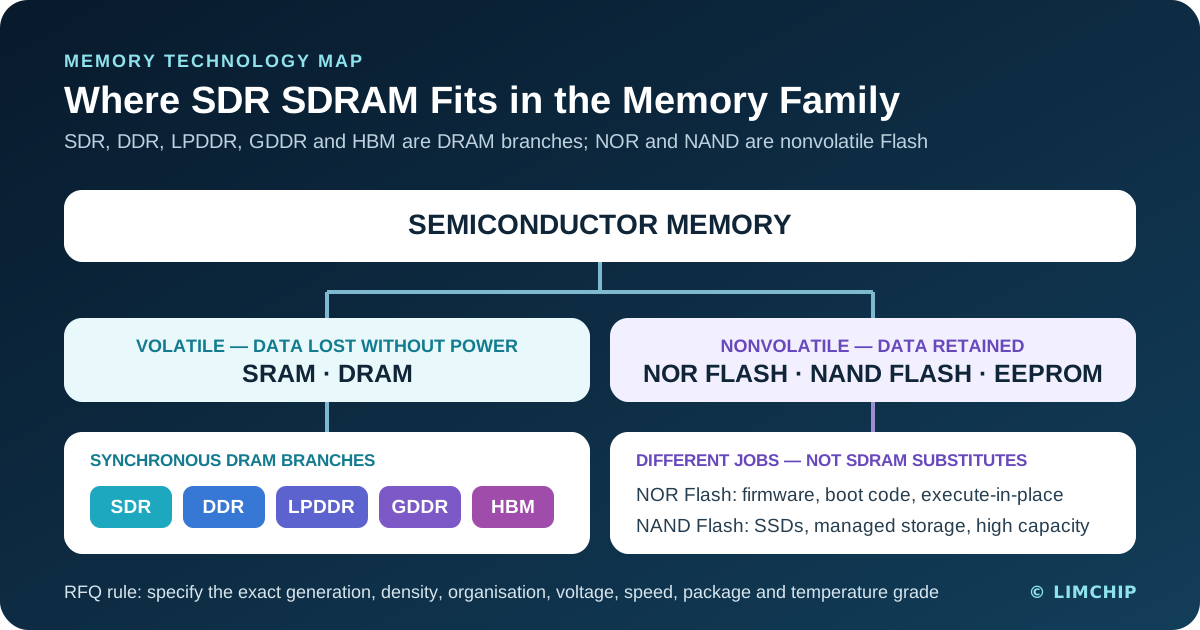
A simple memory-family map #
Memory devices can first be separated by whether they retain data without power.
| Memory class | Main families | What happens after power-off | Typical role |
|---|---|---|---|
| Volatile memory | SRAM, DRAM | Stored data is lost | Working memory, buffers and caches |
| Nonvolatile memory | NOR Flash, NAND Flash, EEPROM and other NVM | Stored data remains | Firmware, code, configuration and mass storage |
SRAM stores each bit without a refresh cycle and is commonly used where low latency matters. DRAM stores data in cells that require refresh, allowing higher density at a lower cost per bit. SDRAM brought the DRAM interface under clocked control, making transfers easier to schedule in digital systems.
The main synchronous DRAM branches serve different system requirements:
| Family | Core purpose | Common applications |
|---|---|---|
| SDR SDRAM | Single-data-rate, usually 3.3 V parallel memory | Legacy and long-life embedded equipment |
| DDR SDRAM | Main system memory with transfers on both clock edges | PCs, servers, industrial computers and embedded processors |
| LPDDR | Lower-power memory optimised for mobile or power-sensitive systems | Phones, tablets, automotive compute and edge devices |
| GDDR | High-bandwidth graphics memory | GPUs, graphics cards and accelerators |
| HBM | Very wide, stacked high-bandwidth memory | AI accelerators, HPC and high-end networking |
NOR and NAND Flash are not SDRAM. NOR Flash is commonly used for boot code and execute-in-place applications, while NAND Flash is used for higher-capacity data storage such as SSDs and managed embedded storage. For example, GigaDevice GD25Q parts are SPI NOR Flash, not companion SDRAM devices.
SDR is not DDR with a slower speed grade #
SDR transfers data once per clock cycle. DDR transfers data on both edges of the clock, but the difference is much deeper than a two-times data-rate label. Voltage, signalling, command protocol, controller design, timing, pinout and package support differ between generations.
| Design item | SDR SDRAM | DDR-family SDRAM |
|---|---|---|
| Typical legacy supply | 3.3 V | Depends on generation and device |
| Transfer principle | One transfer opportunity per clock cycle | Transfers on both clock edges |
| Controller | SDR-compatible memory controller | Generation-specific DDR controller and often PHY support |
| Board impact | Parallel address, command and data bus | Tighter timing and layout requirements as speed increases |
| Replacement rule | Match density, organisation, speed, package and grade | Match the exact DDR generation and full ordering code |
An H5PS1G63JFR device, for example, belongs to the DDR2 generation. It should not be placed in an SDR SDRAM replacement table even though both devices are members of the wider synchronous-DRAM family.
Why 3.3 V SDR SDRAM is still designed into equipment #
SDR SDRAM is no longer the mainstream choice for new PCs or high-performance servers, but that does not make it irrelevant. Many embedded platforms were designed around a proven SDR memory controller and do not need DDR-class bandwidth.
Industrial control and human-machine interfaces #
PLCs, motion controllers, operator panels, servo systems and other industrial equipment can remain in production or service for many years. If the processor and PCB were validated with a 3.3 V SDR interface, changing to DDR may require a new controller, new power rails, a PCB redesign, new firmware work and renewed system qualification.
For these projects, continuity and exact BOM fit can be more valuable than peak bandwidth.
Networking and communications equipment #
Routers, gateways, optical-network equipment and older communications controllers often use SDR SDRAM for packet buffers, control-plane memory or embedded processor memory. The required capacity may be only 64 Mb to 512 Mb, and the existing controller may already meet the product's throughput target.
FPGA and embedded processor boards #
Many FPGA, MCU and ARM-based embedded designs include a native SDR controller or a comparatively simple SDR controller implemented in programmable logic. SDR can reduce controller and board complexity where capacity and bandwidth requirements are moderate.
Automotive and transportation electronics #
Older instrument clusters, displays, infotainment controllers and camera systems may contain SDR SDRAM. Automotive use requires more than a wide temperature number: buyers must confirm the exact automotive grade, qualification, package, change-notification policy and approved part number. An industrial-temperature suffix must not automatically be described as automotive qualified.
Printers, POS terminals and stable consumer platforms #
Printers, payment terminals, set-top boxes and mature appliance designs may keep SDR because the existing hardware is stable and the memory performance remains adequate. Replacing a proven platform only to use a newer memory generation can cost more than maintaining the original BOM.
Winbond SDR SDRAM families listed for mass production #
Winbond remains one of the clearest sources for new 3.3 V SDR SDRAM. Its current product selection material lists 64 Mb, 128 Mb and 256 Mb x16 TSOP devices, including temperature-grade variants, as mass-production products.
| Base ordering code | Density and organisation | Speed | Voltage | Package | Sourcing note |
|---|---|---|---|---|---|
| W9864G6KH-6 | 64 Mb, 4M × 16 | 166 MHz | 3.3 V | 54-pin TSOP | Confirm final temperature and packing suffix |
| W9812G6KH-6 | 128 Mb, 8M × 16 | 166 MHz | 3.3 V | 54-pin TSOP | Confirm grade and controller address support |
| W9825G6KH-6 | 256 Mb, 16M × 16 | 166 MHz | 3.3 V | 54-pin TSOP | Confirm exact suffix, lot and date code |
| W9825G6KH75 | 256 Mb, 16M × 16 | 133 MHz | 3.3 V | 54-pin TSOP | Do not confuse the 133 MHz and 166 MHz speed codes |
The final letters matter. Winbond's product guide includes commercial, industrial and automotive-oriented variants with different temperature and qualification positions. A truncated code such as “W9825G6KH” is therefore not enough for a production purchase.
Available LimChip catalogue entries include W9864G6KH-6, W9812G6KH-6, W9825G6KH-6 and W9825G6KH-6I. Listed quantity, date code and packing condition remain subject to RFQ confirmation.
Micron SDRAM: separate production parts from legacy BOM demand #
Micron's current SDRAM catalogue still shows selected devices in production, including certain 64 Mb industrial-temperature products. However, many familiar MT48LC16M16A2 and MT48LC32M16A2 suffixes appear in Micron's obsolete SDRAM catalogue.
This distinction is important. “Available from the market” does not mean “still manufactured.” Legacy Micron parts may remain available from existing inventory, but buyers should confirm lifecycle status, traceability, lot age and packing condition before treating stock as a repeatable supply source.
| Example part | Main configuration | Typical published position | Buyer interpretation |
|---|---|---|---|
| MT48LC16M16A2P-6A:G | 256 Mb, 16M × 16, 166 MHz, 3.3 V, TSOP | Listed in the legacy/obsolete family context | Source for exact-BOM maintenance; verify lot and packing |
| MT48LC32M16A2P-75IT:C | 512 Mb, 32M × 16, 133 MHz, 3.3 V, industrial temperature | Legacy part-number demand | Confirm suffix, traceability and long-term requirement |
| MT48LC32M16A2TG-75:C | 512 Mb, 32M × 16, 133 MHz, 3.3 V | Legacy package variant | Do not infer package interchangeability from the same density |
| MT48LC4M16A2P-6A IT:J | 64 Mb, x16, 166 MHz, 3.3 V, industrial temperature | Shown in Micron's current SDRAM catalogue | Confirm current status at order time |
LimChip catalogue references include MT48LC16M16A2P-6A:G and MT48LC32M16A2P-75IT:C. These links support exact-part RFQs; they do not override the manufacturer's lifecycle status.
What about Nanya, SK hynix and China-based memory suppliers? #
Nanya NT5SV-family SDR devices and older SK hynix memories may still appear on legacy BOMs and in market inventory. Their status must be checked at the exact suffix level. Do not publish a blanket “in production in 2026” claim without a current manufacturer selection guide or lifecycle notice.
SK hynix H5PS-family devices are DDR2, not original SDR SDRAM. They can be relevant to another legacy-memory sourcing discussion but should remain outside an SDR replacement matrix.
China-based DRAM suppliers are important to the wider DDR and niche-memory market, but a DDR4 device is not an SDR substitute. CXMT DDR4 parts, for example, belong in a DDR4 sourcing article. GigaDevice GD25Q products belong in a NOR Flash article. Grouping them under “SDRAM alternatives” would confuse different interfaces and memory functions.
How engineers should compare SDR SDRAM candidates #
Matching capacity alone is not enough. Two “256 Mb SDRAM” devices can use different organisations, packages, speed grades or temperature grades.
| Engineering check | Why it matters |
|---|---|
| Density | The controller and address map must support the total capacity |
| Organisation | x8, x16 and x32 devices use different data widths and routing |
| Bank and row/column geometry | Mode registers and controller addressing must match |
| Clock and CAS latency | The controller timing must support the selected speed grade |
| Voltage and I/O levels | A 3.3 V SDR interface is not interchangeable with a DDR rail |
| Package and pinout | TSOP and BGA options require different footprints and routing |
| Temperature grade | Commercial, industrial and automotive requirements are not equivalent |
| Refresh requirement | The controller must meet refresh timing across temperature |
For a new design, engineers should also ask whether maintaining an SDR interface is the right long-term decision. If the processor supports only SDR and the bandwidth target is modest, a currently supported SDR device can be practical. If the design needs substantially more capacity or bandwidth, moving to a newer processor and DDR-family memory may offer a better lifecycle path.
Six purchasing checks for active and legacy SDRAM #
1. Quote the complete manufacturer part number, including speed, package, temperature and packing suffixes. 2. Confirm whether the manufacturer lists that exact suffix as production, not-recommended-for-new-design, EOL or obsolete. 3. For legacy stock, request label photos, lot code, date code, quantity split, traceability and packing information before order release. 4. Inspect trays, tubes, reels or dry packs for MSL control, oxidation, bent leads, contamination and signs of repacking. 5. Do not approve a cross-brand alternative until engineering checks organisation, timing, mode-register behaviour, refresh and pin compatibility. 6. Separate a one-time broker lot from a repeatable supply plan; availability must be reconfirmed for every production release.
Preparing an SDRAM RFQ #
A useful RFQ should include:
- Exact part number and approved manufacturer
- Required quantity and delivery schedule
- Acceptable date-code range
- Commercial, industrial or automotive grade
- Package and packing requirement
- Whether approved alternatives are allowed
- Target country and end application
- Need for traceability, inspection or electrical testing
Browse the LimChip memory catalogue or submit the exact requirement through the RFQ form. Current stock, price, date code, lot condition and delivery timing must be confirmed before purchase.
Official reference material #
- Winbond 2025 Specialty DRAM product selection guide
- Winbond 64 Mb, 128 Mb and 256 Mb SDRAM introduction
- Micron current SDRAM catalogue
- Micron obsolete SDRAM catalogue
- JEDEC memory technology areas
- GigaDevice SPI NOR Flash portfolio
Takeaway #
SDRAM is both a broad technical family and, in everyday purchasing language, a common shorthand for original single-data-rate SDR memory. Buyers and engineers should remove that ambiguity before comparing parts.
SDR SDRAM remains useful where a proven 3.3 V controller, moderate bandwidth and long-lived embedded design make continuity more valuable than a platform redesign. Winbond provides clearly documented mass-production SDR families, while many familiar Micron and other-vendor suffixes are now legacy sourcing requirements. The safest decision combines manufacturer lifecycle evidence, full-suffix engineering review and lot-level RFQ verification.
Need stock, date-code or package confirmation?
Send the part number, quantity, target date code and packaging requirements. LimChip will check available lots and RFQ details before you place the order.
Send RFQ