
Nanya is following a different DRAM product-mix strategy #
Samsung, SK hynix and Micron are directing an increasing share of investment, engineering resources and advanced capacity toward HBM, server DDR5 and other high-value products. Nanya Technology is taking a different position: it is continuing to serve the supply gap in DDR4 and LPDDR4 while building its newer DDR5 and LPDDR5 portfolio.
During Nanya's second-quarter 2026 earnings call, management said DDR4 and LPDDR4 together represented roughly 70% of shipments, with DDR5 and DDR3 each around 10%. The written earnings release does not publish this shipment split, but it confirms that Nanya continues to offer DDR5, LPDDR5/5X, DDR4, LPDDR4/4X, DDR3 and LPDDR3.
This is not simply a supplier refusing to move to a newer generation. It is a commercial response to an unusual market: leading DRAM manufacturers are prioritizing AI and server products while a large installed base still requires older memory generations.
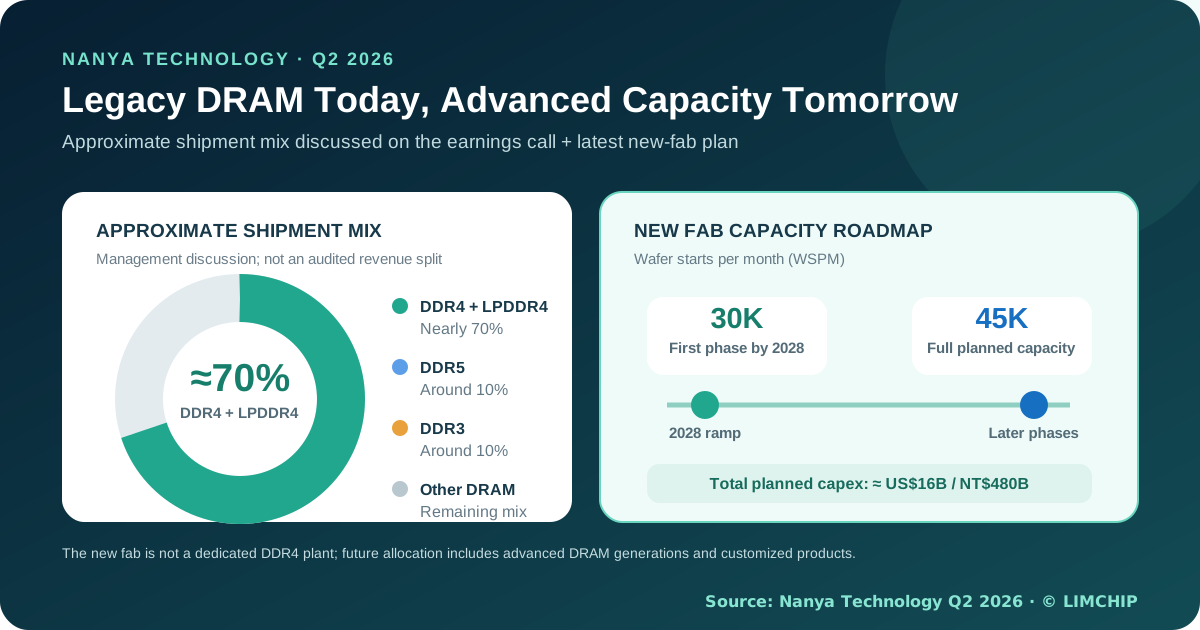
| Product group | Approximate Nanya shipment mix discussed on the Q2 call | Current role |
|---|---|---|
| DDR4 + LPDDR4 | Nearly 70% | Mainstream supply for PCs, consumer, networking, industrial and embedded platforms |
| DDR5 | Around 10% | Newer server/client products and a platform for future mix expansion |
| DDR3 | Around 10% | Legacy and long-life equipment where redesign is difficult |
| Other DRAM | Remaining share | LPDDR5/5X, LPDDR3 and customized products |
The percentages are approximate management commentary rather than an audited product-revenue table. Shipment mix also should not be confused with revenue mix: different products can have very different density and average selling prices.
Why DDR4 demand has not disappeared #
DDR5 adoption is growing, but memory transitions do not replace the installed base overnight. Intel client platforms from the DDR4 era, AMD's AM4 ecosystem, industrial computers, network appliances, set-top boxes, displays and embedded systems can remain in service for many years. Repair demand, capacity upgrades and continued production of approved designs all consume DDR4.
LPDDR4 and LPDDR4X have an equally persistent role in cost-sensitive mobile, automotive, networking and embedded designs. These customers often value validated firmware, stable signal integrity and long qualification histories more than the bandwidth increase of a new memory generation.
| Demand source | Why it remains attached to DDR4/LPDDR4 | Procurement implication |
|---|---|---|
| Installed PCs and workstations | CPU and motherboard memory controller is generation-specific | Confirm module type, rank, density and platform limits before buying |
| Industrial and embedded systems | Redesign and requalification can cost more than the memory | Build lifecycle demand by approved full ordering code |
| Networking and consumer equipment | Existing SoCs may support only DDR3/DDR4 or LPDDR4 | Do not substitute generation or organization without engineering review |
| Automotive programs | Qualification, temperature grade and traceability requirements extend lifecycles | Require automotive grade and lot documentation where applicable |
| Maintenance and repair | Original hardware remains deployed after mainstream production shifts | Inspect date code, storage history, packing and solderability |
The supply side is changing faster than this demand base. HBM consumes advanced wafer capacity and packaging resources, while server customers are securing DDR5 and HBM through longer agreements. Nanya said AI and general-purpose servers were driving strong demand and constraining memory supply for PCs, smartphones, automotive and consumer electronics.
That creates a niche for suppliers willing to keep producing mature products. When competitors reduce DDR4 and LPDDR4 output, Nanya can gain pricing power and customer relevance even without matching the scale of the three global DRAM leaders.
Q2 results show how strongly pricing changed the business #
Nanya reported Q2 2026 revenue of NT$82.55 billion, up 68.2% sequentially. Average selling prices increased by more than 60% quarter over quarter while bit shipments were flat. Gross margin reached 79.5%, and net income was NT$50.19 billion.
Those figures are a warning against reading revenue growth as equivalent to volume growth. The quarter's improvement came primarily from higher pricing, not a comparable increase in shipped bits.
| Q2 2026 indicator | Reported result | Interpretation |
|---|---|---|
| Revenue | NT$82.55 billion | Up 68.2% QoQ |
| Average selling price | More than 60% increase QoQ | Primary driver of revenue and margin improvement |
| Bit shipments | Flat QoQ | Supply volume did not expand with revenue |
| Gross margin | 79.5% | Reflects exceptional pricing and product-market conditions |
| AI infrastructure and server revenue | More than 20% in 1H 2026 | Nanya is not exclusively a legacy-memory supplier |
| 2026 bit-shipment target | High-teens percentage growth YoY | Forward-looking company target, not guaranteed output |
Management expects Q3 operating results to improve further and said operating performance should remain sustainable over the next few quarters. It also expects tight supply to persist for several quarters. These are forward-looking statements and should not be treated as a guaranteed price path.
The new fab: 30,000 wafer starts per month by 2028 #
Nanya's new fab is the most important medium-term supply variable. The first phase is planned to ramp to 30,000 wafer starts per month by 2028. Full planned capacity is 45,000 wafer starts per month, with estimated total capital expenditure of US$16 billion, including construction.
| New-fab milestone | Current company plan |
|---|---|
| First-phase capacity | 30,000 wafer starts per month |
| First-phase timing | Ramp by 2028 |
| Full planned capacity | 45,000 wafer starts per month |
| Total planned investment | Approximately US$16 billion / NT$480 billion |
| Process roadmap | 1C, 1D, 1E and EUV development |
The updated US$16 billion estimate is higher than the NT$300 billion plan announced when the project was introduced in 2021–2022. Buyers should use the latest Q2 2026 guidance rather than mixing the old budget with the current capacity schedule.
The fab should not be described as a dedicated DDR4 plant. Nanya says it will support a broad DRAM portfolio and is developing newer 10nm-class processes, DDR5, LPDDR5 and customized AI products. Future product allocation will depend on qualification, pricing and customer agreements when capacity becomes available.
What this means for the DDR4 supply outlook #
Nanya's strategy reduces the risk that DDR4 disappears abruptly, but it does not recreate the former supply structure. One smaller supplier cannot fully replace every wafer shifted by Samsung, SK hynix and Micron. Nor will a 2028 fab ramp solve a procurement requirement due in the next few quarters.
The likely market is therefore neither “DDR4 is gone” nor “DDR4 supply is safe.” It is a narrower, supplier-concentrated market in which pricing and lead time can remain volatile. A temporary spot-price decline can coexist with tight contract supply for specific densities, organizations, speeds and grades.
Practical sourcing checks #
1. Forecast demand by full part number, density, organization, speed bin, package and temperature grade. 2. Separate module requirements from discrete DRAM requirements; they have different supply chains and qualification risks. 3. Confirm whether a quotation is factory-new stock, authorized channel inventory or independent-market material. 4. Request date code, lot split, packing condition, traceability and storage history before purchase. 5. Do not approve a different die revision, organization or speed solely because it is also labeled DDR4. 6. Compare a lifecycle buy with the engineering cost and qualification time of a DDR5 redesign. 7. Avoid blanket “buy now” decisions: secure critical approved codes based on consumption, safety stock and verifiable supply.
For long-life products, the best response is not panic buying. It is mapping the approved BOM, identifying the least replaceable memory codes and confirming real allocation before the shortage reaches production.
Sources and methodology #
- Nanya Technology, Q2 2026 Investor Conference presentation and earnings release, July 10, 2026.
- Nanya Technology Q2 2026 earnings-call management discussion for approximate product shipment mix.
- Nanya Technology new-fab disclosures for updated capacity and capital-expenditure plans.
Market availability, price, date code and lot condition should be confirmed before purchase. Company capacity plans and outlook statements may change with customer agreements, equipment installation, process qualification and market conditions.
Need stock, date-code or package confirmation?
Send the part number, quantity, target date code and packaging requirements. LimChip will check available lots and RFQ details before you place the order.
Send RFQ