
Article contents0%
- What an optical transceiver is
- The signal path: electrical → optical → electrical
- Key parameters buyers must check
- The global supply chain
- Where the margin sits
- AI demand: the dominant near-term driver
- What can go wrong in procurement
- How to verify a transceiver before you buy
- CPO: will pluggable modules disappear?
- Where optical transceivers are used
- LimChip sourcing view
- FAQ
- Summary
- Sources
An optical transceiver is the bridge between the electrical world of switches and servers and the optical world of fiber. In the last three years, demand for these modules has moved from a steady telecom and data-center cycle into an AI-driven surge. A single GPU in a training cluster can consume on the order of 4–12 transceivers depending on the platform and link topology, and a 10,000-GPU cluster can require on the order of 100,000 modules (figures vary by deployment; treat as planning estimates, not fixed ratios). That scale makes transceivers a component category procurement teams can no longer treat as an afterthought.
This guide breaks down how transceivers work, what sits inside them, where the supply chain is concentrated, and what buyers should verify before releasing an RFQ.
What an optical transceiver is #
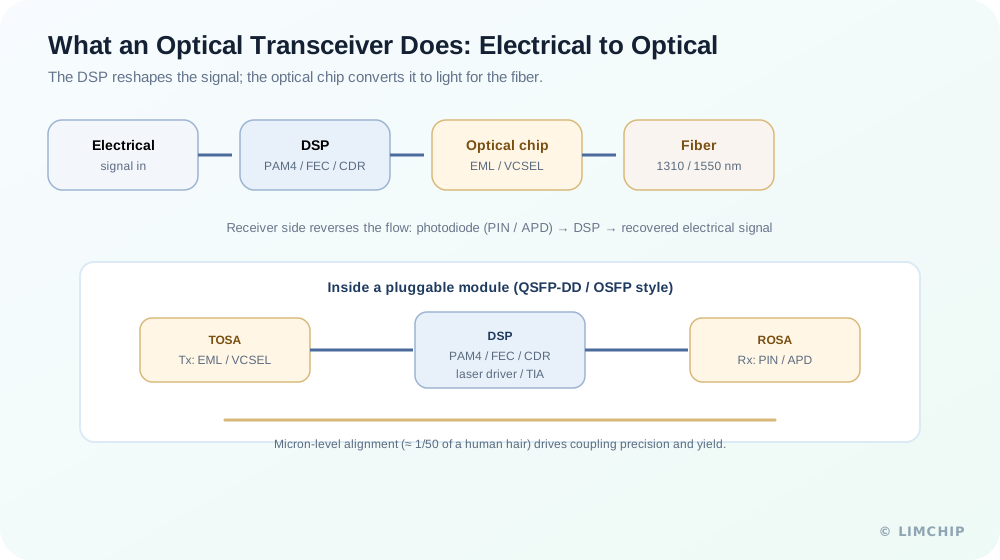
A transceiver converts electrical signals from a switch, NIC or GPU into light pulses that travel down fiber, and converts incoming light back into electrical signals. It is a small module that plugs into a cage on a switch or server board. The real work happens inside at micron-level precision: optical chips handle the light, an electrical chip handles the signal, and a set of precision components aligns everything with the fiber.
The two main optical subsystems are the TOSA (transmitter optical sub-assembly) at the send end and the ROSA (receiver optical sub-assembly) at the receive end. Between them sits the DSP — the digital signal processor that reshapes the waveform, applies PAM4 encoding, runs forward-error correction (FEC) and performs clock-and-data recovery. The DSP is often described as the brain of the module; the TOSA/ROSA are its eyes and voice.
The signal path: electrical → optical → electrical #
Incoming electrical bits are first cleaned up by the DSP. The conditioned signal then drives a laser chip, typically an EML (electro-absorption modulated laser) for long-distance or high-rate links, or a VCSEL (vertical-cavity surface-emitting laser) for short-reach data-center links. The laser converts the electrical waveform into 1310 nm or 1550 nm light. At the far end, a photodiode — PIN for standard reach or APD for longer reach — turns the light back into current, and another DSP recovers the original data.
That conversion is the point of the module. Copper traces lose signal integrity quickly beyond a few meters, while fiber can carry the same data for hundreds of kilometers with minimal loss. For AI clusters, this means GPU memory and compute can be pooled across racks without electrical-distance limits dictating the architecture.
Key parameters buyers must check #
Transceivers are not interchangeable just because they share the same form factor. Before releasing an RFQ, confirm:
The host board is a separate qualification boundary. For FPGA designs, use the FPGA Ethernet PHY and retimer selection guide to freeze the MAC/PCS/FEC owner, electrical lane map and channel-loss evidence before qualifying the optical module.
| Parameter | Why it matters |
|---|---|
| Form factor | QSFP-DD, OSFP, QSFP28, SFP28, etc. The switch cage and connector define this. |
| Data rate | 100G, 400G, 800G, 1.6T. Must match the host port capability. |
| Reach | SR, LR, ER, ZR. Determines the laser type and fiber link budget. |
| Wavelength | 850 nm for multimode VCSEL; 1310/1550 nm for single-mode EML. |
| Modulation | PAM4 is common for 400G+; NRZ for older 100G. |
| FEC | Some systems require host-side FEC; others expect the module to handle it. |
| Host qualification | The switch or GPU vendor usually publishes a qualified vendor list (QVL). |
| Fiber type | OM3/OM4 multimode for SR; OS2 single-mode for LR/ER/ZR. Must match the link plant. |
| Connector | LC, MPO/MTP, etc. Defined by reach and form factor. |
| Temperature grade | Commercial (0–70°C) vs industrial (–40–85°C). Affects where the module can be deployed. |
| DOM / DDM | Digital Optical Monitoring reports live temperature, Tx/Rx power and bias. Required for most managed deployments. |
| EEPROM / CMIS | Stores the module identity, vendor coding and firmware; a reprogrammed EEPROM is a common counterfeit tell. |
A QSFP-DD 800G SR8 and a QSFP-DD 800G LR8 look identical mechanically but are not substitutes. The wrong reach or wavelength will either fail link-up or burn distance margin.
The global supply chain #
Optical transceivers sit at the end of a highly stratified value chain.
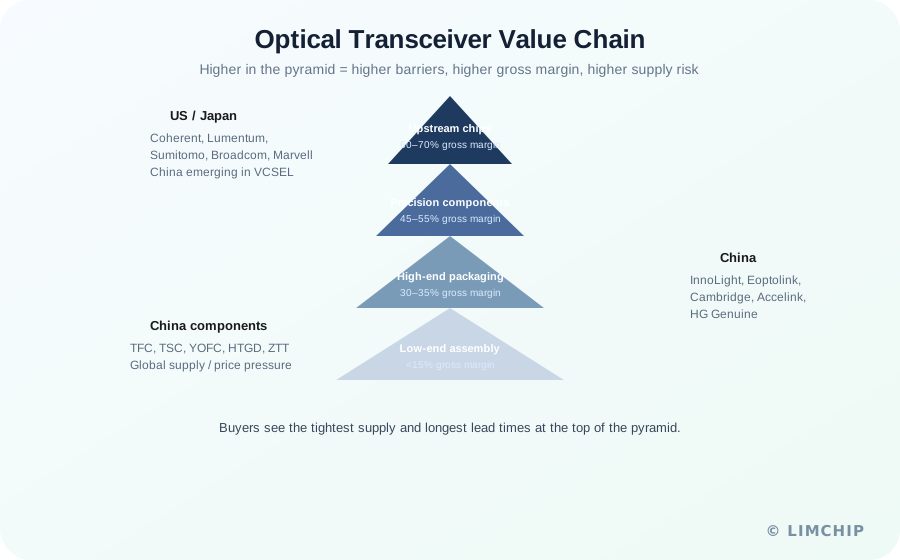
At the top are the optical chips — lasers, modulators and photodiodes. These are usually made on indium phosphide (InP) or gallium arsenide (GaAs) and are widely estimated to account for roughly 40–60% of module cost (industry estimate; the share varies by data rate and volume). Coherent, Lumentum and Sumitomo Electric are among the suppliers that dominate high-end EML lasers and high-speed photodiodes. Chinese suppliers such as Yuanjie Technology, Accelink and Huagong Technology are advancing fast in mid-range VCSEL and lower-speed EML, but high-end 100G+ EML remains concentrated in the US and Japan.
The electrical chip — the DSP that handles PAM4, FEC and clock recovery — is even more concentrated. Broadcom and Marvell are widely cited as holding roughly 90% of the high-end DSP share (industry estimate; the share shifts as new entrants qualify), with advanced designs at 7 nm or below. Domestic Chinese alternatives are mostly in low-end, cost-driven segments.
The precision components — lenses, isolators, beam splitters, fiber ferrules and ceramic housings — are where Chinese suppliers have built real global share. TFC, TSC, Accelink, YOFC, HTGD and ZTT are embedded in the supply chain of nearly every major transceiver maker.
Packaging and assembly is where China holds a leading position in global transceiver output. InnoLight, Eoptolink and Cambridge Technology are among the suppliers with a leading share of global transceiver shipments, especially into AI and cloud customers. HG Genuine and Accelink are also scaling volume quickly. The packaging step is a micron-precision operation: chip placement, optical coupling, wire bonding, hermetic sealing and burn-in test. For established high-volume lines, yields above 99.9% are commonly reported (figure varies by product maturity and volume).
Downstream, the demand engine is AI. Training clusters at Microsoft, Google, AWS, Meta, ByteDance and Tencent are consuming 100G/400G/800G transceivers in multi-million-unit quantities.
Where the margin sits #
The supply chain is often described as a profit pyramid (industry estimates; actual margins vary widely by product and customer). High-end optical and electrical chips sit at the top with an estimated 60–70% gross margin and the deepest technical moats. Precision components sit in the middle with an estimated 45–55% margin — stable, high-volume, but less differentiated. High-end packaging is estimated at 30–35% margin, driven by scale and yield control. Low-end assembly at the base earns less than an estimated 15%, where the competition is mostly price.
For procurement, this explains the lead-time landscape: the tightest supply and longest delivery times are usually at the chip level, not at the module level. If you can source a module, the constraint inside it is often the DSP or the EML laser.
AI demand: the dominant near-term driver #
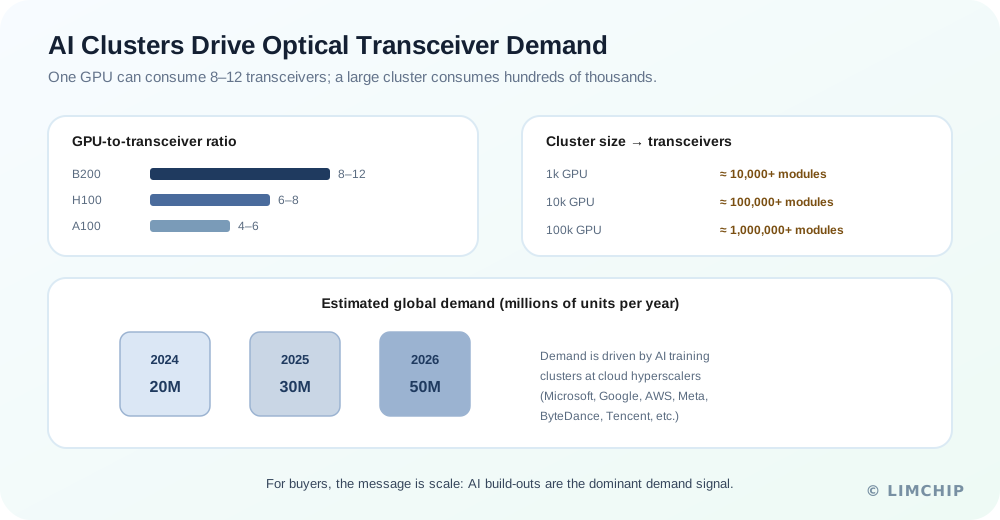
The current AI build-out is the biggest demand signal in the market. A single GPU can require on the order of 4–12 transceivers depending on the generation and link design (industry estimates, not fixed ratios): roughly 4–6 for an A100, 6–8 for an H100, and 8–12 for a B200. Scale that to a cluster and the numbers grow quickly as planning estimates: a 1,000-GPU cluster can consume 10,000+ transceivers; a 10,000-GPU cluster can exceed 100,000; a 100,000-GPU cluster can exceed 1,000,000.
Estimated annual demand has climbed from roughly 20 million units in 2024 to 30 million in 2025 and 50 million in 2026. These are estimates, not forecasts, but they capture the direction: transceivers are now a capacity-constrained, AI-linked component.
What can go wrong in procurement #
- Assuming all QSFP-DD or OSFP modules are interchangeable. Form factor is only a mechanical envelope. Reach, wavelength, DSP and FEC must match.
- Ignoring the qualified vendor list. Hyperscale switches and GPU platforms are picky about firmware and electrical timing. A "generic" module may not link up.
- Under-rating the chip bottleneck. If lead times extend, it is usually because the EML laser or DSP is constrained, not because the assembly line is full.
- Overlooking refurbishment. The market for used, reprogrammed or counterfeit transceivers is active. Without test data, you can receive modules that look right but fail at temperature or margin.
- Missing the CPO transition. Co-packaged optics will eventually replace pluggable modules in some high-end AI switches. The transition is not immediate, but a 3–5-year procurement plan should account for it.
How to verify a transceiver before you buy #
| Check | What to confirm |
|---|---|
| Exact part number / firmware | Same part number can have different firmware revisions. |
| Form factor and keying | QSFP-DD vs OSFP are mechanically incompatible. |
| Reach and wavelength | Determines fiber compatibility and link budget. |
| Vendor and date code | Confirms traceability and fresh stock. |
| Test report | Eye diagram, optical power, BER at temperature. |
| Host qualification | Is the module on the switch or GPU vendor's QVL? |
If a supplier cannot provide the original manufacturer label, lot code and test data, treat the line as high-risk.
CPO: will pluggable modules disappear? #
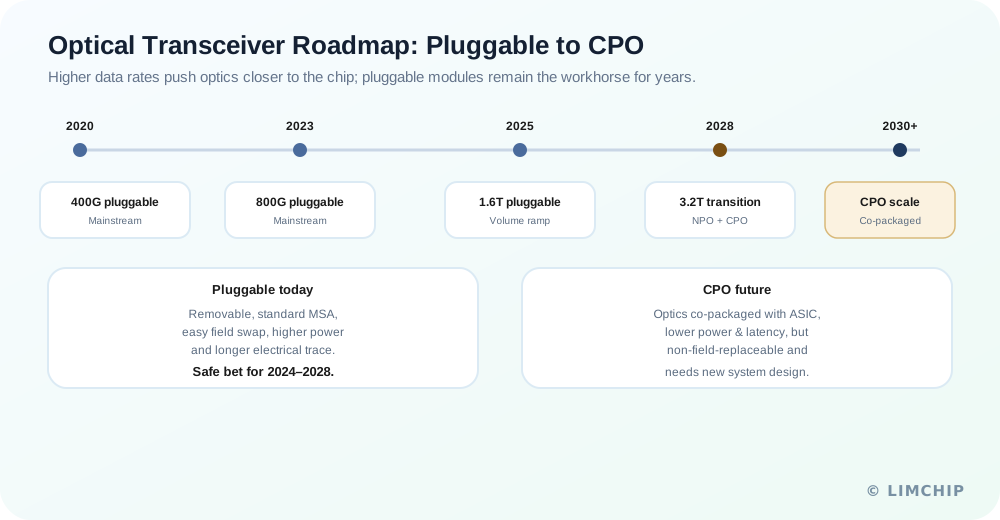
Co-packaged optics (CPO) moves the optical engine onto the same package or substrate as the switch ASIC. The benefits are lower power, lower latency and higher density; the downsides are loss of field replaceability and a harder thermal design. Industry expectation is that the technology moves from lab to commercial deployment between 2026 and 2030, with 1.6T and 3.2T pluggable modules serving as the bridge (timing depends on hyperscaler qualification).
For most buyers, this is a watch item, not a near-term disruption. Pluggable 400G/800G/1.6T modules are expected to remain the standard for data-center and AI cluster deployment through at least 2028 (industry expectation; revisit as CPO qualification progresses). But procurement teams designing 5-year roadmaps should flag CPO as a future form-factor change.
Where optical transceivers are used #
- AI training clusters: GPU-to-GPU and GPU-to-switch links; the highest-growth segment.
- Cloud data centers: Spine-leaf and DCI links between buildings.
- Telecom: Long-haul, metro and 5G fronthaul/backhaul.
- Enterprise: Campus core, storage networking and high-frequency trading.
LimChip sourcing view #
We source optical transceivers as system-level components, not commodity SKUs. The first question we ask is what the module will plug into, because the host platform defines the qualification boundary. For AI-focused buyers, we recommend keeping at least two qualified module sources on the BOM, and we can help verify lot traceability, test reports and date codes before shipment.
If your project needs 100G, 400G, 800G or related precision components, submit an RFQ with the host platform and target reach. We will check availability, vendor qualification and lead time.
FAQ #
Q: Can I replace a 400G SR8 with a 400G LR8 if the cage is the same? No. Reach and laser wavelength are different. The fiber plant and link budget must match.
Q: Are Chinese-made transceivers reliable? China dominates transceiver packaging and ships into the world's largest AI clusters. Reliability depends on the specific vendor and whether the module is qualified for your host platform, not on the country of assembly.
Q: What is the longest lead-time item inside a transceiver? Usually the DSP or the high-speed EML laser. These are the most capacity-constrained devices.
Q: Should I plan for CPO now? Only if your design cycle extends past 2028–2030. For deployments today and through 2027, pluggable modules are the right path.
Summary #
An optical transceiver is a tiny electro-optical system. The parts inside it — optical chips, DSP, precision components and packaging — each come from a different layer of the global supply chain, with different margin profiles and risk levels. AI training clusters are pulling demand to record levels, and procurement teams need to look beyond the module label to form factor, reach, wavelength, host qualification and upstream chip supply. Source with the same rigor you would apply to a complex SoC.
Sources #
- Public disclosures and product information from optical-component and module vendors: Lumentum, Coherent, Broadcom, Marvell, InnoLight, Eoptolink, Accelink, YOFC, ZTT and others. Margin ranges and per-GPU transceiver ratios cited in this article are industry estimates, not vendor-published figures.
- Hyperscaler capex and AI cluster build-out data from public company reports: Microsoft, Google, AWS, Meta, ByteDance, Tencent.
Need stock, date-code or package confirmation?
Send the part number, quantity, target date code and packaging requirements. LimChip will check available lots and RFQ details before you place the order.
Send RFQ