
What changed #
In July 2026, STMicroelectronics expanded its STM32H5 family with the STM32H543 and STM32H553 MCU lines. These devices are positioned as the compact, secure, connected members of the STM32H5 series for designers who do not need the larger flash and graphics headroom of the STM32H5Ex/Fx lines that were announced alongside them. The release gives embedded teams a practical starting point within the same STM32H5 platform, while still leaving room to scale upward if memory or graphics requirements grow later.
The announcement is part of a broader STM32H5 refresh. STMicroelectronics is now offering a single Cortex-M33 platform that spans from 512 KB / 1 MB of flash on the H543/H553 up to 4 MB of flash on the H5Ex/Fx, all sharing the same core architecture, security framework and software ecosystem.
Confirmed specifications #
The following details are taken from STMicroelectronics' public product page and community announcement dated June–July 2026:
| Attribute | STM32H543 / STM32H553 |
|---|---|
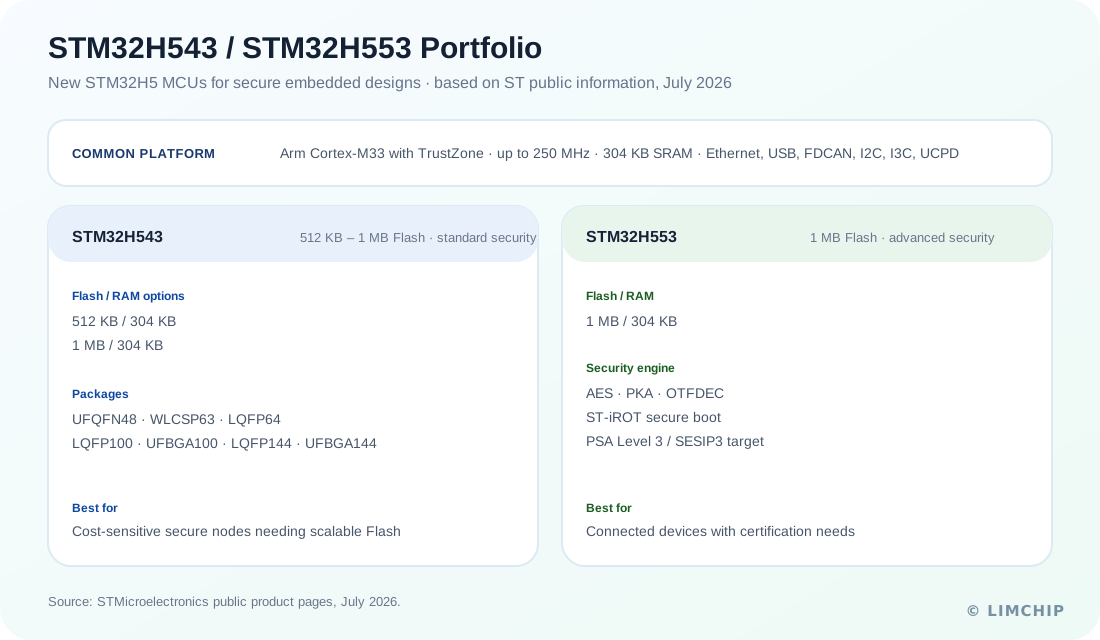
| Core | Arm Cortex-M33 with TrustZone for Armv8-M, up to 250 MHz |
| Flash | Up to 1 MB dual-bank flash; H543 options from 512 KB to 1 MB |
| RAM | 304 KB SRAM |
| Connectivity | Ethernet, FDCAN, USB FS, UCPD, I2C, I3C, external memory interface |
| Packages | 48 to 144 pins in BGA and LQFP, plus WLCSP63 and UFQFN48 |
| Security baseline | TrustZone, secure boot, authenticated debug, tamper protection |
| H553 additions | AES, PKA, OTFDEC crypto accelerators; ST-iROT root of trust |
| Target certifications | PSA Level 3 and SESIP3 |
| Development board | NUCLEO-H553ZG |
The key difference between the two lines is security integration. The H543 covers applications that need standard STM32H5 security features, while the H553 adds dedicated hardware cryptography and ST-iROT for designs that must meet stronger device-identity and secure-boot requirements.
STM32H543 vs STM32H553 at a glance #
| Selection question | STM32H543 | STM32H553 |
|---|---|---|
| Shared platform | Cortex-M33 up to 250 MHz, STM32H5 peripherals and package range | Cortex-M33 up to 250 MHz, STM32H5 peripherals and package range |
| Security position | Standard STM32H5 security baseline | Adds AES, PKA, OTFDEC and ST-iROT |
| Procurement decision | Use when the standard security set meets the approved design | Use when the design requires the additional crypto and root-of-trust functions |
| RFQ requirement | Specify the complete orderable code, flash, package and temperature grade | Specify the complete orderable code, flash, package and temperature grade |
Neither family name is a complete purchasing code. LimChip does not currently publish individual STM32H543 or STM32H553 catalogue entries, so this guide does not claim live stock. Send the exact manufacturer orderable code and quantity for a current sourcing check.
Why embedded buyers should care #
The H543/H553 is not a direct replacement for existing STM32F4, STM32F7 or STM32H7 parts. It is a new migration option within the STM32H5 ecosystem. For procurement teams, this matters in three ways:
- More package choices. With options from 48-pin UFQFN up to 144-pin LQFP
and UFBGA, the same MCU family can now cover both space-constrained consumer devices and industrial boards that need more I/O.
- A clearer security split. The H553 gives engineering a ready-made path to
PSA Level 3 / SESIP3 target certifications without adding external secure elements, while the H543 keeps BOM cost lower for less sensitive designs.
- Ecosystem reuse. Because the devices share the STM32H5 software ecosystem
and development tools, existing firmware investment can carry over, reducing qualification risk when a design is migrated.
Affected applications and BOM decisions #
STMicroelectronics lists the primary application targets as industrial and factory automation, smart home, smart city, and consumer electronics. From a sourcing perspective, buyers should review BOMs that currently rely on:
- STM32F4 or STM32F7 devices approaching mid-life;
- older STM32H7 parts where the design does not need the full H7 performance;
- multi-vendor MCU strategies that could be consolidated onto a single STM32H5
platform.
Any BOM review should be done with engineering. The Cortex-M33 core, TrustZone programming model, and pin assignments differ from older Cortex-M4 or Cortex-M7 parts, so a drop-in replacement is not guaranteed.
Sourcing and lead-time signals #
New MCU ramps create predictable procurement risks. Based on the ST community post, H543/H553 production volumes will reach distribution later in 2026, while samples are already available through STMicroelectronics sales offices.
| Signal | What it means for buyers |
|---|---|
| Samples available, distribution later | Engineering can start evaluation now, but production quoting should wait until distributor stock and lead times are confirmed. |
| New package types (WLCSP63, UFQFN48) | Smaller packages often have longer initial lead times and stricter handling requirements. Confirm reel size and MSL before RFQ. |
| Security-tier part-number split | Procurement judgment: H553 suffixes will likely carry a small premium over H543 for the added crypto hardware. Make sure RFQs specify the exact security level, not just "STM32H5." |
| Dev board allocation | NUCLEO-H553ZG availability can be an early indicator of how quickly ST is ramping support for the line. |
Buyers should also watch whether distributors publish first-reel quantities and whether ST issues any allocation notices during the initial ramp. Early shortages on Nucleo boards do not always translate into production MCU shortages, but they are a useful leading indicator.
LimChip supply chain perspective #
For OEM and EMS procurement teams, the STM32H543/H553 launch is a signal to review near-term STM32 BOMs rather than an immediate buying opportunity. If a design can tolerate the Cortex-M33 architecture and does not need more than 1 MB of flash, the H5 family now offers a wider migration path than it did before the announcement.
LimChip recommends confirming four details before issuing an RFQ:
1. Exact part number, including package, flash size, temperature grade and security tier (H543 vs. H553). 2. Whether engineering has qualified the part or only the dev board. 3. Target production date and whether distributor stock will align with it. 4. Whether the design needs the H553 crypto features, or if the H543 meets the requirement at lower cost.
Practical takeaway #
The STM32H543/H553 extends the STM32H5 family into compact, secure, connected embedded designs. Treat the launch as a planning event: verify engineering approval, sample availability and target production timing before committing to a new MCU family. When you are ready to quote, specify the exact package, flash size and security tier to avoid mismatches during ramp.
Sources #
- STMicroelectronics. STM32H543/H553 product page, accessed July 2026.
- STMicroelectronics Community. New STM32H5 lines give developers more room to scale, June/July 2026.
Need stock, date-code or package confirmation?
Send the part number, quantity, target date code and packaging requirements. LimChip will check available lots and RFQ details before you place the order.
Send RFQ