
NAND supply is tight, but the market is not uniformly short #
TrendForce's July 2026 NAND Flash update estimates that the market will remain undersupplied through 2026 and that supply pressure may begin to ease in the second half of 2027. The forecast is important, but it should not be read as a single expiry date for every NAND product.
The reported imbalance is a market-level bit forecast. A positive supply-demand balance in late 2027 would mean total NAND bit output is growing faster than total demand. It would not guarantee immediate availability for a particular raw NAND die, enterprise SSD, eMMC, UFS device, industrial temperature grade or firmware-qualified module.
For buyers, the useful conclusion is therefore not “wait until late 2027.” It is that the next several quarters may remain allocation-sensitive, while the eventual recovery is likely to arrive at different times for different product segments.
Why suppliers cannot add NAND output quickly #
TrendForce identifies two constraints on near-term supply growth. Existing fab space remains limited, and major memory manufacturers are prioritizing DRAM investment as AI infrastructure absorbs HBM and server-memory capacity. NAND suppliers are consequently relying heavily on process migrations, higher layer counts and better bit output per wafer rather than a rapid increase in wafer starts.
That approach can raise total bit supply, but it does not behave like adding a fully qualified replacement factory. A migration to a newer NAND generation also changes die characteristics, controller requirements, firmware validation and sometimes the economics of lower-density products. More bits can enter the market while a legacy density or long-lifecycle device remains difficult to replace.
TrendForce expects Korean, US and Japanese suppliers to continue upgrading existing production and selectively expanding current facilities during 2027. It also forecasts that increased equipment installation at China-based NAND suppliers could lift their share of global NAND bit output to nearly 19%. These are forecasts, not guaranteed production or qualification schedules.
AI servers are changing the NAND demand mix #
The demand side is increasingly led by servers rather than consumer devices. TrendForce estimates that servers already account for more than 40% of NAND Flash bit demand. Its application forecast moves the server share from 44.2% in 2026 to 51.1% in 2027, while PC, mobile, game-console and other shares become smaller.
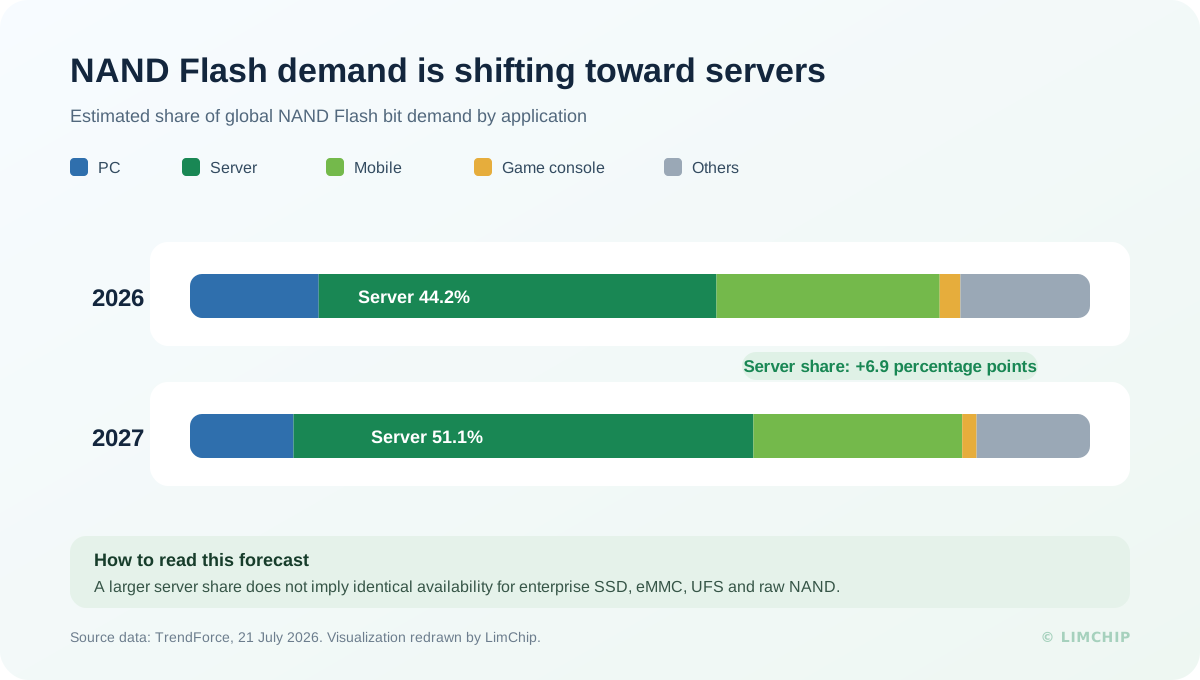
The shift does not mean consumer NAND demand disappears. TrendForce says smartphones and notebook PCs together still represent nearly 40% of bit demand, so weak consumer shipments can materially offset server growth. It forecasts 2026 smartphone production to decline by 15%–20% year over year and notebook shipments by around 10%, with both categories remaining under pressure in 2027.
At the same time, shipments of new Intel and AMD server platforms are expected to accelerate in the second half of 2026. TrendForce forecasts full-year server shipments to grow 17% year over year, followed by stronger growth in 2027 as server CPU constraints ease and long-term memory agreements improve component availability. Each figure is a market forecast and should not be treated as a confirmed shipment result for an individual platform or supplier.
Why late 2027 could look more balanced #
TrendForce estimates a NAND supply deficit of approximately 4%–5% in 2026. Its model turns positive in the second half of 2027 as process migrations and new equipment increase supply while consumer demand remains weak. Three forces therefore have to work together:
| Forecast driver | How it could ease the market | What could delay relief |
|---|---|---|
| Higher bit output per wafer | More capacity from existing fabs | Migration, yield or qualification delays |
| Additional China-based output | Expands global bit supply | Equipment ramp and customer qualification timing |
| Weak phone and notebook demand | Reduces competition for consumer NAND | A stronger-than-expected device replacement cycle |
| Continued server growth | Supports enterprise demand and supplier investment | AI demand can absorb incremental output faster than expected |
The forecast is therefore conditional. Stronger AI-storage demand, slower process transitions or supplier discipline could extend tightness. Conversely, weaker server investment or a faster capacity ramp could bring balance earlier.
Raw NAND, eMMC, UFS and SSDs will not recover together #
“NAND Flash” covers several procurement markets with different qualification and replacement barriers.
| Product area | Main dependency | Buyer risk during a tight market |
|---|---|---|
| Enterprise SSD | Controller, firmware, endurance, form factor and server qualification | Allocation can remain tight even when total wafer supply improves |
| Client SSD | Capacity, controller and OEM validation | Consumer weakness may improve availability sooner, but BOM substitutions still require testing |
| eMMC and UFS | Managed-NAND firmware, package, speed grade and host compatibility | Same capacity is not evidence of drop-in compatibility |
| Raw SLC/MLC/TLC NAND | Interface, geometry, ECC, endurance and lifecycle | Legacy densities may tighten as suppliers migrate to newer processes |
| Industrial and automotive storage | Temperature grade, retention, endurance and change control | Qualification and lifecycle requirements can delay any practical relief |
This distinction matters when interpreting market headlines. A fall in general NAND contract prices would not automatically release an industrial eMMC device with approved firmware. Likewise, an enterprise SSD shortage does not prove that every serial NAND or consumer card product is unavailable.
Inventory signals remain mixed #
TrendForce describes manufacturer inventory as relatively lean. Module makers, however, have accumulated more inventory because weak consumer demand has slowed sell-through, while inventories held by other buyer groups remain more controlled.
That split can create misleading spot-market signals. A distributor may show available modules while the underlying NAND generation remains tight, or quote an apparently abundant capacity that does not match the customer's controller, firmware or endurance requirement. Buyers should separate physical stock from executable, approved stock.
RFQ and sourcing checks for the next several quarters #
Before approving NAND-related supply, capture enough detail to distinguish the actual device from a broad market category.
1. Provide the complete part number, including density, package, speed and temperature suffix. 2. State whether the requirement is raw NAND, eMMC, UFS, SSD or a custom module. 3. For managed NAND, confirm controller and firmware restrictions with the engineering team before accepting a substitute. 4. For raw NAND, document interface, page/block geometry, ECC requirement, endurance target and approved die revision. 5. Confirm executable quantity, lot count, date code, packing method and storage condition rather than accepting an inventory headline. 6. Ask whether the quotation is supported by physical stock, scheduled factory allocation or an unconfirmed lead-time estimate. 7. For industrial and automotive programs, include temperature, retention, qualification and product-change-notification requirements.
| Market signal | Practical buyer response |
|---|---|
| Enterprise SSD demand remains strong | Confirm allocation and delivery by exact qualified model |
| Consumer modules accumulate inventory | Do not assume the same availability applies to embedded or industrial NAND |
| Supplier process migration accelerates | Recheck die revision, controller firmware and ECC compatibility |
| Forecast points to 2H27 relief | Maintain alternate-source work until approved supply actually improves |
Procurement takeaway #
The most defensible reading of the July outlook is that 2026 remains a shortage year at the total-market level, while the probability of broader relief rises in the second half of 2027. It is a planning horizon, not a purchasing promise.
Projects already approved around a specific enterprise SSD, eMMC, UFS or raw NAND part should continue monitoring allocation, firmware and lifecycle risk. New designs should avoid qualifying only by capacity and interface. The closer a product is to an industrial, automotive or server workload, the more important revision control, endurance evidence and traceability become.
For an RFQ, send the exact storage part number, target quantity, required date code or lifecycle window, application, temperature grade and any firmware or qualification restrictions. Availability, lot condition and delivery should still be confirmed at the time of purchase.
Official reference #
Need stock, date-code or package confirmation?
Send the part number, quantity, target date code and packaging requirements. LimChip will check available lots and RFQ details before you place the order.
Send RFQ