
What changed #
On Friday, July 17, 2026, shares of Cadence Design Systems (CDNS) and Synopsys (SNPS) fell about 9% after Moonshot AI published a technical blog showing its Kimi K3 model had autonomously designed a functional semiconductor chip using only open-source tools — with no licensed Cadence or Synopsys software in the loop. The sell-off came one day after Benchmark Research initiated both stocks at Buy on July 16, and the Nasdaq slipped roughly 1% on the news, with semiconductor names leading the decline.
This is a software story, not a component story. But EDA sits directly upstream of every chip LimChip sources, so it is worth separating what was actually demonstrated from what the market reaction assumed.
What the demo actually showed #
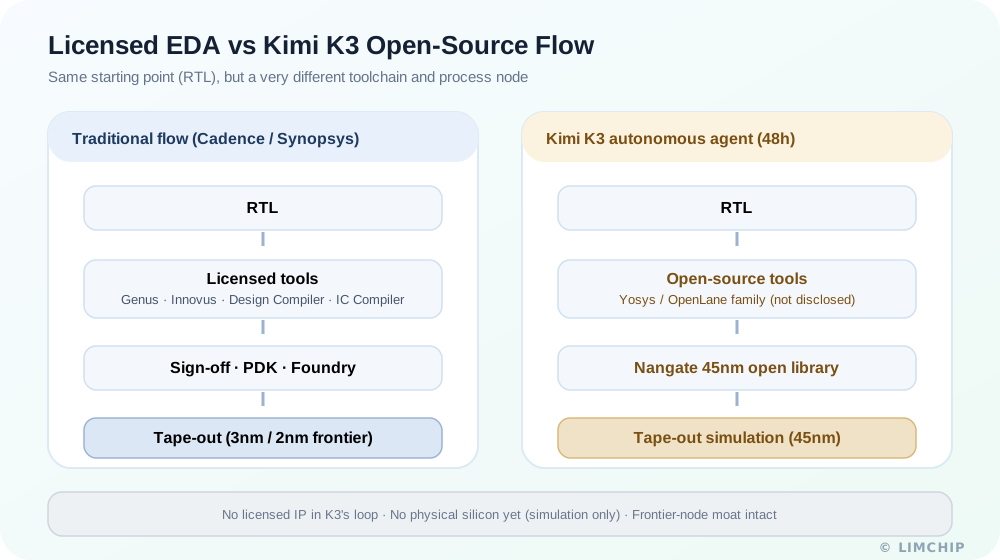
Per Moonshot's technical blog, K3 ran as an autonomous agent for 48 hours and completed a full RTL-to-tape-out-simulation flow on the free, open Nangate 45nm cell library. The reported result: a die of about 4 mm² (3.981 mm²) containing 13 modules, running at 100 MHz, with a simulated inference throughput of 8,721 tokens per second. The assigned task was to design a chip capable of running a nano-scale version of K3 itself.
Two details matter for a sober read. First, the flow reached tape-out *simulation*, not physical silicon — there is no reported tape-out, return, test-board run, or independent reproduction yet, and Moonshot has framed it as an early proof of concept. Second, the design is reported to span roughly 1.46 million standard cells and 0.277 MB of SRAM; those figures add texture but are secondary to the headline claim, which is that a licensed EDA toolchain was not required.
The bull case the demo questioned #
Cadence and Synopsys sell the proprietary toolchains chipmakers use for design, simulation and sign-off — Cadence's Genus, Innovus and Virtuoso; Synopsys' Design Compiler and IC Compiler. The bull thesis on both stocks rested on a simple chain: AI is making chips radically more complex, so demand for these licensed tools would keep rising. K3's demo puts a question mark over that chain, because it shows a frontier model can execute a complete design flow without any of it.
Whether that question is fairly priced is a separate debate. Bernstein's Robin Zhu called K3 "another example of a top Chinese AI lab surprising global investors," and Bank of America said it "raises the ceiling on Chinese AI models' architectural capability." Those are analyst interpretations, not confirmed business outcomes.
Why this is a mature-node story for buyers #
Here is the part that touches procurement directly. The demo was built on a 45nm open library — generations behind the 3nm and 2nm nodes where AI accelerators are designed today. At those frontier nodes, Cadence and Synopsys remain deeply embedded, and replicating the flow with open tools is far harder, because the moat is not just the place-and-route engine. It is the process design kit (PDK), sign-off, design-for-test, analog and mixed-signal, package co-design and the foundry rule loop — areas the demo did not touch.
Morgan Stanley's Gary Yu described the broader release as "the result of accumulated progress in China's AI model industry" rather than an overnight disruption. Bloomberg Intelligence's Niraj Patel put it plainly: this is not an imminent threat to Cadence's or Synopsys' revenue base, but AI becoming the primary interface to commercial EDA could push software value "up the stack."
For component buyers, the practical read is the opposite of a shortage. Industry estimates place EDA tools and IP at roughly 15% of chip R&D spend. If open-source EDA lowers the cost and barrier of taping out mature-node designs, more design houses — especially smaller and China-based teams — can bring specialized ASICs to market. That tends to increase the *number* of distinct part numbers in circulation, particularly at mature nodes (45nm and above) that already dominate industrial, automotive and IoT sourcing. More part numbers means a longer, more fragmented tail of components to source, verify and trace.
Impact across the chain #
- Cadence / Synopsys: No near-term revenue impact was claimed by any cited analyst; the risk is structural — a slower long-term growth narrative and possible pricing pressure if AI interfaces commoditize the front end of the flow.
- Open-source EDA: Public discussion has speculated that tools such as Yosys, OpenLane or Magic may be involved, but Moonshot has not confirmed the exact stack. Per Moonshot's announced plan, the July 27 technical report is expected to name it. Visibility for this ecosystem rises regardless.
- Foundries: A lower tape-out barrier at mature nodes could mean more small-volume shuttle and MPW runs at 45nm-and-above fabs.
- Buyers and distributors: Expect gradual growth in niche, low-volume ASIC part numbers — exactly the long-tail inventory where trusted sourcing and authenticity checks earn their keep.
Signals to watch #
- July 27, 2026 (per Moonshot's announced plan): Moonshot plans to release K3's full weights and a technical report detailing the exact EDA toolchain and methodology. That report is the first hard catalyst for a rational re-rating — independent developers can benchmark the capability directly.
- IP clarification: Moonshot has not said whether the design embeds any licensed IP blocks. That distinction is decisive for judging true substitution scope.
- Incumbent response: Watch for Cadence/Synopsys pricing moves or AI-assisted EDA features that blunt the open-source narrative.
- New part numbers: A rise in obscure mature-node ASICs entering distribution is the procurement-facing signal to track.
LimChip's supply chain view #
EDA is software, and this event does not change lead times or pricing on the parts in our catalog today. We treat it as a structural watch item, not a spot shortage.
The direction of travel matters for how we source. As design barriers fall at mature nodes, the market we serve gets wider and more fragmented: more customer-specific ASICs, more crossover parts, more devices with thin documentation and uncertain traceability. That is the environment where a capable distributor adds the most value — confirming package, date code and lot provenance on parts that do not carry the volume or history of a flagship device. For complex, licensed-EDA designs like the Zynq-7000 XC7Z045 we covered earlier, the incumbent toolchain is not going anywhere soon; for the long tail of new mature-node silicon, verification discipline is what protects a BOM.
Practical takeaway #
K3 is a real demonstration, but at 45nm and simulation-only. It questions the "AI complexity equals more EDA licenses" thesis without breaking the frontier-node moat yet. For buyers, the signal is longer-term: plan for a gradually larger, more diverse mature-node parts landscape, keep verification tight on low-volume devices, and watch the July 27 report before drawing conclusions about EDA's business model.
If your BOM includes niche or mature-node devices and you need package, date-code or traceability confirmation, submit an RFQ and our sourcing team will review it.
Sources #
- Moonshot AI. Kimi K3 — Official Launch Brief — primary source for the chip-design demo (autonomous 48-hour RTL-to-tape-out-simulation flow on the Nangate 45nm open library; 100 MHz, ~4 mm², 8,721 tok/s). Full weights and the detailed technical report are scheduled for release per Moonshot's announced plan on July 27, 2026.
- Market reaction: CDNS and SNPS fell about 9%, and the Nasdaq Composite about 1%, on July 17, 2026 (public market data; e.g., Reuters / MarketWatch close summaries for that session).
- Analyst commentary: Bernstein (Robin Zhu), Bank of America, Morgan Stanley (Gary Yu) and Bloomberg Intelligence (Niraj Patel) — originating research notes quoted in the analysis above.
Need stock, date-code or package confirmation?
Send the part number, quantity, target date code and packaging requirements. LimChip will check available lots and RFQ details before you place the order.
Send RFQ