
Why these terms matter #
In electronic component sourcing, words like original, new, bulk, refurbished, remarked and pulled are often used loosely. That creates risk. Two offers may use similar wording while carrying very different quality, traceability and production risk.
Before comparing price, buyers should first classify the stock condition. A factory-sealed reel from a traceable channel is not the same risk as loose material in a bag. A used-pull BGA that has been cleaned and reballed is not the same risk as opened original tray stock.
| Stock description | Practical meaning | Initial risk position |
|---|---|---|
| Factory-sealed original | Original label and seal remain intact with clear traceability | Lowest starting risk, subject to document and lot checks |
| Opened original | Unused parts may remain in original packaging, but the seal has been opened | Confirm storage, MSL exposure and quantity history |
| Loose new | Parts may be unused but have weak packaging or mixed-lot evidence | Require stronger marking, lead/ball and traceability checks |
| Refurbished | Parts may have been cleaned, polished, re-tinned, reballed or repacked | Do not treat as new original stock |
| Remarked | Marking may have been changed to another code, grade or date | High risk; hold for investigation and testing |
| Used pull | Parts were removed from assembled boards or recovered equipment | Prior use and thermal history must be disclosed |
Factory-sealed original stock #
Factory-sealed original stock means the manufacturer packaging remains intact. The label, quantity, date code, country of origin and package format should be consistent. This is usually the lowest-risk form of stock outside direct manufacturer confirmation.
Buyers should still check details. Confirm the full part number, suffix, date code, packing format, seal condition and whether the offered quantity comes from one lot or multiple lots. For moisture-sensitive packages, confirm dry-pack and humidity-card condition.
Opened original packaging #
Opened original packaging can still be acceptable. Many real stocks are opened because a previous customer bought partial quantity, a distributor split a reel, or an EMS project returned excess material.
The key question is what happened after opening. Was the material kept in the original reel, tray or tube? Was it dry packed again? Is the label still available? Are all pieces from the same lot? If the answers are clear, opened original packaging may be usable for many projects.
Loose new or bulk stock #
Loose new stock usually means the parts are claimed to be unused but are no longer in complete manufacturer packaging. This category needs careful review because it sits between low-risk original stock and high-risk unknown stock.
Loose stock may be real excess inventory, but it can also hide mixed date codes, different lots, weak storage control, missing MSL history or repackaging. For production orders, ask for package photos, label evidence, quantity split and inspection records before approving.
Refurbished ICs #
Refurbished ICs are parts that have been processed to improve their appearance or make them saleable again. Processing may include cleaning, sanding, coating, re-tinning, lead straightening, reballing or repacking.
The issue is not just appearance. Refurbished parts may have unknown prior use, thermal stress, soldering history, damaged leads, compromised moisture history or inconsistent electrical reliability. Some may pass basic power-on tests and still fail under high temperature, long runtime or production load.
Remarked ICs #
Remarked ICs have had their marking changed. The new marking may claim a different date code, speed grade, temperature grade, package variant, automotive grade or even a different part number.
This is especially dangerous for high-value parts where nearby grades look similar: FPGA, memory, processor, power stage, RF, ADC, DAC, automotive and industrial parts. A lower-grade device can sometimes pass a simple function test but fail in the real operating range.
Used-pull components #
Used pulls are devices removed from old boards, scrap equipment, returned modules or recovered assemblies. They may be cleaned and sold as used, or they may be refurbished and presented as new.
Used-pull risk depends on application. For non-critical repair work, some buyers knowingly accept used pulls. For production, medical, automotive, aerospace, telecom or high-reliability equipment, used pulls are usually unacceptable unless the customer explicitly approves the risk.
How to compare offers correctly #
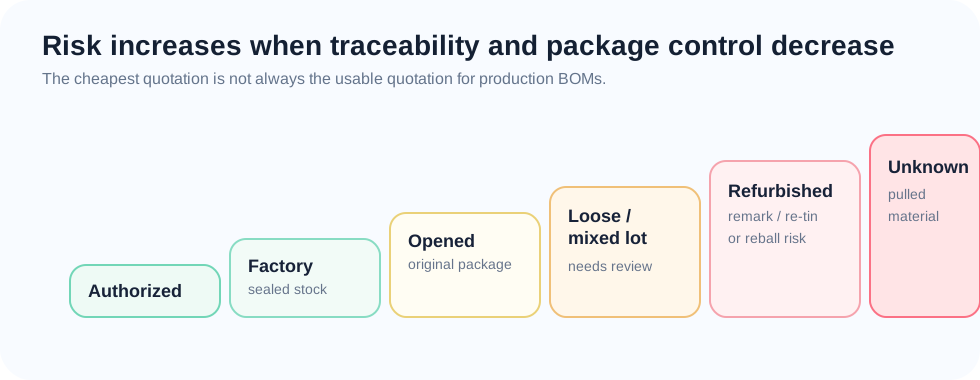
Do not compare only unit price. Compare stock category first, then price.
| Stock category | Typical risk | What to confirm |
|---|---|---|
| Factory sealed original | Lowest | Seal, label, date code, quantity and lot |
| Opened original package | Low to medium | Remaining label, storage and MSL control |
| Loose new / bulk | Medium | Lot consistency, photos and inspection evidence |
| Refurbished | High | Surface, pins, prior use and test method |
| Remarked | High | Marking logic, grade, date code and source |
| Used pull | Highest for production | Prior use, rework history and customer approval |
Questions to ask before approving stock #
- Is the material factory sealed, opened original package, loose stock or bulk?
- Can the supplier provide label, reel, tray, tube and top-marking photos?
- Are all pieces from one date code and one lot, or mixed?
- Is the part moisture-sensitive, and is dry-pack history clear?
- Has the material been re-tinned, reballed, cleaned, sanded or remarked?
- Is the part intended for production, repair, prototype or emergency shortage
support?
- Does the customer require authorized-channel traceability?
When lower-risk stock is worth paying more for #
For expensive BOMs, the cost difference between two quotations is often smaller than the cost of a failed build. A cheaper lot can become expensive if it causes incoming rejection, assembly defects, field failure, customer delay or redesign work.
Higher-traceability stock is usually worth prioritizing for FPGA, memory, processor, automotive, medical, aerospace, RF and high-current power devices. Those parts are harder to inspect visually and more expensive to debug after assembly.
Procurement takeaway #
The word original is not enough. Buyers need to know package condition, traceability, lot consistency and prior-use risk.
Before approving an RFQ, classify the stock: factory sealed, opened original, loose new, refurbished, remarked or used pull. Then decide whether the price is worth the risk for that specific project.
Need stock, date-code or package confirmation?
Send the part number, quantity, target date code and packaging requirements. LimChip will check available lots and RFQ details before you place the order.
Send RFQ