
Article contents0%
- A second platform beyond the established FPGA vendors
- The right language for a global engineering and sourcing discussion
- Four comparison groups at a glance
- 1. Gowin GW1N and Lattice iCE40 or MachXO
- 2. Anlogic DR1 and Altera Cyclone V SoC
- 3. Pango Micro Titan-3 and AMD high-density FPGA platforms
- 4. Fudan Microelectronics and Microchip for space or high-reliability work
- Toolchain, hardware and support: a safer evaluation model
- When can engineers call performance comparable?
- Is the lower-cost platform really cheaper?
- Six engineering and RFQ checks
- Official product references
- Procurement takeaway
A second platform beyond the established FPGA vendors #
China-based FPGA vendors are increasingly considered for more than emergency sourcing. For engineers, they can provide another implementation path when the required logic, memory, I/O, transceivers and development tools fit the design. For procurement teams, they may offer a lower acquisition cost, more regional support options or a more diversified supply route.
The useful question is not whether one country’s FPGA industry is universally “better.” It is whether a specific alternative platform can deliver comparable results for the target workload at a lower total project cost. Comparable results may mean that both platforms meet the same timing, throughput, latency, power and interface requirements; it does not mean that their architectures or headline specifications are identical.
A lower device quotation is also not automatically a lower-cost design. Engineers and buyers should include EDA licences, IP, PCB changes, firmware and RTL migration, verification, certification, yield and long-term maintenance in the total-cost comparison. When those items remain manageable, a China-based FPGA can become a credible second platform alongside an established international vendor.
The right language for a global engineering and sourcing discussion #
For an international audience, China-based FPGA vendors is usually more precise than *domestic FPGA vendors*. The word *domestic* depends on where the reader is located: a device made by a Chinese supplier is domestic to a buyer in China but imported to a buyer elsewhere. Chinese FPGA vendors is also acceptable when referring broadly to companies headquartered in China.
On the other side of the comparison, established international FPGA vendors is more accurate than *imported brands*. Lattice, Altera, AMD and Microchip sell through global channels, and whether a device is imported depends on the buyer's country, shipping route and contractual supply chain.
The same care is required when discussing alternatives. FPGA families from two vendors are rarely pin-compatible or tool-compatible. This article therefore uses migration candidate or alternative platform, not *drop-in replacement*. Any migration requires engineering qualification.
Four comparison groups at a glance #
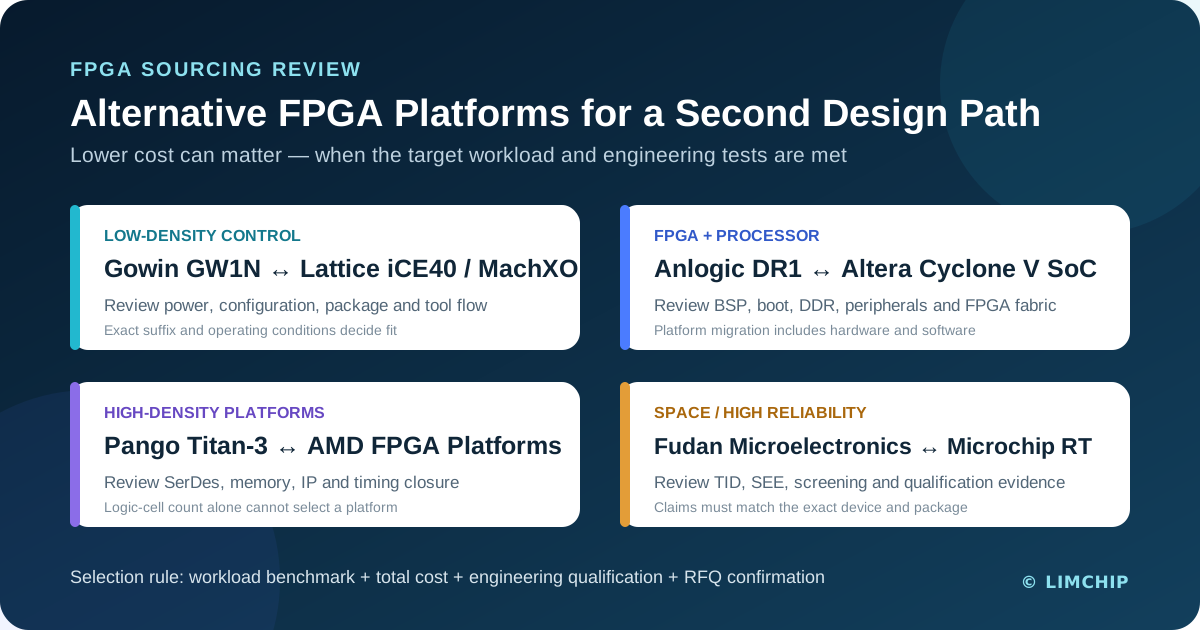
These are market-position comparisons, not declarations that the paired devices are technical equivalents. The purpose is to identify where a lower-cost second platform may be technically credible. Exact logic architecture, memory, PLLs, DSP blocks, I/O standards, transceivers, package, temperature grade and software flow must be compared at the full orderable-part-number level.
| Design segment | China-based vendor or family | International reference | First engineering question |
|---|---|---|---|
| Low-density control and compact logic | Gowin GW1N | Lattice iCE40 or MachXO | Is low power, package size or embedded flash the main constraint? |
| FPGA plus hard processor system | Anlogic DR1 FPSoC | Altera Cyclone V SoC | Can the software, boot flow and board interfaces be migrated? |
| High-density communications and acceleration | Pango Micro Titan-3 | AMD Kintex 7 or selected Versal families | Which transceiver, memory and IP requirements are mandatory? |
| Space or high-reliability programmes | Fudan Microelectronics qualified FPGA offering | Microchip RTG4 or RT PolarFire | What radiation, screening and qualification evidence does the programme require? |
1. Gowin GW1N and Lattice iCE40 or MachXO #
Gowin GW1N and Lattice iCE40 are reasonable families to review for compact control logic, interface bridging and low-density embedded designs. They are not automatically interchangeable. Even devices with similar logic capacity can differ in embedded memory, nonvolatile configuration, I/O count, PLL resources, package footprint and static power under the buyer's actual operating conditions.
Gowin describes GW1N as a 55 nm embedded-flash FPGA family with multiple density and package options. Lattice positions iCE40 around low power and small form factors, while MachXO families cover broader control and bridging requirements. Those product positions make the vendors worth comparing, but a procurement decision still has to start with the exact suffix and package.
| Review area | Gowin route | Lattice route | Buyer action |
|---|---|---|---|
| Configuration | Review embedded-flash features by GW1N device | Review iCE40 or MachXO configuration architecture | Confirm boot-time and external-memory constraints |
| Power | Obtain the exact device and operating-condition estimate | Obtain the exact device and operating-condition estimate | Compare vendor power-tool outputs, not headline current figures |
| Package | Check the required GW1N package and pinout | Check the exact iCE40 or MachXO package | Treat a package change as a PCB review |
| Tool flow | Validate Gowin EDA against the real RTL and constraints | Validate the applicable Lattice tool flow | Run synthesis, timing and programming trials before approval |
Engineering and sourcing position: Gowin can be a useful lower-cost second platform where its logic, embedded flash, I/O and package meet the design and a trial build closes timing and power targets. Lattice remains relevant where its low-power portfolio, established IP or an already-qualified design reduces programme risk. Compare total migration cost as well as device price, and confirm commercial terms by RFQ for the exact part and quantity.
2. Anlogic DR1 and Altera Cyclone V SoC #
The accurate Anlogic comparison for an FPGA-plus-processor design is the DR1 FPSoC family, not the stand-alone PH1A FPGA. Anlogic states that DR1M combines a dual-core Arm Cortex-A35 processor system, programmable logic and an AI engine. Altera Cyclone V SoC combines FPGA fabric with a dual-core Arm Cortex-A9 hard processor system across several density options.
This is a platform migration rather than a component substitution. CPU architecture generation, boot sequence, DDR interface, peripheral set, FPGA fabric, software development kit and board support are all part of the change.
| Review area | Anlogic DR1 | Altera Cyclone V SoC | Buyer action |
|---|---|---|---|
| Processor subsystem | Check the exact DR1M or DR1V processor configuration | Check the exact SE, SX or ST HPS configuration | Confirm OS, BSP, boot and peripheral requirements |
| Programmable logic | Compare LUT, memory, DSP and I/O resources | Compare LE/ALM, M10K, DSP and I/O resources | Re-synthesise the real design; do not compare one headline number |
| External memory | Confirm controller, PHY, speed and topology support | Confirm controller, PHY, speed and topology support | Validate the production memory device and layout |
| Lifecycle | Request a written supply statement for the exact DR1 code | Check the current product status and notices for the exact Cyclone V code | Do not describe a whole family as discontinued without an official notice |
Engineering and sourcing position: DR1 may be evaluated as an alternative platform for new embedded designs where its processor, programmable logic and accelerator mix can meet the system benchmark at an acceptable total cost. Cyclone V SoC remains important for installed equipment and mature software ecosystems. The migration budget should include board work, RTL and constraint conversion, software porting, verification and regulatory retest. A lower chip price only creates value when those engineering costs are recovered across the expected production volume.
3. Pango Micro Titan-3 and AMD high-density FPGA platforms #
Pango Micro positions Titan-3 as a FinFET high-performance FPGA family, with the PG3T1300 offering up to 1.3 million logic cells. AMD Kintex 7 is an older 28 nm family with up to 478K logic cells, while Versal is a heterogeneous adaptive-SoC portfolio with substantially different architecture and, in selected series, integrated HBM. These are not same-generation, one-for-one competitors.
A useful comparison therefore begins with the workload rather than a scorecard. For communications, network security, industrial equipment or data movement, the decisive items may be transceiver protocols, reference clocks, memory interfaces, PCIe implementation, vendor IP, timing closure and long-term tool support. For AI or HBM-dependent systems, logic-cell count alone says very little about platform fit.
| Mandatory evidence | Why it matters |
|---|---|
| Exact transceiver line rates and supported protocols | A similar maximum rate does not prove protocol or signal-integrity equivalence |
| Memory-controller and PHY support | DDR generation, width, topology and validated devices affect the board |
| Required IP availability | PCIe, Ethernet, DSP and security blocks can dominate migration cost |
| Timing-closure trial on representative RTL | Device capacity does not predict place-and-route success |
| Tool licence, version and support plan | A production design needs a reproducible build environment |
Engineering and sourcing position: Titan-3 can be considered as a second high-density platform where its resources and vendor-supported interfaces match the project, representative RTL closes timing, and system throughput meets the same acceptance test. AMD devices may remain preferable when approved IP, development flow, qualification history or heterogeneous compute functions are essential. Neither route should be selected from logic capacity or an unverified percentage price comparison alone.
4. Fudan Microelectronics and Microchip for space or high-reliability work #
Space, defence and other high-reliability programmes cannot be compared using a generic FPGA score. Microchip publishes device-specific radiation and qualification information for RTG4 and RT PolarFire. For example, Microchip specifies more than 100 krad total ionising dose for RTG4 and lists package-level QML qualification status.
Any Fudan Microelectronics device proposed for the same programme must be reviewed against the exact mission profile and documentation supplied for that orderable code. A commercial or industrial FPGA with a familiar logic-density name is not automatically equivalent to a radiation-tolerant device.
| Programme check | Evidence to request before approval |
|---|---|
| Radiation performance | TID, SEE/SEU/SEL test reports, test method and applicable lot/device |
| Screening and qualification | Exact standard, class, package and production flow |
| Traceability | Manufacturer documentation, lot records and authorised supply path |
| Mission environment | Orbit, accumulated dose, shielding, temperature and expected lifetime |
| Design mitigation | TMR, EDAC, configuration scrubbing and fault-response plan |
Engineering and sourcing position: describe Fudan Microelectronics as a China-based FPGA supplier under evaluation for qualified programmes, unless the exact device documentation supports a stronger statement. Describe Microchip RTG4 or RT PolarFire using the qualification and radiation claims attached to the exact family and package. Do not claim that either platform is a universal substitute for the other.
Toolchain, hardware and support: a safer evaluation model #
Fixed numerical scores such as “8:3” look decisive but are difficult to defend. Tool maturity, support response and migration difficulty change by device, distributor, region and project. A weighted project score is more useful.
| Evaluation area | Suggested project evidence |
|---|---|
| Toolchain | Compile representative RTL, check timing, simulation, debug and programming |
| Hardware | Compare exact package, I/O, memory, DSP, clocking, transceiver and power needs |
| IP ecosystem | List every required hard block, soft IP licence and validated reference design |
| Support | Record named FAE contact, escalation route and response commitment in writing |
| Supply | Confirm current stock, lead time, lifecycle statement, lot condition and destination restrictions |
| Qualification | Match temperature, automotive, industrial, military or space evidence to the exact code |
When can engineers call performance comparable? #
“Comparable performance” should be the result of an agreed acceptance test, not a marketing description. The two platforms do not need identical resource counts; they need to satisfy the same system requirements with acceptable margin.
| Engineering test | Comparable means |
|---|---|
| Timing closure | Required clock domains close timing with the agreed margin |
| Data throughput | Sustained payload throughput meets the system target |
| Latency | Worst-case end-to-end latency remains within the application limit |
| Resource margin | Logic, RAM, DSP, clock and routing utilisation leave production margin |
| Power and thermal | Measured board power and junction temperature stay within limits |
| Interface stability | DDR, SerDes, PCIe, Ethernet or sensor interfaces pass stress testing |
| Build reproducibility | The approved tool version can reproduce the production bitstream and reports |
Engineers should run this comparison with representative RTL, production-like clocks, the intended package and the actual external-memory topology. A small demonstration project is useful for tool familiarisation but cannot prove that a full production design has equivalent performance.
Is the lower-cost platform really cheaper? #
Use total cost of ownership rather than the quoted unit price alone:
```text Total platform cost = device and support cost + EDA and IP licences + PCB and prototype work + RTL, firmware and software migration + verification and certification + production maintenance and lifecycle risk ```
A second platform is commercially attractive when the device and support savings over the forecast volume exceed the one-time migration cost, while the qualified design still meets performance, quality and delivery requirements. For a low-volume legacy project, staying with the existing international device may be cheaper. For a new or higher-volume design, qualifying an alternative platform earlier can create more value.
Six engineering and RFQ checks #
1. Send the full manufacturer part number, package, speed grade and temperature grade; a family name is not enough for a valid comparison. 2. State the required quantity, target delivery date, acceptable date-code range and packing condition. 3. Identify every hard requirement: logic resources, RAM, DSP, PLLs, I/O standards, transceivers, processor cores and external-memory interfaces. 4. Ask engineering to qualify the alternative platform through synthesis, timing, board, software and environmental testing before changing the AVL. 5. Confirm export, end-use, destination and compliance requirements for the specific transaction rather than assigning a generic “restriction risk” to an entire brand. 6. Build a total-cost comparison that separates recurring device savings from one-time migration, tool, prototype and certification costs.
For available international-vendor FPGA parts, buyers can review the LimChip FPGA catalogue or send the exact part number and quantity through the RFQ form. Current stock, date code, price and delivery timing must be confirmed before purchase.
Official product references #
- Gowin GW1N documentation
- Lattice iCE40 product information
- Anlogic DR1 FPSoC family
- Altera Cyclone V product table
- Pango Micro product information
- AMD Kintex 7 product information
- AMD Versal HBM product information
- Fudan Microelectronics product information
- Microchip RTG4 product information
Procurement takeaway #
China-based FPGA vendors can be credible, potentially lower-cost alternative platforms for new designs, supply-chain diversification and region-specific support. Established international vendors can offer mature tools, broad IP ecosystems and extensive qualification history. Neither group wins every design, and “comparable performance” must be demonstrated against the target workload rather than assumed from a product table.
The defensible strategy is to compare exact devices against an approved requirements matrix, benchmark representative RTL, calculate total platform cost, obtain current commercial terms by RFQ, and treat every cross-vendor move as an engineering migration. A dual-platform plan is valuable only after both designs, software flows and supply routes have been qualified.
Need stock, date-code or package confirmation?
Send the part number, quantity, target date code and packaging requirements. LimChip will check available lots and RFQ details before you place the order.
Send RFQ