
Article contents0%
- What is an IC package?
- Why package type matters when buying components
- IC package types quick comparison
- Through-hole packages: DIP, SIP and ZIP
- SOIC, SOP, SSOP and TSSOP
- QFP, LQFP and TQFP
- QFN and DFN
- BGA, FBGA, LGA, CSP and WLCSP
- Memory and FPGA packages buyers often see
- How package codes appear in part numbers
- Package-related RFQ checklist
- Common sourcing mistakes to avoid
- FAQ
- Procurement takeaway
What is an IC package? #
An IC package is the physical body around a semiconductor die. It protects the silicon, exposes electrical connections to the PCB and controls how the device is handled, soldered, inspected, stored and shipped.
For engineers, package type affects footprint, thermal behavior, signal integrity and assembly process. For buyers, it affects whether the part offered by a supplier is actually the same orderable device approved in the BOM.
That is why a package guide should not stop at definitions. A real sourcing check needs to connect the package name to the exact manufacturer part number, suffix, packing format, date code, lot condition and inspection requirement.
Why package type matters when buying components #
Two devices can share the same base function and still be wrong for the same board. The difference may be a package suffix, pin count, exposed pad, tray versus reel packing, temperature grade or moisture sensitivity requirement.
The most common buyer mistake is treating a short base number as the identity. In real procurement, the full manufacturer part number matters. A nearby suffix may mean another package, another lead finish, another reel quantity, another temperature grade or a customer-specific orderable code.
Before quoting or releasing an order, confirm these items:
- Full manufacturer part number, including suffix and packing code.
- Package / case name, pin count, body size and pitch when relevant.
- Packing condition: tape and reel, tray, tube, dry pack, cut tape or bulk.
- Date code range, lot consistency and acceptable country-of-origin requirement.
- MSL handling requirement for moisture-sensitive packages.
- Inspection requirement, especially for BGA, FBGA, WLCSP, QFN and DFN parts.
IC package types quick comparison #
| Package type | Mount style | Typical buyer concern | Common examples |
|---|---|---|---|
| DIP | Through-hole | Legacy fit, socket option, bent leads | Older logic, optocouplers, op amps |
| SOIC / SOP | Surface-mount leaded | Similar names, width variants, reel code | Analog ICs, logic, drivers |
| SSOP / TSSOP | Surface-mount leaded | Fine pitch, suffix and package width | Interfaces, converters, MCUs |
| QFP / LQFP / TQFP | Four-side leaded SMT | Pin count, lead coplanarity, bent leads | MCUs, DSPs, controllers |
| QFN / DFN | No-lead SMT | Hidden pads, exposed pad, reflow quality | PMICs, RF ICs, sensors |
| BGA / FBGA | Ball-grid array | Reballing risk, X-ray, lot traceability | Memory, FPGA, processors |
| LGA | Land-grid array | Coplanarity, pad condition, assembly control | Processors, RF modules, sensors |
| CSP / WLCSP | Chip-scale package | Fragility, fine pitch, storage and handling | Mobile, wearable and RF devices |
| TSOP | Surface-mount memory package | Width, pin count, obsolete stock risk | Older Flash and SRAM |
Through-hole packages: DIP, SIP and ZIP #
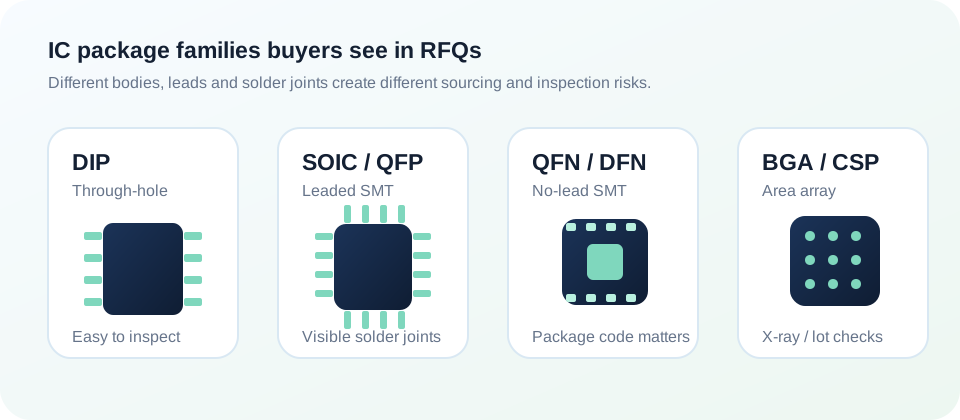
Through-hole packages use metal leads that pass through plated holes on the PCB. DIP is the best-known format because it is easy to socket, inspect and replace. It remains common in education, prototypes, legacy industrial equipment and some optocoupler or interface designs.
The sourcing risk is usually not technical complexity. It is age, storage condition and exact body width. Older through-hole ICs may come from long-held inventory, mixed lots or discontinued production. Buyers should check lead condition, oxidation, date code, original tube or tray condition and whether the project accepts older date codes.
SOIC, SOP, SSOP and TSSOP #
SOIC and SOP packages are widely used for analog ICs, logic, op amps, interface devices, gate drivers and small power-management parts. They have visible gull-wing leads on two sides, so solder joints are easier to inspect than QFN or BGA packages.
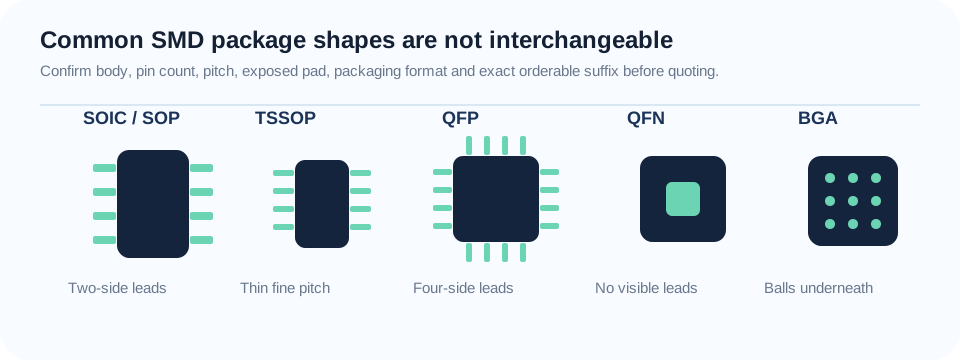
SSOP and TSSOP reduce body size and pitch. They save board space but increase handling sensitivity. A buyer should not assume that SOIC, SOP, SSOP and TSSOP are interchangeable. Package width, pitch and orderable suffix can change the land pattern.
For RFQ work, confirm whether the approved BOM asks for reel, cut tape, tube or tray. A distributor offer that matches the base part number but not the packing code may still be usable, but it should be confirmed before order release.
QFP, LQFP and TQFP #
QFP packages put leads on all four sides. LQFP and TQFP variants are common in microcontrollers, DSPs, industrial controllers and some mid-range logic devices. Their advantage is practical: the leads are visible, and rework is more realistic than with BGA.
The weak point is mechanical handling. Fine-pitch leads bend easily. If stock is loose, mixed, re-trayed or handled without proper protection, lead coplanarity can become a real assembly issue.
When sourcing QFP-type devices, confirm the exact pin count, package thickness, body size and suffix. For older MCUs or allocation items, ask for label photos and package-condition photos before payment.
QFN and DFN #
QFN and DFN packages have no protruding leads. The pads sit under the edge of the body, and many devices include a central exposed thermal pad. They are compact and thermally efficient, which is why they are common in PMICs, RF devices, wireless ICs, current-sense amplifiers, small converters and sensors.
For buyers, the risk is inspection. A QFN can look clean from the top while the real solder quality depends on reflow, pad design and thermal-pad wetting. Package code and exposed-pad details matter because two similar suffixes may not share the same recommended footprint.
For incoming stock, check reel or tray condition, MSL label, dry-pack status and whether the device has been opened. If the material is for production, avoid ambiguous bulk stock unless engineering and quality teams have approved it.
BGA, FBGA, LGA, CSP and WLCSP #
BGA and FBGA packages use solder balls under the package. This supports high pin count, compact routing and high-speed interfaces. Memory ICs, FPGAs, processors, networking ASICs and complex SoCs often use BGA or FBGA packages.
This is where sourcing risk becomes much higher. A BGA device can be removed from old boards, cleaned, reballed, remarked and sold as new. The top marking alone is not enough. For high-value FPGA, CPU, GPU, memory or SoC parts, buyers should request traceability, date-code details, label photos, package photos and inspection support when the source is not a direct authorized channel.
LGA packages use flat lands instead of solder balls. CSP and WLCSP packages push the body size close to the die size and are common in compact mobile, RF and wearable products. These fine-pitch packages are sensitive to handling, moisture, coplanarity and board assembly control.
Memory and FPGA packages buyers often see #
Memory devices are a good example of why package verification matters. DDR, LPDDR, NAND Flash, eMMC and UFS parts are commonly sold in FBGA-style packages. The same memory family may have multiple densities, organizations, speed grades and package codes. For Samsung, SK hynix, Micron, Winbond, Nanya, ChangXin, YMTC and GigaDevice memory-related sourcing, confirm the exact orderable part number rather than relying on a short description.
FPGA and CPLD devices carry the same lesson at a higher unit value. Xilinx, Altera, Lattice and Microchip devices often encode family, density, speed grade, temperature grade and package in the part number. A nearby suffix may not be an approved substitute. For shortage items, extra caution is needed because reballed, remarked, engineering-sample or mixed-lot devices can create expensive field failures.
How package codes appear in part numbers #
There is no single universal suffix system across all manufacturers. One vendor may use letters for package type, another may combine package, temperature, packing and RoHS details into a longer orderable code.
Common patterns buyers should watch:
- Package family letters such as QFN, TQFP, BGA, FBGA, LGA, SOIC or TSSOP.
- Pin count or ball count embedded in the package code.
- Packing suffixes such as reel, tape and reel, tray, tube or cut-tape variants.
- Temperature grade markers such as commercial, industrial, automotive or
extended-temperature versions.
- Lead-free, RoHS or green-package suffixes.
When in doubt, ask the supplier to confirm the manufacturer orderable code and match it against the datasheet, manufacturer product page or approved AVL/BOM.
Package-related RFQ checklist #
Use this checklist before committing to stock:
| RFQ item | What to confirm |
|---|---|
| Exact manufacturer part number | Keep the full suffix, grade and orderable code |
| Package / case | Confirm body, pin count, pitch, dimensions and exposed pad if applicable |
| Packing format | State reel, tray, tube, cut tape or dry-pack requirements |
| Quantity and shipment split | Confirm whether the pieces come from one lot or several lots |
| Date code | Define the acceptable year/week range before quote confirmation |
| Inspection evidence | Request label, reel/tray, top-marking and package-condition photos for high-value or non-authorized stock |
- MSL: confirm dry-pack status and humidity card for moisture-sensitive devices.
- Inspection: consider X-ray or deeper inspection for BGA/FBGA/WLCSP risk.
- Replacement rule: never quote a nearby package or suffix as a substitute
without engineering approval.
Common sourcing mistakes to avoid #
The first mistake is treating package as a minor detail. It is not. Package changes can affect the footprint, thermal path, solder process and inspection method.
The second mistake is accepting partial part numbers. A base number may be enough for casual searching, but it is not enough for purchasing.
The third mistake is ignoring packing condition. For production, tray, reel, MSL, dry-pack and label condition can matter as much as the electrical part number.
The fourth mistake is treating BGA and FBGA stock like ordinary leaded IC stock. Area-array packages need stronger traceability and inspection discipline because reballing and remarking are harder to catch visually.
FAQ #
What is the most common IC package type? #
There is no single package used everywhere. SOIC/SOP, TSSOP, QFN, QFP and BGA are all common, depending on the device type. Analog and logic ICs often use SOIC or TSSOP. PMICs and RF parts often use QFN. Memory, FPGA and processors often use BGA or FBGA.
What is the difference between QFP and QFN? #
QFP has visible gull-wing leads on four sides. QFN has no protruding leads, and its pads sit under the package edge. QFN is smaller and often better thermally, but inspection and rework are harder.
Why are BGA packages risky in sourcing? #
BGA solder balls are underneath the package, so ordinary visual inspection is limited. High-value BGA parts can also be reballed or remarked. Buyers should confirm source, lot, date code, package condition and inspection method before accepting risk stock.
Can a different package suffix be used as a replacement? #
Only if engineering approves it. A different suffix may mean another package, pin count, temperature grade, packing format or lead finish. Treat suffix differences as real differences until confirmed.
What should I send in an RFQ for package confirmation? #
Send the full part number, target quantity, approved manufacturer, required package, acceptable date code, packing preference, destination and whether substitutes are allowed. If the part is high value, ask for label and package photos before order release.
Procurement takeaway #
IC package type is not just a design topic. It is also a sourcing-control topic. For routine parts, package checks prevent wrong-footprint purchases. For memory, FPGA, processor, RF and power devices, package checks also reduce counterfeit, remarking, reballing and lot-mixing risk.
The safest rule is simple: buy against the full manufacturer part number, then verify package, suffix, packing condition, date code and inspection requirement before the order is released.
Need stock, date-code or package confirmation?
Send the part number, quantity, target date code and packaging requirements. LimChip will check available lots and RFQ details before you place the order.
Send RFQ