

Article contents0%
- Altera's catalogue is a lifecycle map, not one product line
- 1. MAX CPLDs: instant-on control and legacy board logic
- 2. Cyclone: cost-optimized FPGA families
- 3. Arria: mid-range transceivers and SoC options
- 4. Stratix: high-end FPGA and SoC capacity
- 5. Agilex: Altera's current adaptive-computing platform
- Family selection at a glance
- Representative Altera device identifiers
- Procurement rules for Altera parts
- RFQ template
- Conclusion
- Sources
Altera's catalogue is a lifecycle map, not one product line #
Altera's portfolio runs from small CPLDs used for power-up control and board glue logic to high-end FPGAs and SoC FPGAs used in communications, video, industrial systems and data-center acceleration. The family name helps narrow a search, but it is not enough to approve a substitute. Package, speed grade, temperature grade, configuration method, transceivers, memory and Quartus support can all change the engineering result.
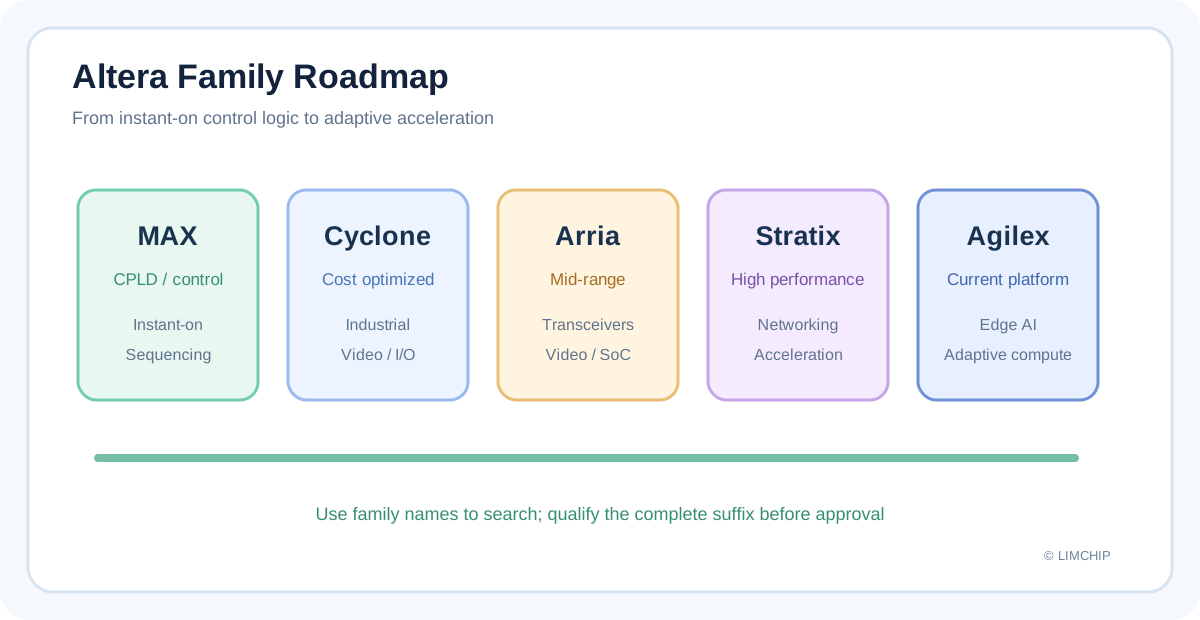
Altera's current device-support collection separates recommended, mature and legacy families. It lists Agilex 3/5/7/9, Stratix 10, Arria 10, Cyclone 10 and MAX 10 among the recommended portfolio, while older Stratix, Arria and Cyclone families remain available for lifecycle support. Altera's device-support collection is the right starting point for lifecycle review; a distributor listing is not a substitute for the manufacturer's status.
1. MAX CPLDs: instant-on control and legacy board logic #
MAX II and MAX V #
MAX II and MAX V are commonly found in boards that need simple sequencing, reset generation, address decoding, configuration bridging or low-density control logic. They are valued because configuration is stored on the device and the logic comes up quickly after power is applied.
Representative orderable families include MAX II EPM240, EPM570, EPM1270 and EPM2210, and MAX V 5M40Z, 5M80Z, 5M160Z, 5M570Z, 5M1270Z and 5M2210Z variants. The exact suffix determines package, I/O count, temperature grade and compliance status.
These families can remain practical for maintenance, but they should not automatically be selected for a new design. Altera's own catalogue places MAX V in the power- and cost-optimized group while MAX 10 is the newer FPGA option. Confirm current status and last-time-buy information for the exact device before treating a listing as production supply.
MAX 10 #
MAX 10 is a non-volatile FPGA family intended for single-chip control, configuration and moderate logic density. Representative density ranges include 10M02, 10M04, 10M08, 10M16, 10M25 and 10M50 variants, with device-specific packages such as U169, AE144 and AF484 appearing in market listings.
MAX 10 is a better starting point than MAX II for many new low-density designs, but “replacement” is not automatic. Check I/O voltage, configuration pins, internal flash behavior, ADC availability, timing, package footprint and Quartus edition. A board using a MAX II device may need schematic, PCB and firmware changes even when the logic utilization is small.
2. Cyclone: cost-optimized FPGA families #
Cyclone IV and Cyclone V #
Cyclone IV E devices such as EP4CE6, EP4CE10, EP4CE30, EP4CE75 and EP4CE115 are common in mature industrial, educational, display and video designs. Cyclone IV GX variants add serial transceivers for higher-speed links. Cyclone V extends the family with E, GX, GT and SoC variants, including devices such as 5CEBA, 5CGX, 5CGT and 5CSE families.
These families are still encountered in installed equipment and repair demand. The official catalogue treats Cyclone IV and Cyclone V as mature products rather than the default starting point for a new design. Do not publish an absolute “fully discontinued” or “available” claim for an entire family: lifecycle depends on the exact ordering code and revision.
Cyclone 10 LP and GX #
Cyclone 10 is the current cost-optimized path for many new designs. Cyclone 10 LP targets lower-cost logic without high-speed transceivers; Cyclone 10 GX adds higher-performance logic and transceiver capability. Representative search terms include 10CL025, 10CL040, 10CL055, 10CL080, 10CL120 and 10CX085/105/150/220 variants.
Altera's configuration documentation distinguishes Cyclone 10 LP from Cyclone 10 GX, including their configuration schemes and device resources. The configuration support table should be checked before calling a Cyclone 10 device a drop-in replacement for Cyclone IV. “Pin-compatible” must be confirmed at the exact package and board level, not inferred from the family name.
3. Arria: mid-range transceivers and SoC options #
Arria II and Arria V devices remain relevant in broadcast, communications and test equipment maintenance. Arria 10 is the more current mid-range family, with GX, GT and SoC variants. Common catalogue searches include 10AX016, 10AX027, 10AX048, 10AX057, 10AX066 and 10AX115, but each suffix carries important package, speed and temperature information.
Arria 10 combines substantial programmable logic with high-speed I/O; SoC variants integrate dual-core Arm processing. It is a platform family, not one interchangeable component. Verify transceiver lane count, protocol IP, DDR interface, HPS requirements, power rails and Quartus Pro support before approving an alternative.
4. Stratix: high-end FPGA and SoC capacity #
Stratix V is a mature high-end family found in legacy networking, radar, signal-processing and ASIC-prototyping equipment. Stratix 10 is the more current high-performance family, with FPGA and SoC variants and device ranges such as 10SX210, 10SX280, 10SX320, 10SX480, 10SX570 and 10SX940 appearing in sourcing requests.
The exact Stratix 10 device determines whether it includes HBM, which transceiver configuration is available, which package is used and which Quartus flow applies. Never describe every Stratix 10 device as an HBM device. The buyer must confirm the full orderable code and the product datasheet for the selected member.
5. Agilex: Altera's current adaptive-computing platform #
Agilex 3, Agilex 5, Agilex 7 and Agilex 9 are positioned across cost-optimized, mid-range, high-performance and flagship segments. Altera's product pages describe Agilex devices for adaptive acceleration, networking, industrial systems, AI and physical-AI workloads.
- Agilex 3: cost- and power-optimized applications where modern I/O and programmable logic are needed.
- Agilex 5: mid-range FPGA and SoC designs, including edge AI, industrial vision and control.
- Agilex 7: higher-performance networking, compute and acceleration platforms with device-specific transceiver and memory options.
- Agilex 9: flagship designs where maximum bandwidth, compute density or HBM-class memory options justify a larger platform review.
Do not treat a short code such as “A5ED013,” “AGF014” or “AG906” as a complete orderable part number. These are family or device identifiers; package, speed, temperature, revision and packing suffixes still need to be captured in the RFQ.
Family selection at a glance #
| Family | Typical role | Good fit | Main sourcing risk |
|---|---|---|---|
| MAX II / MAX V | CPLD and instant-on control | Sequencing, reset, glue logic, maintenance | Mature lifecycle and exact-suffix availability |
| MAX 10 | Non-volatile low-density FPGA | Single-chip control, compact industrial boards | Package, flash, ADC and I/O differences |
| Cyclone IV / V | Mature cost-optimized FPGA | Legacy video, industrial and education designs | Long-life support and mixed-lot stock |
| Cyclone 10 LP / GX | Current cost-optimized FPGA | New industrial, display and control designs | Not every package is a drop-in replacement |
| Arria 10 | Mid-range FPGA / SoC | Communications, video and test systems | Transceiver, HPS and DDR qualification |
| Stratix 10 | High-performance FPGA / SoC | Networking, prototyping and acceleration | High power, package and memory complexity |
| Agilex 3/5/7/9 | Current adaptive platform | Edge AI through data-center acceleration | New toolchain, power and lifecycle assumptions |
Representative Altera device identifiers #
The following list is intentionally more detailed for search and RFQ preparation. These are family/device identifiers and representative ordering patterns, not a substitute for the complete manufacturer orderable number. The final suffix can encode package, speed grade, temperature grade, revision and packing.
MAX CPLD and MAX 10 #
- MAX II: EPM240, EPM570, EPM1270, EPM2210; common package patterns include T100, T144, F256 and F324.
- MAX V: 5M40Z, 5M80Z, 5M160Z, 5M570Z, 5M1270Z and 5M2210Z; package examples include E64, T100 and F256/F324 variants.
- MAX 10: 10M02, 10M04, 10M08, 10M16, 10M25 and 10M50; market searches commonly include 10M08SAE144, 10M50DAF484 and smaller U169/AU variants.
Cyclone IV and Cyclone V #
- Cyclone IV E: EP4CE6, EP4CE10, EP4CE15, EP4CE22, EP4CE30, EP4CE40, EP4CE55, EP4CE75 and EP4CE115.
- Cyclone IV GX: EP4CGX22, EP4CGX30, EP4CGX50, EP4CGX75, EP4CGX110 and EP4CGX150.
- Cyclone V E: 5CEBA2, 5CEBA4, 5CEBA5, 5CEBA7 and 5CEBA9.
- Cyclone V GX: 5CGXFC3, 5CGXFC5, 5CGXFC7 and 5CGXFC9.
- Cyclone V GT: 5CGTFD5, 5CGTFD7 and 5CGTFD9.
- Cyclone V SoC: 5CSEBA2, 5CSEBA4, 5CSEBA5, 5CSEBA6 and 5CSEBA8.
Cyclone 10 #
- Cyclone 10 LP: 10CL025, 10CL040, 10CL055, 10CL080 and 10CL120.
- Cyclone 10 GX: 10CX085, 10CX105, 10CX150 and 10CX220; a complete code may contain a package such as YU484/YU780 and a speed/temperature suffix.
Arria families #
- Arria II GX: EP2AGX45, EP2AGX65, EP2AGX125, EP2AGX190 and EP2AGX260 for legacy communications and video maintenance.
- Arria V GX/GT: 5AGXBA3, 5AGXBA5 and 5AGXBA7, with device-specific transceiver and package variants.
- Arria V SoC: 5ASX and 5ASE families where the HPS and FPGA fabric must be qualified together.
- Arria 10 GX/GT: 10AX016, 10AX027, 10AX048, 10AX057, 10AX066 and 10AX115.
- Arria 10 SoC: 10AS016, 10AS027, 10AS048, 10AS066 and 10AS115 patterns; confirm the exact HPS, package and transceiver configuration.
Stratix families #
- Stratix V: 5SGXA3, 5SGXA5, 5SGXA7, 5SGXAB5 and 5SGXAB9 for mature high-end maintenance.
- Stratix 10 GX: 1SX016, 1SX040, 1SX065, 1SX110, 1SX210, 1SX280 and 1SX480 patterns.
- Stratix 10 SX SoC: 1SX210, 1SX280, 1SX320, 1SX480, 1SX570 and 1SX940 patterns; verify whether the selected member includes HPS and the required memory interface.
- Stratix 10 MX: device-specific HBM variants must be checked against the exact memory stack and package; do not infer HBM support from the Stratix 10 name alone.
Agilex families #
- Agilex 3: AG3C / AG3E device patterns for power-optimized edge and embedded designs.
- Agilex 5: A5ED008, A5ED013, A5ED020, A5ED028 and A5ED036 patterns; E-Series and D-Series differ in processor, memory and I/O options.
- Agilex 7: AGF014, AGF019, AGF022, AGF027 and AGF035 patterns; F-Series, I-Series and M-Series are not interchangeable by name.
- Agilex 9: AG903, AG904, AG906 and AG909 patterns for flagship acceleration and high-bandwidth designs.
For every identifier above, the RFQ should expand the code to the complete orderable number. For example, `10AX048`, `5CGXFC7`, `1SX280` and `A5ED013` are useful search anchors, but they do not uniquely define package, speed, temperature or packing. A supplier quote that omits the suffix is incomplete.
Procurement rules for Altera parts #
Freeze the exact suffix #
The family name is not the identity. Record the complete manufacturer part number, package, speed grade, temperature grade, revision, packing code and any “N” or compliance suffix. A distributor's shortened description is not enough for an approved BOM.
Separate lifecycle from spot stock #
“In stock” does not prove that a family is recommended for a new design. For mature MAX, Cyclone, Arria or Stratix parts, ask for current manufacturer status, last-time-buy information where applicable, date code, lot consistency and original packaging. A repair quantity and a ten-year production requirement are different sourcing problems.
Confirm tools and IP #
Check the required Quartus Prime edition and version, IP license, encrypted cores, Platform Designer files, programming-file format and production programming flow. A device that fits the board mechanically can still fail the project if its IP or tool support is unavailable.
Validate replacement claims #
For every proposed replacement, compare logic resources, DSP blocks, embedded memory, PLLs, transceivers, I/O standards, configuration pins, power rails, timing constraints and package ball map. “Pin-compatible” is only one item in a qualification plan.
Protect against counterfeit and mixed lots #
High-value mature FPGAs attract remarked and refurbished stock. Require traceability, factory packaging, lot documentation and a sample inspection plan. For critical equipment, qualify the supplier before releasing mixed date codes or mixed lots into production.
RFQ template #
Send the complete Altera orderable part number, target quantity, acceptable date-code window, package and packing requirement, operating temperature, destination, project stage and whether substitutes are allowed. If a replacement is being considered, include the original device, board revision, Quartus project version and the technical constraints that cannot change.
Conclusion #
Altera's seven practical sourcing layers run from MAX CPLDs and MAX 10 through Cyclone, Arria, Stratix and Agilex. Older families remain important for installed-base maintenance, while Agilex, Stratix 10, Arria 10, Cyclone 10 and MAX 10 form the more relevant starting points for many new evaluations. The safe buying rule is simple: use the family name to find candidates, then qualify the exact suffix, package, lifecycle, tools and traceability before you commit.
Sources #
- Altera FPGA device and product support collections
- Altera FPGA product portfolio
- Altera FPGA configuration support
- Altera FPGA AI Suite supported families
- Altera power-sequencing guidance for current FPGA families
Lifecycle labels and replacement suggestions should be rechecked against the exact orderable part and current manufacturer notices before purchase. This article is a sourcing guide, not a blanket electrical equivalence statement.
Need stock, date-code or package confirmation?
Send the part number, quantity, target date code and packaging requirements. LimChip will check available lots and RFQ details before you place the order.
Send RFQ