

The ranking is a channel signal, not just a leaderboard #
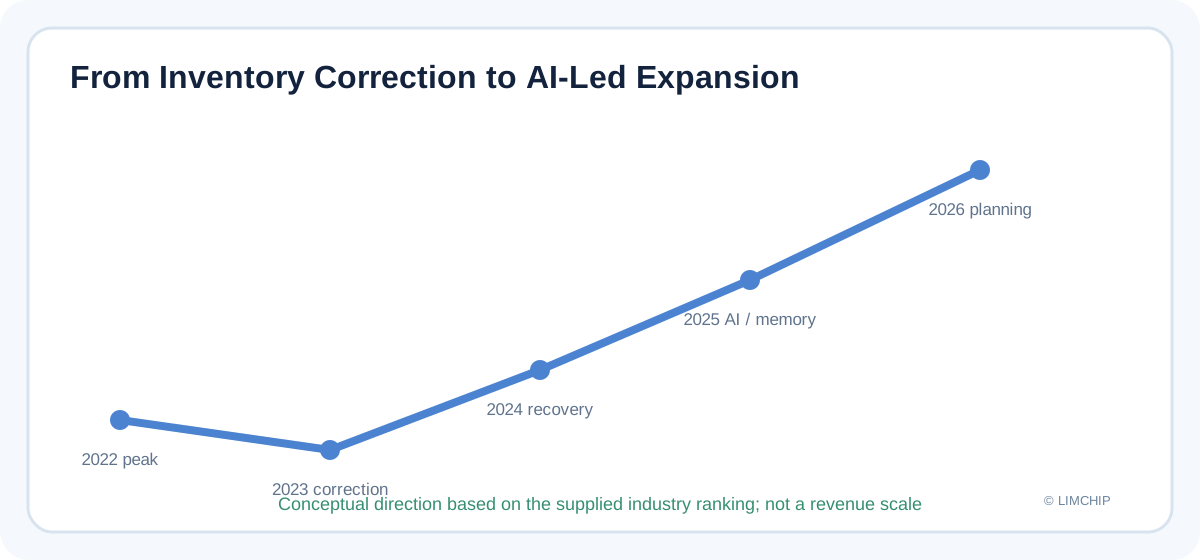
The 2025 Global Electronics Distributor Revenue Top 50 report describes a distribution market that has moved from post-inventory correction into a new expansion phase. The important story is not the exact revenue of every company. It is the change in what is moving through the channel: AI infrastructure, memory, logic devices and the supporting power, connectivity and passive components around them.
The ranking also needs context. It combines public-company filings with voluntarily disclosed data from private distributors, uses a common exchange-rate method and excludes some large private companies that did not participate. The results are therefore an industry reference, not an audited market-share database.
Four large distributors still set the pace #
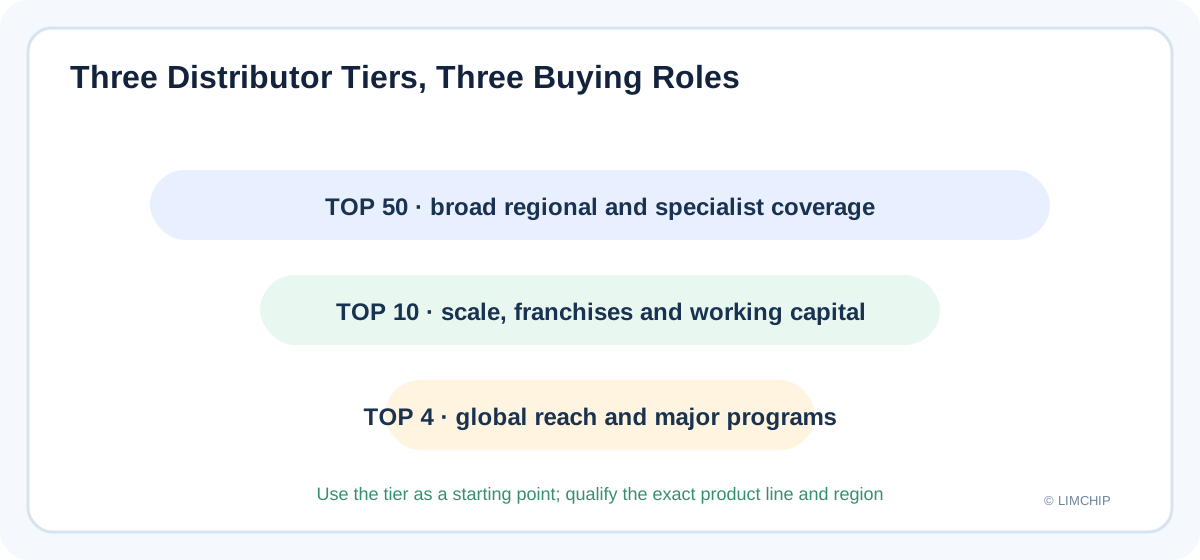
Arrow Electronics, Avnet, WT Microelectronics and WPG remain the familiar top tier. Their ordering changed, but the broader pattern did not: a small group of global distributors still handles a very large share of the channel's value.
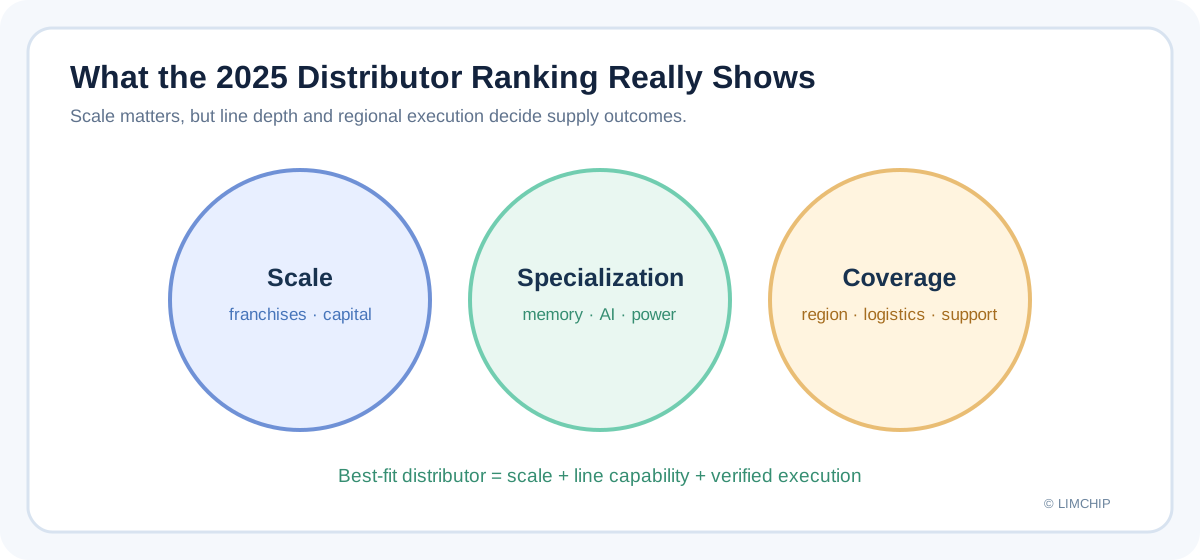
That scale gives the largest distributors advantages in franchise access, working capital, inventory positioning and multinational support. It does not mean they are interchangeable. One may be strongest in enterprise computing, another in Asian semiconductor franchises, another in industrial and aerospace accounts, and another in high-volume regional fulfillment.
For an OEM buyer, the useful question is not “who is number one?” but “which channel has the right authorized line, geography, technical support and allocation position for this BOM?”
AI and memory changed the product mix #
The report's strongest common thread is demand from AI servers and memory. Data-center and server sales expanded quickly for several leading distributors, while memory-focused businesses benefited from the recovery in DRAM and NAND pricing.
This creates a multiplier effect. A server build needs accelerators and processors, but it also needs high-density memory, power-management devices, networking, connectors, timing, thermal and storage components. When a hyperscale project accelerates, several distributor product categories can rise together.
The effect is visible in the channel even when distributors do not disclose identical product classifications. One company may report “data center and server,” another “computing,” and another “memory.” Buyers should compare the underlying demand drivers rather than treat those labels as directly equivalent.
The middle of the ranking is becoming more important #
The top tier remains concentrated, but the broader Top 50 is not standing still. Regional distributors and specialist firms gained ground in storage, industrial, automotive, power and technical design-in services. Some grew by focusing on one product category; others expanded through overseas branches, authorized franchises or acquisitions.
This matters during allocation. A smaller specialist may have better access to a specific memory, power or connector line than a larger generalist. Conversely, a global distributor may be better positioned for a multi-country production release. Supplier selection should therefore combine channel scale with line-level capability.
| Buyer requirement | Distributor capability to check |
|---|---|
| Global production | Local inventory, tax and logistics coverage |
| AI-server BOM | Memory, power, networking and thermal line depth |
| Mature FPGA or MCU | Lifecycle visibility and traceable stock |
| Automotive or industrial | Qualification support, lot control and documentation |
| Shortage response | Allocation access and realistic lead-time updates |
Regional growth is uneven #
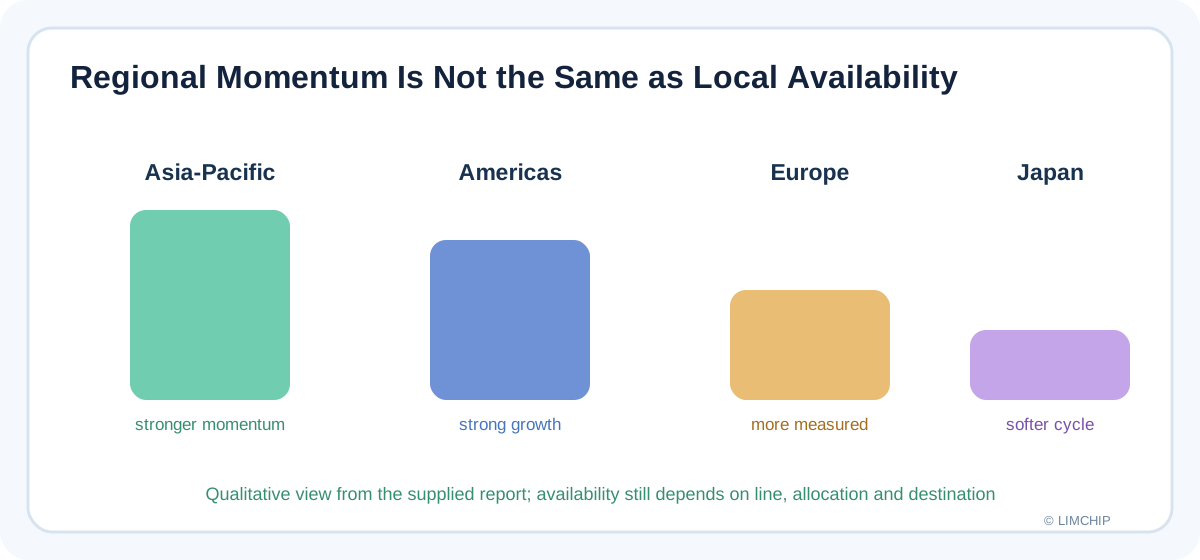
The report points to stronger momentum in Asia-Pacific and the Americas, while Europe was more measured and Japan faced a softer environment. These regional differences affect inventory placement, currency exposure, customer mix and the speed at which a distributor can reallocate stock.
For buyers, regional growth does not automatically mean regional availability. A part may be plentiful in one hub and constrained in another because of franchise restrictions, export controls, local demand or customs requirements. RFQs should specify the destination and whether an alternate shipping location is acceptable.
Distribution is becoming a technical service #
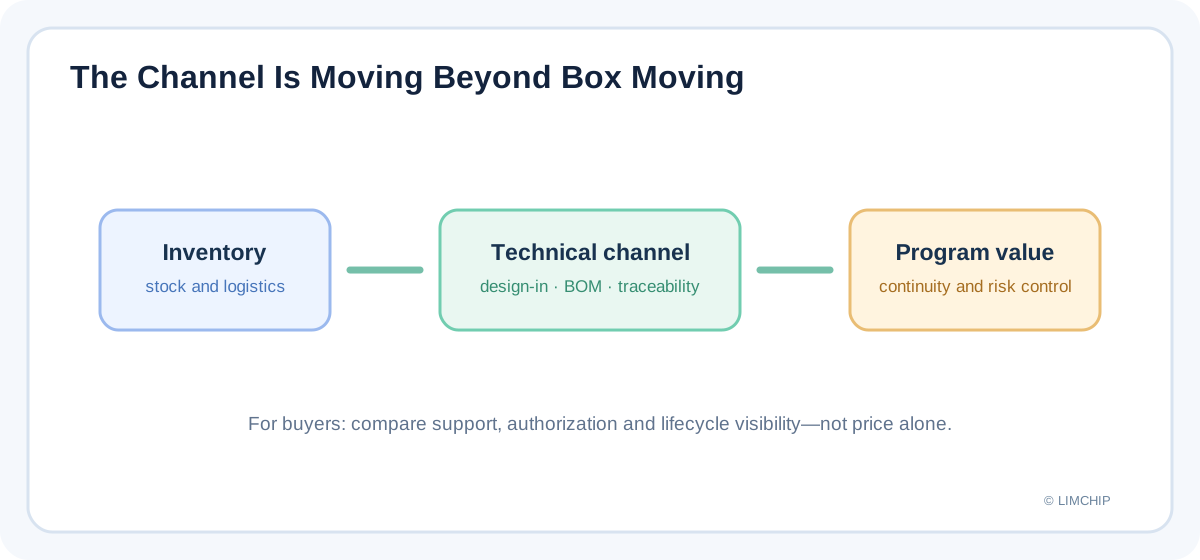
The modern distributor is moving beyond order taking. Reference designs, design-in support, programming, kitting, BOM analysis, authorized traceability and lifecycle notifications are increasingly part of the value proposition.
That shift changes how procurement should evaluate a supplier. A slightly lower quote is not necessarily better if it comes with mixed date codes, weak documentation or no engineering escalation path. For a critical BOM, the real comparison is landed cost plus qualification effort, risk and schedule exposure.
Consolidation and overseas expansion continue #
Mergers and acquisitions remain a practical way for distributors to add product lines, customer access and regional coverage. At the same time, Chinese and Asian distributors are building more overseas capability, while international distributors are adjusting their Asia strategies.
This creates both opportunity and risk. A broader network can improve supply options, but an acquisition can also change contracts, inventory ownership, ERP systems and contact points. Buyers should re-confirm authorization, quality records and return procedures after a supplier announces a major corporate change.
What this means for OEM and EMS procurement #
The 2025 ranking suggests five practical actions:
1. Map critical BOM lines to at least one authorized channel and one qualified alternate. 2. Separate memory and AI-related allocation risk from ordinary catalogue availability. 3. Ask distributors to identify committed stock versus indicative or brokered stock. 4. Require exact manufacturer part numbers, packaging, date code and lot information. 5. Evaluate technical support and lifecycle visibility alongside price.
The channel is recovering, but recovery does not mean every component is easy to buy. AI and memory demand can tighten one portion of a BOM while other categories remain negotiable. A good distributor strategy therefore uses multiple channels by risk—not one supplier for everything.
Bottom line #
The 2025 Global Top 50 ranking shows a distribution industry benefiting from the AI and memory cycle, while also becoming more regional, technical and consolidated. For buyers, the lesson is straightforward: revenue rankings describe scale, but reliable supply depends on the exact line, suffix, region, authorization and lot.
Sources #
- 2024 Global Electronics Distributor Revenue Top 50 background report
- WPG Holdings company information and 2025 revenue reference
- International Electronics Business 2026 Q1 distributor follow-up
The 2025 ranking figures and classifications are summarized from the supplied industry report. Company filings, exchange rates, participation and product-category definitions differ; this article is an independent LimChip market analysis, not a reproduction of the ranking table.
Need stock, date-code or package confirmation?
Send the part number, quantity, target date code and packaging requirements. LimChip will check available lots and RFQ details before you place the order.
Send RFQ