

Article contents0%
The Rockchip RV1126B has become one of the most frequently inquired-about edge AI processors in recent months. Across security camera vendors, industrial automation OEMs and robotics teams, the question keeps surfacing: *Can this chip actually deliver 3 TOPS of on-device inference in a 35 millimeter footprint?* The short answer is yes — but the full answer requires understanding what makes this SoC different from the generic "AI chip" crowd, where its architecture creates real sourcing advantages, and what BOM teams should verify before committing to an RV1126B-based platform.
This guide walks through the RV1126B from silicon to system board, explains why the 35 × 35 mm form factor matters more than most datasheets admit, and gives procurement teams a concrete checklist for evaluating RV1126B core boards and EVM platforms.
What the RV1126B actually is #
The RV1126B is Rockchip's mid-to-high-end AI vision processing SoC, announced in May 2025 and shipping in volume since late 2025. It sits above the 0.5-TOPS RV1103B/RV1106B entry-level vision chips and below Rockchip's larger RK3588-class application processors. Its positioning is deliberate: edge devices that need real-time visual AI inference without a cloud round-trip, at a power budget that allows battery or always-on deployment.
Core compute block #
| Block | Specification |
|---|---|
| CPU | Quad-core ARM Cortex-A53 @ up to 1.75 GHz |
| L1 cache | 32 KB I + 32 KB D per core |
| L2 cache | 512 KB shared |
| NEON / FPU | Yes (per-core) |
| TrustZone | Yes |
| Low-power MCU | Integrated HPMCU with 16 KB cache |
Rockchip claims the CPU delivers more than 2× the performance of chips in the same class — a claim that holds up when comparing against single-core or dual-core Cortex-A7/A53 alternatives commonly used in IP-camera SoCs. For BOM teams, the practical implication is that a single RV1126B can run the Linux application stack, the AI inference pipeline, the network protocol stack and the video encode/decode simultaneously without offloading to a companion MCU.
The NPU: 3 TOPS with model flexibility #
The built-in NPU is the headline number:
| NPU feature | Detail |
|---|---|
| Peak INT8 throughput | 3 TOPS |
| Supported data types | INT4, INT8, INT16, FP16, BF16, TF32 |
| Quantization | W4A16 / W8A16 mixed precision |
| Weight sparsification | Supported |
| Transformer optimization | Dedicated path for attention-heavy models |
| Large-model support | Multimodal large models (MLMs) under ~2B parameters |
The sub-2B parameter ceiling is not a limitation for edge vision tasks. Most production object-detection models (YOLO variants, EfficientDet, MobileNet-SSD) run well under 500M parameters. The 2B headroom means the same hardware can also host lightweight vision-language models (VLMs) for scene-description tasks, or small speech-recognition models for voice-command interfaces — without changing silicon.
Framework support covers TensorFlow, TensorFlow Lite, PyTorch, Caffe and ONNX. For teams already trained on one of these stacks, porting to RV1126B is a quantization-and-benchmark exercise, not a rewrite.
AI-ISP: the hidden differentiator #
Most vision SoCs handle image signal processing (ISP) on the CPU or via a conventional ISP block that shares memory bandwidth with the NPU. The RV1126B takes a different approach: a dedicated AI-ISP hardware block that operates independently of the 3-TOPS NPU.
| AI-ISP capability | Detail |
|---|---|
| Max sensor resolution | 12 megapixels |
| HDR modes | 2F HDR (line-based, frame-based, DCG) |
| Low-light enhancement | AI Remosaic for day/night dual-mode adaptation |
| Geometric correction | Fish-eye / arbitrary-shape distortion correction |
| Stabilization | 6-DOF digital image stabilization |
| Sensor interfaces | Up to 4× MIPI CSI inputs (2×4-lane or 4×2-lane) |
| Video output | MIPI-DSI / parallel RGB up to 1080p@60 fps |
The independence from the NPU is the key architectural point. On competing platforms, running advanced ISP algorithms (multi-frame noise reduction, HDR fusion, dehazing) consumes NPU cycles that are then unavailable for inference. On RV1126B, the AI-ISP runs its own pipeline while the full 3 TOPS remains available for detection, classification or tracking models.
AOV 3.0: always-on vision at microwatt standby #
AOV (Always-on Vision) version 3.0 is Rockchip's third-generation low-power surveillance technology. The numbers that matter for BOM planners:
| AOV 3.0 spec | Value |
|---|---|
| Standby power | Approximately 1 mW |
| Wake-up trigger | Audio event detection (anomalous sound) |
| Wake-up latency | ~0.1 seconds from standby to full operation |
| Monitoring mode | 24/7 audio-video sensing without full power draw |
The practical use case is a battery-powered or PoE-powered camera that must remain vigilant around the clock — detecting glass-breaking sounds, alarm sirens, shouting or abnormal machinery noise — while drawing negligible current. When an event triggers, the system ramps to full CPU+NPU+ISP power in roughly 100 ms and begins recording and analyzing video.
Video encoding: super-compression #
The video engine supports:
- H.264 / H.265 encode: 3840 × 2160 @ 30 fps + 1920 × 1080 @ 30 fps simultaneously
- H.264 / H.265 decode: 4K @ 30 fps
- Super encoding: Dynamic bitrate optimization that reduces storage by ~50%+
compared to traditional CBR H.265 at equivalent perceptual quality
For devices that record locally (SD card, eMMC) or stream over bandwidth-constrained links (4G LTE, LoRa backhaul), super encoding directly translates to either longer retention time or lower data-plan cost.
Security: hardware-grade crypto #
The RV1126B integrates a national-cryptography-grade security subsystem:
| Security feature | Standard |
|---|---|
| Public-key crypto | SM2 (Chinese national standard) |
| Hash | SM3 |
| Symmetric cipher | SM4 |
| Isolation | ARM TrustZone |
| Key management | Keyladder secure key storage |
For government, enterprise or critical-infrastructure deployments where data provenance and tamper-resistance are contractual requirements, having these blocks in silicon avoids the need for an external secure element and simplifies certification.
The 35 mm form factor: why size is a sourcing dimension #
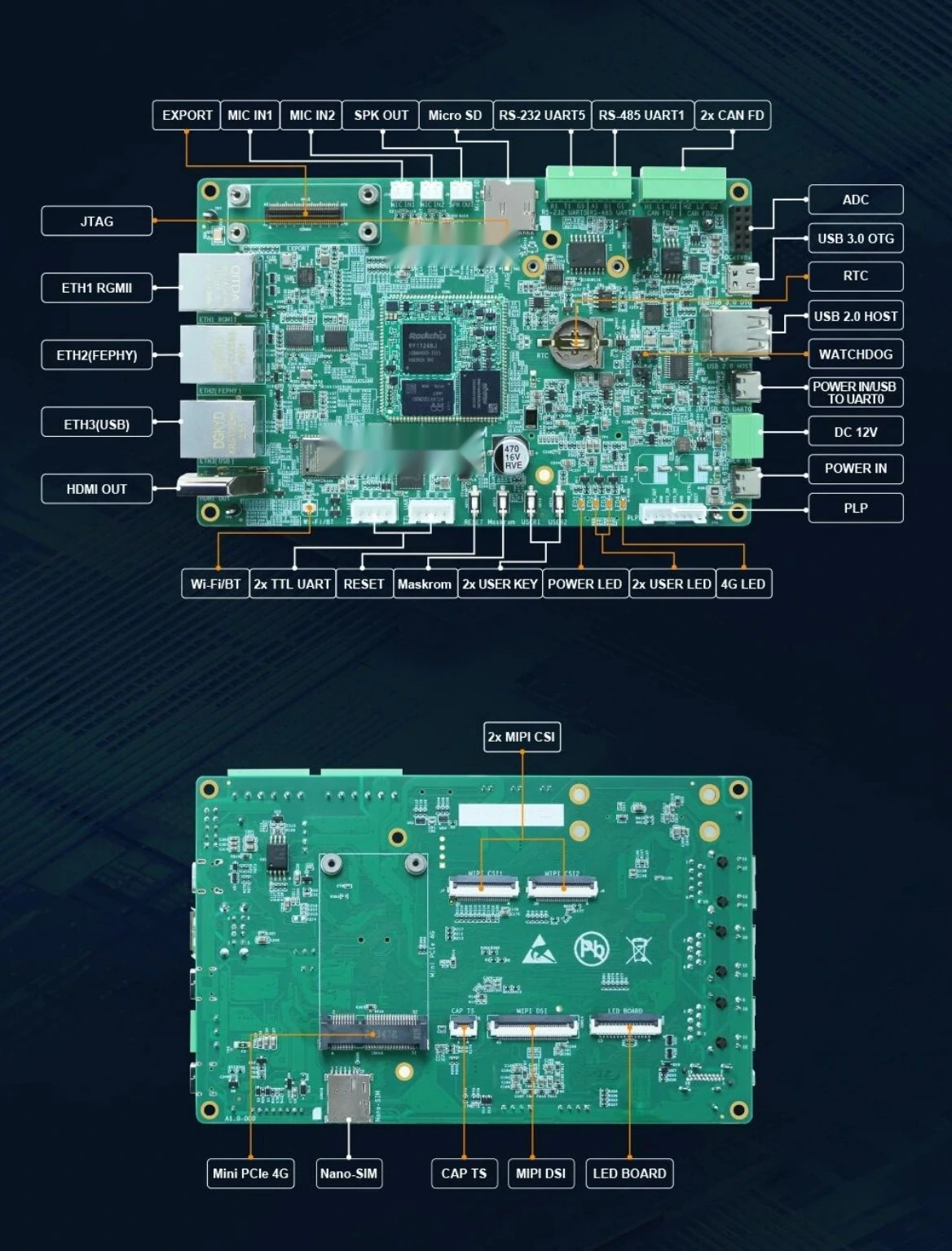
The TL1126-EVM shown above is Rockchip's reference evaluation platform for the RV1126B. It exposes every peripheral — four Ethernet ports (including one over USB), HDMI out, USB 3.0 OTG, dual CAN FD, multiple UARTs, MIPI CSI/DSI, Mini PCIe for 4G expansion, Nano-SIM slot and more. This board is for development and benchmarking, not for production embedding.
What has driven the surge in RV1126B inquiries is the 35 × 35 mm production module:
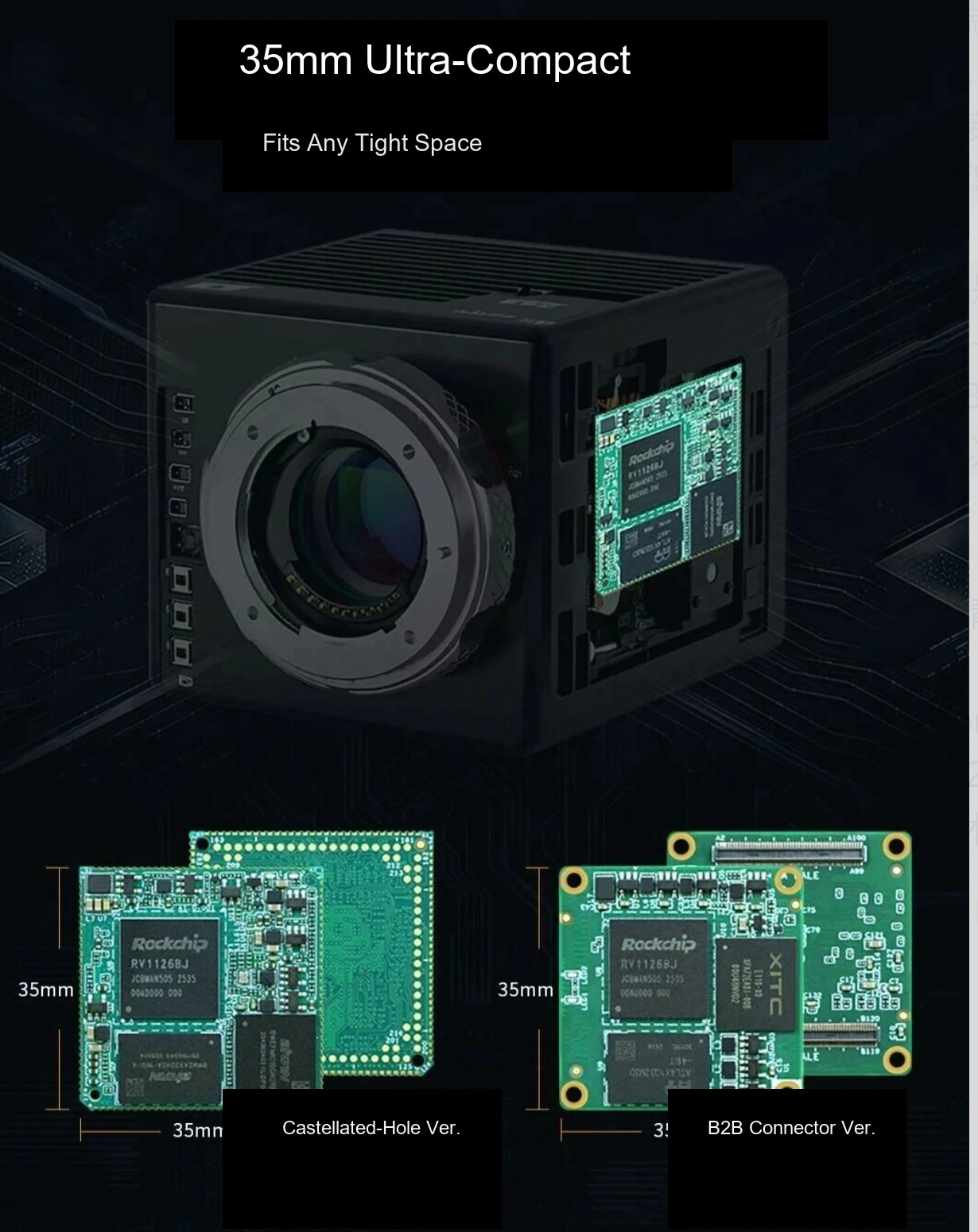
Two mechanical variants exist for the same silicon:
| Variant | Interface type | Typical use case |
|---|---|---|
| Castellated (LGA) | Solder balls on perimeter, reflow onto carrier PCB | Space-constrained camera modules, integrated into lens-housing assemblies |
| Board-to-board (B2B) | High-density mezzanine connector | Modular designs where the compute card can be swapped or upgraded independently |
Both measure 35 mm × 35 mm — small enough to fit inside the barrel of a standard IP-camera housing, behind a license-plate recognition enclosure, or on the arm of a collaborative robot. For BOM teams evaluating RV1126B-based products, the form-factor choice drives three downstream decisions:
1. Thermal design: Castellated versions conduct heat through the PCB; B2B versions may need additional thermal pads between the connector faces. 2. Repairability: B2B allows field replacement of the compute module; castellated is effectively permanent after reflow. 3. Supply chain: Some module vendors stock only one variant; confirming availability for your chosen form factor early avoids late-stage redesign.
Architecture overview #

The diagram above shows how the major blocks connect. A few architectural notes that affect component selection:
- Memory bandwidth is 3200 MT/s (up from 2166 MT/s on the prior RV112).
This matters when running concurrent 8M@45fps encode + 3-TOPS inference — DDR4 or LPDDR4 is strongly recommended over LPDDR3 for bandwidth-intensive use cases.
- The NPU and AI-ISP do not share a memory bus to main DRAM in the way
that some competing ISP+NPU implementations do. Each has optimized paths that reduce contention under peak load.
- USB 3.0 OTG is present (unusual in this class), enabling high-speed
data offload or direct connection to a host PC for debugging without sacrificing the USB 2.0 host port used for Wi-Fi dongles or peripherals.
Where RV1126B fits in the market #

The four-quadrant map above groups the most common RV1126B deployment scenarios. Each quadrant maps to distinct BOM priorities.
Smart security #
Face detection, body tracking, safety-gear compliance (helmets, vests), perimeter intrusion and smoke/fire detection all run efficiently on the 3-TOPS NPU. The AOV 3.0 audio wake adds a second sensing modality — glass-break or alarm-sound detection — that works even when the video pipeline is in low-power standby.
BOM priority: Confirm the module vendor provides pre-trained model packages for the detection categories you need (or verify that your own models quantize cleanly to INT8/W8A16 on Rockchip's toolchain).
Industrial vision #
Production-line defect inspection, OCR barcode reading, component counting and equipment monitoring benefit from the 6-DOF stabilization (cameras mounted on vibrating machinery) and multi-camera dynamic stitching (panororphic inspection of wide conveyors or assembly lines).
BOM priority: Verify industrial temperature rating (-40 °C to +85 °C) on both the SoC and the module's passive components (capacitors, especially). Some consumer-grade modules use commercial-temp parts that will drift outside spec in factory environments.
Robotics and vehicle #
Visual navigation, obstacle avoidance and driver-monitoring systems (DMS) are natural fits. The sub-2B LLM/VLM support enables basic semantic reasoning on the device ("describe what you see" or "is this person wearing a safety vest?") without cloud connectivity — valuable for robots operating in warehouses with spotty Wi-Fi coverage.
BOM priority: Automotive-qualified modules (AEC-Q100) may be required for in-cabin or ADAS-adjacent uses; confirm whether the vendor's RV1126B module carries automotive-grade certification or only industrial.
Retail and smart IoT #
Footfall analytics, product recognition for self-checkout kiosks, ANPR parking barriers and visitor-management terminals all fit the RV1126B profile. The super-encoding feature reduces storage costs for multi-camera retail deployments.
BOM priority: Total bill-of-materials cost matters more here than in industrial/automotive segments. Compare the landed cost of the complete module (CPU + DRAM + eMMC + PMIC + connectors) against competing solutions (e.g., Allwinner, Amlogic, HiSilicon) at equivalent NPU throughput.
Procurement checklist for RV1126B-based products #
When evaluating an RV1126B core board or finished product, run through this list before releasing a purchase order:
| Check item | Why it matters |
|---|---|
| SoC marking | Confirm "RV1126B" (not plain RV1126); the "B" brings the NPU upgrade and AI-ISP |
| DRAM density & type | 2 GB or 4 GB LPDDR4/DDR4 recommended for 3T + 8M encode workloads |
| eMMC capacity | 8 GB minimum for OS + models; 16–32 GB if local recording is required |
| Form factor | Castellated vs B2B — match to your mechanical envelope and repair strategy |
| Temperature grade | Industrial (-40~+85°C) vs commercial (0~+70°C) — verify for target environment |
| Certifications | CE/FCC/ROHS baseline; ask about AEC-Q100 or IEC 61508 if applicable |
| BSP & SDK maturity | Kernel version, U-boot support, NPU driver version, pre-built model zoo |
| Security features enabled | SM2/SM3/SM4 and TrustZone must be active in shipped firmware |
| Power measurement data | Ask for measured idle / typical / peak current at your target voltage |
| Lead time & MOQ | RV1126B is in volume production, but specific module SKUs may have allocation constraints |
| Second-source option | Identify whether another module vendor offers a pin-compatible alternative |
Practical takeaway #
The RV1126B is not just another "AI chip" press release. Its combination of 3 TOPS NPU, independent AI-ISP, AOV 3.0 microwatt standby, hardware crypto and a 35 × 35 mm production footprint addresses a real gap in the edge-vision market: devices that must see, think and stay alert continuously, inside tiny enclosures, on tight power budgets. The surge in sourcing inquiries reflects genuine design-win momentum, not marketing hype.
For procurement teams, the action items are straightforward: lock in your form-factor variant (castellated or B2B), verify industrial temperature range if your deployment is outdoors or factory-floor, confirm the BSP includes the NPU drivers and model quantization tools you need, and request measured power data rather than relying solely on datasheet typical values. And as always: confirm exact manufacturer part numbers, package types, date codes and quantities in your RFQ — the edge-AI market is moving fast, and allocation windows can close quickly.
*Sources: Rockchip RV1126B Brief Datasheet V1.0 (2024-12-19); Rockchip official product page (rock-chips.com); Forlinx Embedded RV1126B technical article (2025); EEChina RV1126B launch coverage (2025); Tronlong TL1126-EVM documentation.*
Need stock, date-code or package confirmation?
Send the part number, quantity, target date code and packaging requirements. LimChip will check available lots and RFQ details before you place the order.
Send RFQ